
Subject Centric Lighting
LIGHTING ESSENTIALS WORKSHOP: SUBJECT CENTRIC LIGHTING
I hope you enjoy this workshop.
It is the culmination of decades of being a working, professional photographer and having to meet the challenges of making images for other people. Other people with high expectations and demands for the work. Other people who didn’t necessarily care how hard it was to make the shot they wanted, they wanted that shot. Now.
Being a photographer in a small market meant I didn’t necessarily have a strict specialty, although people and still life did make up the bulk of my work. I would occasionally shoot architecture and food, as well as the now and then corporate shoot.
I wasn’t really a ‘generalist’, but some weeks it seemed as though my assignments were as unrelated as they possibly could be.
One week I had a food shot going on in one corner of the studio, with a catalog shoot going on in the other part. All of this while I was shooting a lingerie shoot for an ad agency in the rest of the studio. Heady times, long hours, really damned fun.
This workshop will take us through many of the ways to light photographic subjects. And lighting is, as they say, lighting. Yeah, I am so old I remember when “off camera flash” was simply called lighting.
We are going back to that time. Lighting is lighting and the goal is always the same: to make an image that represents what we see in our mind’s eye. Knowing what we want is step one, making it happen with the tools at hand is step two.
The assignments will be given one per week. They will remain in place for future photographers. You do not have to start at the beginning, but the first five lessons are absolutely important to review before moving to the assignments you want to do.
SUBJECT CENTRIC LIGHTING
I call my system “Subject Centric Lighting” because the subject plays a bigger part in the lighting than the lighting gear does. How a subject renders the lighting we apply to it, and how the camera receives that light is what makes our images interesting.
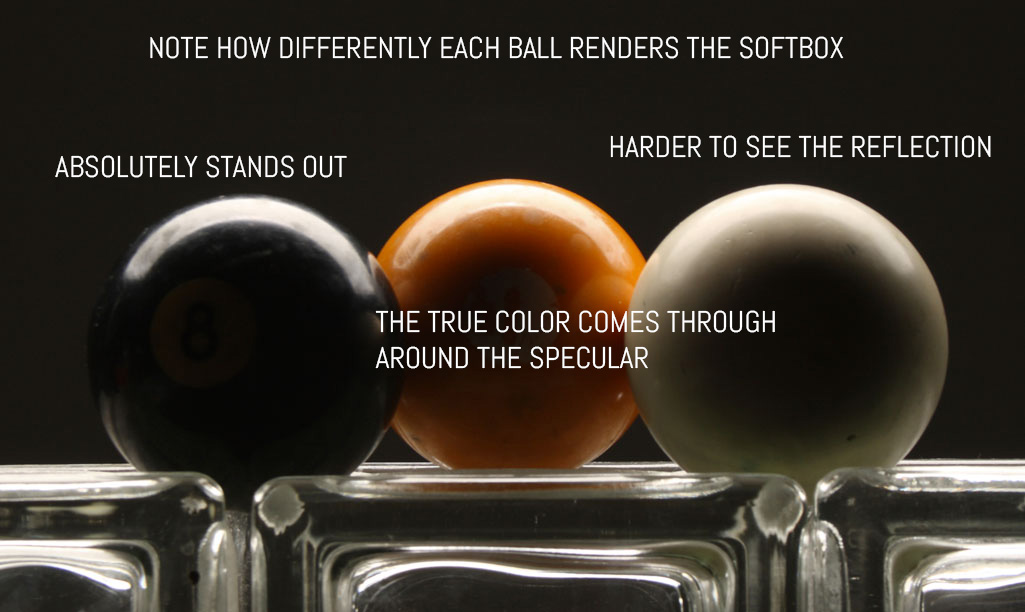
Subject Centric Lighting recognizes that light does the same thing every time. It is the subject that changes the way the light reflects back to our camera, not the light tool we choose to light the subject with. Lighting a dark bowling ball with a soft box presents a far different rendition of the light than using the same light for a white bowling ball. Everything is changed – from specular presentation to shadow fall.
But more of that as we go along.
First, let’s get into the basic principals of light and lighting.
LIGHT DOES THE SAME THING EVERY TIME
It must. Otherwise, we could never control it.
Imagine a saxophone with its many variations of keys. A sax player has to know that if a certain set of keys are pushed, a specific sound will come out. If it was random, then no music could be produced. There would be no point in learning the saxophone since there was no knowledge to be applied that would render it usable.
The same with lighting. We have to know that if we have a flash at 1/4 power, 15′ from the subject, that a specific exposure will be generated. We can control how much exposure that is by changing the ISO of course, but always at any specific setting that flash will produce the same measurable amount of light. Every time.
It is the same thing with modifiers. A softbox will look like a softbox when it is being reflected from a shiny surface. An umbrella will wrap the light if used to do so based on science and physics, not some magical desire to use an umbrella.
So if light does the same thing, how can we use that knowledge to make light do what we want it to do? And if it does the same thing every time, why do images look different from each other when using the same or similar lighting?
Subjects.
Subjects are dimensional, with textures and surfaces, and shadows and speculars and more. A shiny subject renders the light back to the camera differently than a diffuse subject does. A dark subject renders the perceptible highlights differently than a light subject. Subject change, but the physics of light do not.
WHAT YOU WILL NEED:
This workshop is designed to teach you the basic principles of lighting for photography. We will have weekly assignments and you can start anywhere, anytime. There is no charge for this workshop, although we will be asking for your email so we can keep you up-to-date with all that is going on in the workshop.
We have a Facebook Group for this workshop, and you will be able to meet others in the workshop, ask questions and find out when the open webinars will be.
You will need a camera, of course. And while much of the natural light information can be used with even a cell phone camera, much of the photographic education will require a camera with aperture / shutter speed controls.
Lighting gear:
A 5-in-one reflector kit would be a great purchase since it will be something you will be available to use over and over for all sorts of image lighting effects. I call them the best bang for the buck in lighting gear.
White cards. From the Dollar Store or Target, white foam style boards will be a vital part of your gear.
Photographic light stands. A couple of cheap ones would be fine if you do not have any at the moment.
A couple of ‘A’ Clamps from the local hardware store will hold the boards and reflectors to the stands. Get the cheap ones.
A tripod will make your work a lot easier, and there are some good ones that are not expensive.
If you are going to use artificial light, there are too many options for me to tell you much other than we will be doing a lot with them. So whether you are a speedlight shooter, have a couple of studio lights, or even continuous light set ups, all the information is the same. Light is light, and the gear is there to provide that light.
We will learn to control light and make it do provide the look we want.
On the black cue ball, the light is distinctly shaped and no other light is seen. On the orange ball, we see the softbox specular, and a bit of the true tone of the orange around it. That bright orange makes the highlight specular a bit harder to see distinctly – at least as distinctly as the black ball. On the white ball, the specular all but disappears into the white true tone of the ball.
Same light is seen differently by the camera because of the makeup of the subject. We will be discussing this in length in future posts.
Light.
It is a substance that we cannot smell, touch or hear.
Can we see light? No… we can only see what it reflects from. The subject.
I will refer to that as the “presentation of the light” in this workshop. That refers to the way the subject is taking the light onto its surface, then reflecting it back to the camera lens.
No… we can only see what it reflects from. The subject defines the light… we cannot see the light in transit from source to subject, only what the subject reveals after the light has come into contact with it.
To me, that is one of the magical qualities of light, almost mysterious and yet compliant with our wishes. I think of light as a liquid when planning my lighting… it helps
I think of light as a liquid when planning my lighting… it helps me ‘see’ something that isn’t there but yet has similar properties. Direct light is like water from a hose, while diffused light is mist. Ambient is similar to fog in my mind, while umbrellas are more like garden sprinklers.
You can think of light in many different ways to help you plan your shots, but whatever you do to help, keep in mind that light does the same thing every time. Everytime. If you have a light that gives you an exposure at f-ll
If you have a light tool that gives you an exposure at f-ll on 1/2 power at ISO 100 at 6 feet… it will repeat that for you (barring some sort of malfunction) every single time you set it at that distance, power, and ISO.
The predictability of light tools makes controlling it a matter of understanding what it does and how to use the tools at our disposal to modify, control, and adjust it to suit our plan.
Even the sun is predictable. F-16 at 1/100 with ISO 100 film. (Sunny 16 Rule: F-16 at 1/ISO). This makes understanding light far easier than if it was unpredictable.
Getting the idea of what to shoot is harder than shooting it in most case… once you know how to light correctly.
Important Note:
Everything reflects. Everything.
Dark, rough fabric does not reflect as much as a shiny, painted surface. But it does indeed reflect.
It is important to know that as we begin.
We will first turn our study to the four principles of light. While I am not a fan of rules, I will say that understanding these four principles will definitely enhance your ability to handle any lighting situation you may have.
SIZE OF THE LIGHTSOURCE RELATIVE TO THE SUBJECT
DISTANCE OF THE LIGHTSOURCE
COLOR OF THE LIGHTSOURCE
ANGLE OF THE LIGHTSOURCE
Now here is the hard part: there is no hierarchy to these principles. What that means is there is no ‘first, second’, etc. Each one of these four principles are as important as the others. We do not approach it from size first, then color – or any of that. All of it is very important and all are important at the same time.
This single idea – that all four of these principles are equal in importance is perhaps the hardest one to think about – but it starts to flow when you get it down. You can do this.
Now to be sure there are times when we start with one or another of these principles because that is the biggest challenge at the moment. And those priorities will change from shot to shot. It is to be expected since we never know what is going to be in front of us at any specific moment.
LIGHT DOES THE SAME THING EVERY TIME.
And we can control that light by the way we understand the principles of light, and understand how those principles affect a given subject depending on their properties.
Let’s look at the four principles of light.
THE FOUR MAIN PRINCIPLES OF LIGHT
Working on the Edge of the Light: A Natural Light Assignment
Our Natural Light Assignment this week is a lot of fun and so easy to do. You only need a model or subject, a camera and lens, and a setting sun. And maybe a building or two... your call. These shots were taken in downtown Phoenix at a fun group shoot we were doing at...
Three Hot Shooters to Watch: Kate Orne, Nick Onken and Jake Chessum
Sometimes the fun of looking at images takes over and you just want to feast your eyes on pictures that amaze, involve, stimulate and motivate. The three photographers here are some of my favorites and I return again and again to their wonderful imagery. In particular...
25 New Images from the Lighting Essentials Pool
Well, the pool keeps gettin'g deeper, ya know. I was perusing it last night and realized how many incredible pics had been added recently. This pool is really rich with excellent photography. I want to build the forum up a bit, and if anyone has questions and such,...
Tech Sheet: Two Speedlights and the Sun for a Dramatic Portrait
Our first Tech Sheet of 2009 is kinda fun. I have been working on getting a client to approve a project I want to do and they did over the holidays. It will be a series of images of athletes and artists in environments that may not be their regular habitat. This image...
Welcome to the Best Year Ever! 2009 Will Rock!
Well, the last year of a strange and rocky decade draws to a close tonight. I know this past year has been an emotional roller-coaster for me as well as a very successful one with the workshops and the business. I hope you will join me in saying 'hasta la vista, baby"...
Real Simple Headshots on Location
Occasionally you may have a situation where you have to do a lot of images in a very short amount of time. These kinds of gigs can be a little disconcerting if you over think them and get caught in a web of setting up and production as time slips ever so quickly by. I...
The First Assignment: Pitfalls and Opportunities
Every photographer has a first assignment. There simply has to be one. The culmination of lots of hard work, a great portfolio and perhaps a little luck and there it is... a job. The first assignments can be very stressful or they can be a thrilling moment in the...
Tech Sheet – 12/19/08: Two Bare Speedlights for Drama
Today's tech sheet looks at using two speedlights for a dramatic headshot. We aren't doing anything really special, although I did modify a Gary Fong diffuser to give me a round light instead of the oblong/square light that a normal speedlight gives off. I wanted to...
One Setup, Two Different Shots (from the Archives)
Well this one is kind of fun. I found this in the archive box and remembered that it was a kinda fun little slide show. This "soundslide" offers a look into how I took a single lighting setup and shot it two ways. I use a big softbox often when I am working with...
25 Excellent Images From the LE Pool
Well, as the year grows to a close, I am happy to see so many wonderful images in the Lighting Essentials Flickr Pool. I went through the last 10 pages or so last night and found these excellent examples of using light to make a shot more interesting. They are all...
ON LOCATION: with Jerry OConnor, Jim Vigileos and Christina
Photographers in Phoenix like dramatic skies. We get so many days in a row of bright, blue that when it gets dark and moody up there some of us grab cameras. My friends Jim Vigileos and Jerry OConnor did that recently and along the way they grabbed Christina to add to...
Modeling the Light: A Model’s Role in Lighting
' Britney Spears "Kill the Lights! Don't be scared, make a move, see me now" A model has a role in lighting? What? Unheard of? Crazy? Not so much. A model has to do more than smile prettily and pose, she has to be aware of her environment, from the objects in place to...
One Light for a Highly Reflective Item
A simple product shot can sometimes present a lot of challenges for the photographer not used to thinking about reflected specular lighting. In this shot, the product is practically lit with specular reflection. There is very little direct light on the Hard Drive...
An Editorial Portrait Assignment on a Short Schedule
There are occasions when you need to work very, very fast and still deliver a shot that makes both client and subject happy. These types of shoots can be frustrating and challenging, but it keeps the adrenaline going and when it results in an image that everyone...
December 2008 Lighting Essentials Desktops
Here they are... a day late, but here nonetheless... Lighting Essentials Free Desktops. This time I will explain a little about the lighting so you can get some brain exercise as well as some fun desktops for your monitor. NOTE: Our schedule for the first half of next...
Let’s Do Some Lighting Today… (from the Archives)
Today's update is one from the archives, but it is still a great post you will enjoy. Even includes a 16 minute video... bad audio, but you will get the ideas from the shoot. We are doing better audio for our next releases, but this is what it is. I would like to take...
New Camera Announcements from Canon
Some amazing new cameras from Canon. I don't get involved in new gear releases, but this stuff is starting to get exciting now. Canon D5 PRODUCT HIGHLIGHTS 50.6MP Full-Frame CMOS Sensor Dual DIGIC 6 Image Processors 3.2" 1,040K-Dot ClearView II LCD Monitor Full HD...
Going North – Taking a Photo Trek
Every year I host a meet-up of Project 52 members. Part workshop, part social, full on fun. There is no fee for this, we share all expenses, so it is a very comfortable and relaxing time with the tribe. This year we will also be doing a road trip to the north country....
A Simple Photo of a Red Balloon
The recent assignment in Project 52 was to shoot a single red balloon and make it the focal point. The students made some amazing images. And shooting a red balloon is not the easiest thing to do. Give it a try - all you need is a camera and a red balloon. Here...
Portraits Inspired by Peter Lindbergh
This week we looked at the work of Peter Lindbergh. These are the images that the students in the 8 Week Portrait Class did after studying Lindbergh. The workshop is designed for inspiration, not copying. "Imitate. Assimilate. Innovate." - Clark Terry, jazz trumpet...
New Photography Books
New Photography books on Amazon.
“What Do You Charge For? EBook
Last summer I wrote four articles based on the five scariest words a beginning photographer can hear... "What do you charge for..." It ended up being nearly 20 pages, and it can definitely help you work through some of the myriad questions that haunt us when we don't...