
DISTANCE OF THE LIGHT SOURCE FROM THE SUBJECT
The second principle of light is the distance of the light source from the subject.
One thing for sure, if it is artificial light, the distance of the light source from the subject can change the size relationship, but there are other things that happen as well.
With artificial lights, one of the most important rules is The Inverse Square Law.
And it can be kinda scary that one. First, it’s a law. That seems pretty definite. And of course it has something to do with math – ‘squared[. But the word INVERSE? What the heck is that?
Let’s not sweat that right at the moment.
Let’s just acknowledge it for what it means to us.
Essentially, the Inverse Square Law (ISL) means that the farther the light is from the subject, the less bright it will appear. We know that, right. The closer we get to a light source, the brighter the reflectance of that source from whatever we are bringing close to the light.
Say you are in a very dark room, and there is only one small light in the corner. You are desperately trying to read the calory count on your small bag of Cheetos but it is way too dark where you are. Well – simple, we take the Cheetos bag over to the light and as we get close to the light, we can instantly read that we are never allowed to eat Cheetos again.
Now that is way too simple for any rule, or LAW, especially one that concerns math and something called Inverse.
The ISL is a way of measuring that light fall off and it shows us that there is actually a formula to how much that light falls off. Formulas are great. They are like systems. We can use them over and over to achieve the results we need.
This formula is way simpler than the name implies:
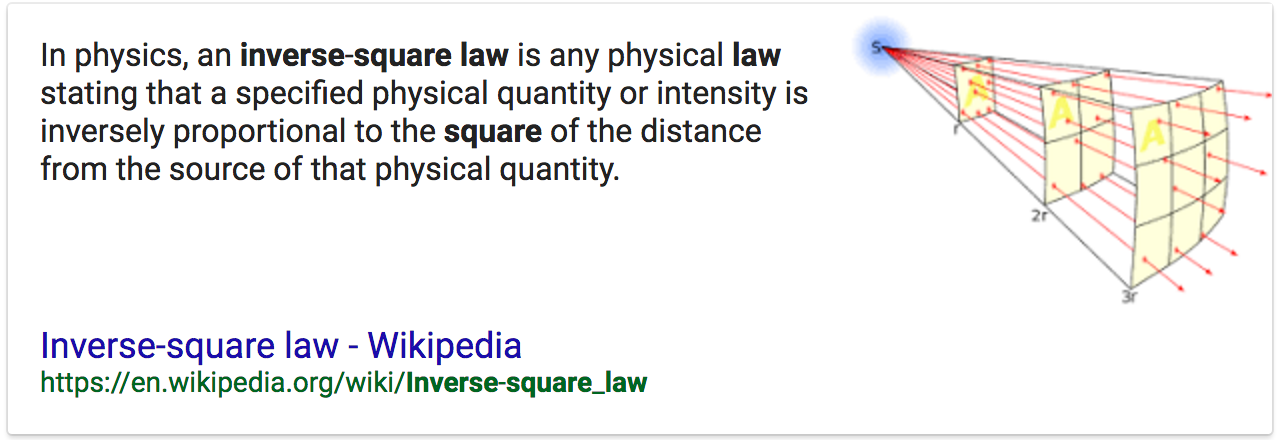
As you can see in the illustration above, at twice the distance the light has to cover four times as much space making it four times less powerful.
Four times less = 2 stops less in f-stops.
So if the light was f-8 on your subject at 4 feet, and you moved the light back to 8 feet, the amount of light on the subject would now equal f-4. If you started at f-4 at 8 ft and moved the light in to 4 ft it would be f-8.
What if instead of moving the light from 8 ft to 4 ft you decided to move it in 6 ft? Well, that would be half way between f-8 and f-4… f-5.6.
Now look at what happens when we apply the rule to a set of distances.
THE IMPORTANCE OF KNOWING RECIPROCALS
A reciprocal is simply understanding the relationships between all the numbers we throw around in photography.
F-stops, shutter speeds, ISO – all work hand in hand with each other to make the image with correct (for you) exposure. Changing any one of these three will necessitate a change in one of the others to compensate.
Let’s look at ISO:
f-4 / 1/125 @ ISO 100
If we change that to ISO 200 one of those above will have to change. Either the f-stop or the shutter speed. Since the ISO is now one stop more powerful, we either have to change to f-5.6 or change the shutter speed to 1/250. Both of these changes have the affect of decreasing the exposure setting one stop due to increasing the ISO by one stop.
Simply knowing the basics of one set will make it easy for you to re-configure for a new set.
I use ISO as my constant. In this case, I will use the settings of Sunny 16 (f-16 at 1/ISO).
ISO is 100 for these reciprocals.
f-16 @ 1/100
f-11 @ 1/200
f-8 @ 1/400
f-5.6 @ 1/800
f-4 @ 1/1600
f-2.8 @ 1/3200
These are committed to rote memory.
Changing the ISO compels me to make associated changes in these figures. If the ISO goes faster, I simply change the f-stop OR shutter speed to correlate to the amount of change in ISO. If the changes go out of the range of my camera, I will change one first, then catch up the other.
Example:
The light is getting a bit low, and I want to shoot with a shutter speed that allows me to hold the camera still. I take a meter reading and find that at ISO 100, my exposure for that shot is f-4 @ 1/15. Well, that aint’a gonna work for me handheld.
So first I decide that f-4 should be f-5.6 because of some Depth of Field issues (which moves the shutter speed down to 1/8), so that means I will have to move the ISO one stop for that aperture change to:
f-4 / ISO 100 @ 1/15 to f5.6 / ISO 100 @ 1/8 (reciprocal, one less stop in shutter speed to correlate with additional stop in aperture.
f-5.6 / ISO 200 @ 1/15
f-5.6 / ISO 400 @ 1/30
f-5.6 / ISO 800 @ 1/60
Learn your reciprocals for faster and more accurate decisions in the field.
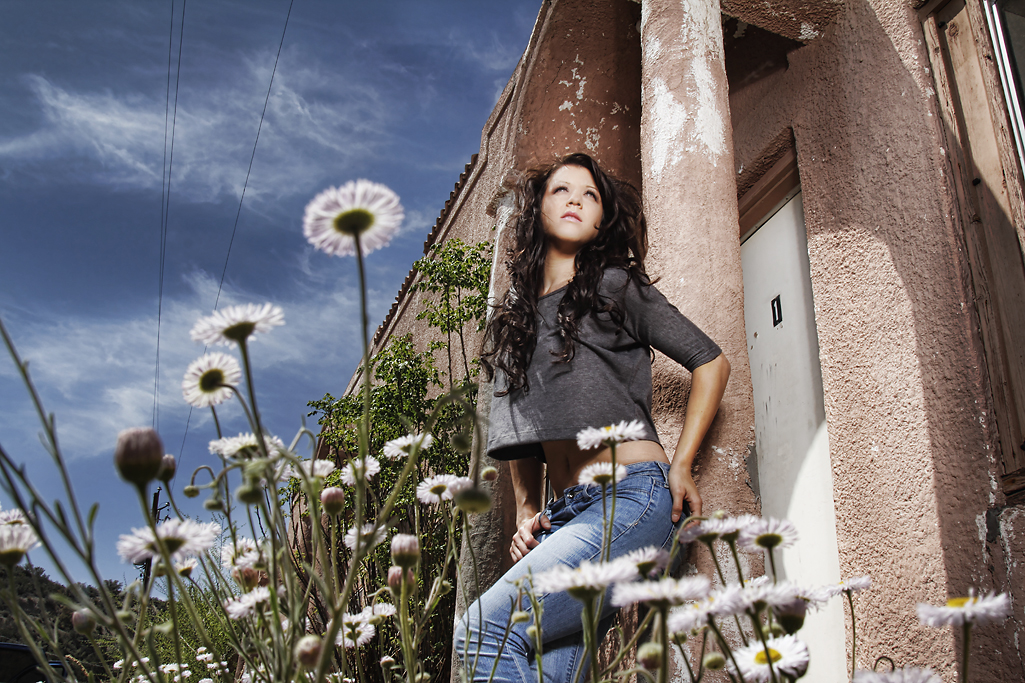
Bri in Miami.
I didn’t want the old building to go too dark behind her so I moved her next to the column. This gave me the ability to move the light in close to her, and let the background fall off fast – but retain the light and the texture right around her so she didn’t ‘pop’ out and look too overly lit.
This is a 4ft softbox with a Profoto 300 WS head and a single diffusion panel in the softbox. It is just above camera viewpoint in this shot – very close to her. You can see the light falling off as it reaches her knees.
I wanted the shot to appear somewhat realistic and not “strobed” so a careful blend of one stop over the ambient was chosen.
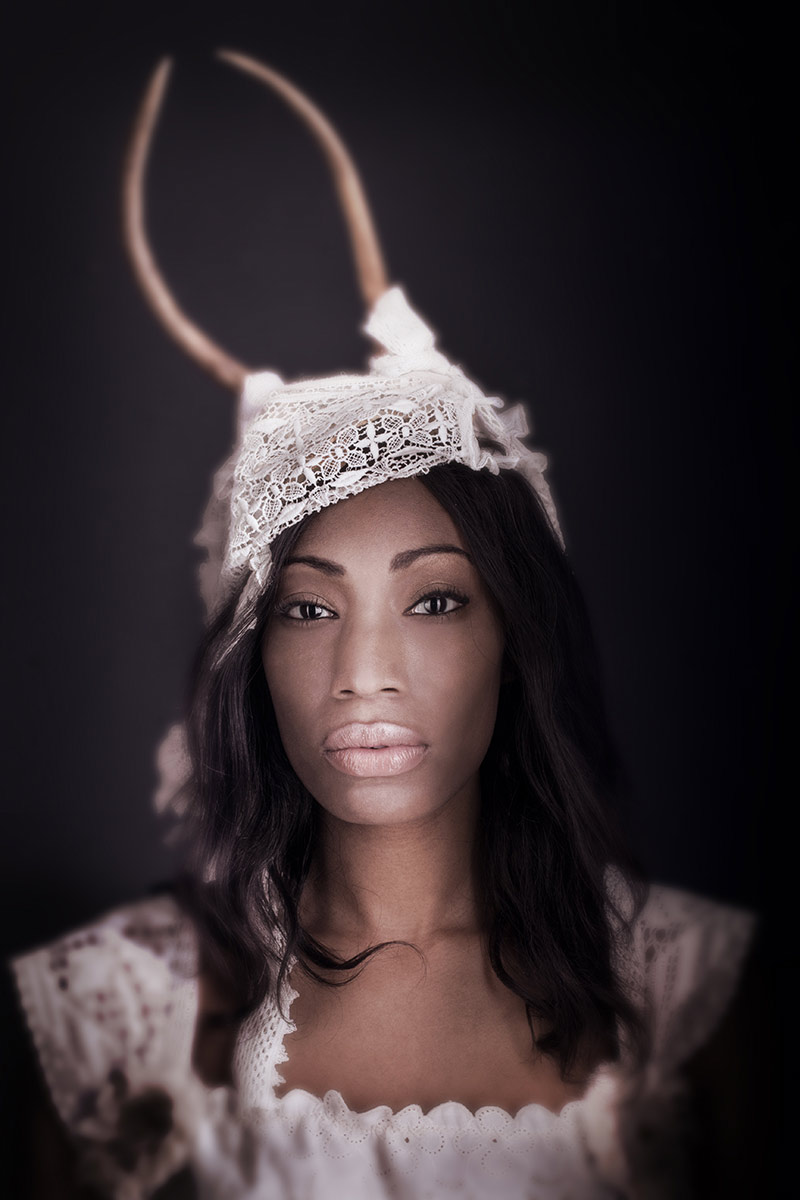
Ivy in the Studio.
My studio had bright white walls in a cove. I didn’t want this image to be on a white background so I moved Ivy far enough away that the light on her had no effect at all on the white wall behind her. It was simply way too underexposed to render at all.
Controlling the exposure through the Inverse Square Law is one of the more important tools you will have at your disposal.
And get this – it doesn’t cost a penny.
ASSIGNMENTS FOR THIS CLASS:
- Using a light source of your own: (studio strobe, speedlight, continuous light) place the light close to the subject and then move the subject AND light source closer to and farther back from a single background. Notice how the image presents itself as you go closer to the background with your subject and light, and what happens when you take subject and light farther away.
- Place camera and background at a fixed point. Then move your subject into the f-16 and make an exposure. Move back to f-11, then f-8, f-5.6, f-4 and if you can f2.8. What happens to the background as you move the subject closer to it and adjust exposure.
- Build your string meter. See below.
Find a piece of good, smallish rope. Clothesline will do nicely.
Put your light on a stand, and run the string straight out from the flash. The flash should be set at 1/8 power if possible. Not full. It should be on “normal” zoom setting neither on telephoto or wide angle.
- Using a meter and a remote flash trigger, find the exposure point for f-4 by going down the rope and aiming the ambient light meter dome directly at the strobe. Keep going until you find the point where f-4 is noted on your meter.
- Using a knot or marker, note that point as f-4.
- Now find the middle of the rope and note it with knot or marker.
- Between the end of the rope and the middle (left side) put a knot or mark in the middle of that area.
- Between the middle of the rope and the end to the right put a knot or marker
- On the right side, now find the middle between the end and the first mark, and knot it or marker
You now have simple rope meter that will be incredibly accurate in all situations.
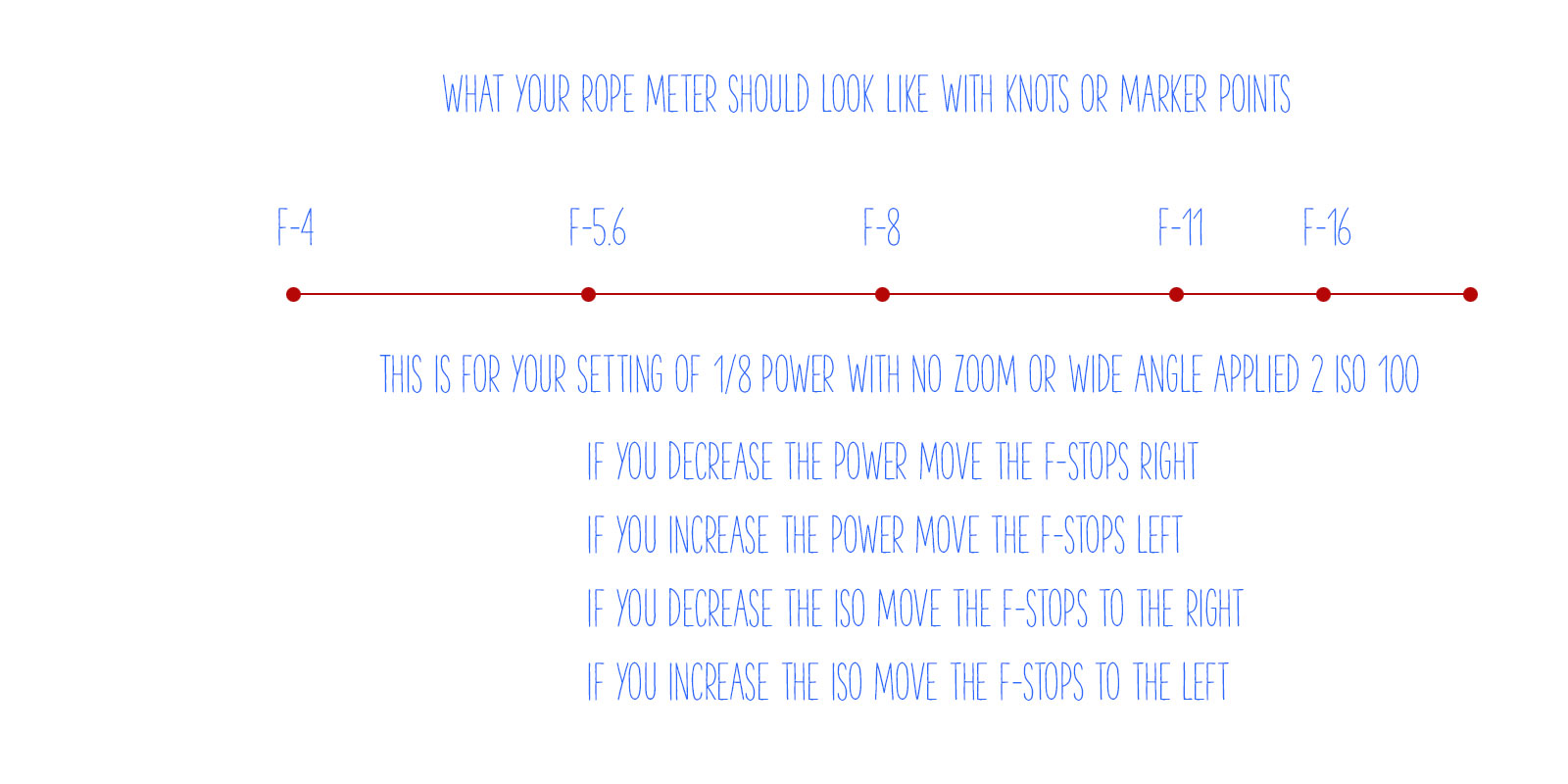
Finding f-4 is the most important part. Use a lightmeter for best results.
If you want to use a gray card, make sure it is at a very slight angle to the light source so it will not have a specular for the camera to see (the reflection of the light source). Shoot at f-4 until you find the distance that will render a single line of pixels in your histogram dead center. That is perfect exposure of a gray card.
Of course, you must fill the lens with the gray card, no extraneous stuff in the viewfinder – just the gray card.
Are You Using Emotional Lighting?
I am restless. Unsettling so. I am finding myself wondering aloud what the point is of the image in front of me. Is it to delight? Is it to show my how sharp the lens is? Is it to make me see something I may not have usually seen? Is it to show me how many lights the...
See Ya, 2009… Looking Toward 2010 With Excitement
Well, here we are. The last year of a decade filled with innovation and stagnation, amazing highs and devastating lows. We enter the second decade of the 2000's in 365 days. A year of endings and beginnings, 2010 may be a defining year in so many photographers...
8 Essential Sites for Emerging Professional Photographers
A recent posting elsewhere with "5 Essential Photography sites" or whatever, didn't sit well with me. I don't consider a vendor an essential. My vendor may be essential to me, but they are not essential to you. I found the list rather dreadfully full of vendors. So I...
Introducing the New Category: Rants & Raves
Time for a new category here on LE. I want to share a lot of things with you all, but it needs to be done on a near daily basis. And that causes some problems with how the longer posts get distributed. The "Rants & Raves" pages may appear daily, with the longer...
42 Wonderful Images from the LE Flickr Forum
Well, we enter that last week before the holiday week. That is the week between Christmas and New Years. Another fun post of images from the Lighting Essentials Flickr Pool. Some of the best Flickr photography around. And speaking of that forum, I have decided to kick...
Pittsburgh Overview: A fun and challenging workshop
Well, this was the second to last workshop for 2009 and it had its own challenges. The weather wanted to be a problem, and we were unsure of out talent pool. Talent was wonderful and the weather... while being a little stubborn on Sunday, finally opened up and gave us...
Branding Your Photography Business: A Realistic View
Branding Your Photography Business: A Realistic View Brand. Branding. Words that we hear a lot about. “Brand Yourself†we hear from some quarters. “We specialize in Branding†we hear from others wanting to sell their expertise. And consultants want us to...
Stay Fresh, Stay Current, Stay Visible: by Daron Shade
Daron Shade introduces CMS (Content Management System) and discusses how it benefits photographers greatly to have a website that they can manage themselves. Far more than keeping the portfolio fresh with uploaded images, a full CMS gives photographers greater impact...
Images from the Toronto LE Workshop
Hi, and welcome to Lighting Essentials, a place for photographers. I do believe that is the first time I have used a welcome, and it had to be done. I guess. Stats show that I am getting new people all the time. Actually I was a bit surprised at all the people who are...
It’s All About Me! Photographers ‘About Me’ Pages
Creating an "About Me" page can be quite a challenge for photographers. What should be included? How should it read? First person or third person voice? Should there be a client list or should it be separate. Well, let's take a long look at a lot of those questions....
A Passion for the Image
37,000 feet over the Great Plains of these wonderful United States and I find myself drifting off a bit, as the days have been long and nights short lately. The workshops are the most fun I have had in a long time, and they keep me pretty busy. As well, time must be...
33 Wild and Wonderful Images from our LE Flickr Pool
Image by Don Fadel. Hey... it's been a while. Sorry 'bout that. I have been traveling so dang much that it has been a little hard to get to the site... but I have really got a lot of stuff ready to go. The last few weeks included Boise, Toronto and this weekend it is...

Using a Light Meter and “Placing” the Photographic Exposure
“Breaking Out” as a Professional Photographer: Daron Shade
Daron Shade presents a really well written article about 'Breaking Out' and Breaking In to the world of commercial photography. Another of our "Going Pro" series. I hope you enjoy them. Today finds me in Boise, Idaho. The day after a fantastic workshop weekend here....
44 Terrific Images from the Lighting Essentials Flickr Pool
COVER PHOTOGRAPH BY MATTHEW DUNN We have another inspirational post from the Lighting Essentials Flickr Pool. 44 terrific images that hopefully will inspire you. I love looking through that pool whenever I have a few minutes. Take your time, and as always, the images...
Posing and Lighting: The Synergy and Concept. Guest Post by Eduardo Frances
This morning finds me in Boston. It's cold and overcast, but our goal is to have a terrific workshop. And we will. Eduardo Frances is our guest columnist this morning. He hails from El Salvador and I have profiled him on the site here. I am sure you will enjoy this...
Staying Natural in Front of the Lens: Model Behavior
Briana Shaker adds a new article on having fun and getting the job done. It is good reading for photographers and models alike. More after the jump as they say. I want to take a few minutes and let everyone know how much I appreciate the great emails and comments you...
Gear… OK, Let’s Discuss Gear. Photographic Tools That I Like
I get a lot of questions about gear at the workshops and by email. I have lots to say about gear, but I am not a gear-head. I love gear that helps make my work easier, and couldn't care less about cost or prestige. If something works well I like it. And if it isn't...
Marketing and Good Karma: Guest Post by Daron Shade
Hi everyone. I am in the midst of the Mexico workshop, and a little behind on my gear post. It was mangled in my DB and I have retrieved it fine, but there are some issues with the images. Watch for it in a day or so. In the meantime, my bud from Tucson, Daron Shade,...
Five Things To Do To Land Assignment Photography
As we begin to work toward our new focus on Lighting Essentials, I want to discuss some truths that go along with this business. Some are probably truths for most any business, and some are narrowly within the creative realm of endeavors... but all are nearly...
10 Nifty, Excellent Excuses for Failing at Photography
After being actively involved with photographers of all types for quite a long time, I have met successful shooters and those who have not made it. There are a gazillion excuses for failing at this business. (And a few reasons as well. But excuses are different than...
An Interview with Daron Shade, Tucson Photographer
Daron Shade is a Tucson, Arizona photographer. We have a great interview here and a few of Daron's photographs to enjoy. But first an update on some changes here at Lighting Essentials. For quite a while I have been working to find my voice and deliver the kind of...
24 Photographs That Rock: From the LE Flickr Pool
Cover Shot by Megan. Wow. It has been a while since I posted. My apologies and an explanation. 1. I had decided to move from my little studio to one that has more space to shoot and in a location that I like better. More on that later. 2. I had the flu. Yeah... the...
Natural Light Portraits from Seattle
The Seattle workshop was amazing. We had a great time and made some amazing images. Using the facilities of SPA, we were able to do several setups. And the models, stylists and hair artists were off the chart. Incredible styling, hair that was spectacular and a dozen...