
DISTANCE OF THE LIGHT SOURCE FROM THE SUBJECT
The second principle of light is the distance of the light source from the subject.
One thing for sure, if it is artificial light, the distance of the light source from the subject can change the size relationship, but there are other things that happen as well.
With artificial lights, one of the most important rules is The Inverse Square Law.
And it can be kinda scary that one. First, it’s a law. That seems pretty definite. And of course it has something to do with math – ‘squared[. But the word INVERSE? What the heck is that?
Let’s not sweat that right at the moment.
Let’s just acknowledge it for what it means to us.
Essentially, the Inverse Square Law (ISL) means that the farther the light is from the subject, the less bright it will appear. We know that, right. The closer we get to a light source, the brighter the reflectance of that source from whatever we are bringing close to the light.
Say you are in a very dark room, and there is only one small light in the corner. You are desperately trying to read the calory count on your small bag of Cheetos but it is way too dark where you are. Well – simple, we take the Cheetos bag over to the light and as we get close to the light, we can instantly read that we are never allowed to eat Cheetos again.
Now that is way too simple for any rule, or LAW, especially one that concerns math and something called Inverse.
The ISL is a way of measuring that light fall off and it shows us that there is actually a formula to how much that light falls off. Formulas are great. They are like systems. We can use them over and over to achieve the results we need.
This formula is way simpler than the name implies:
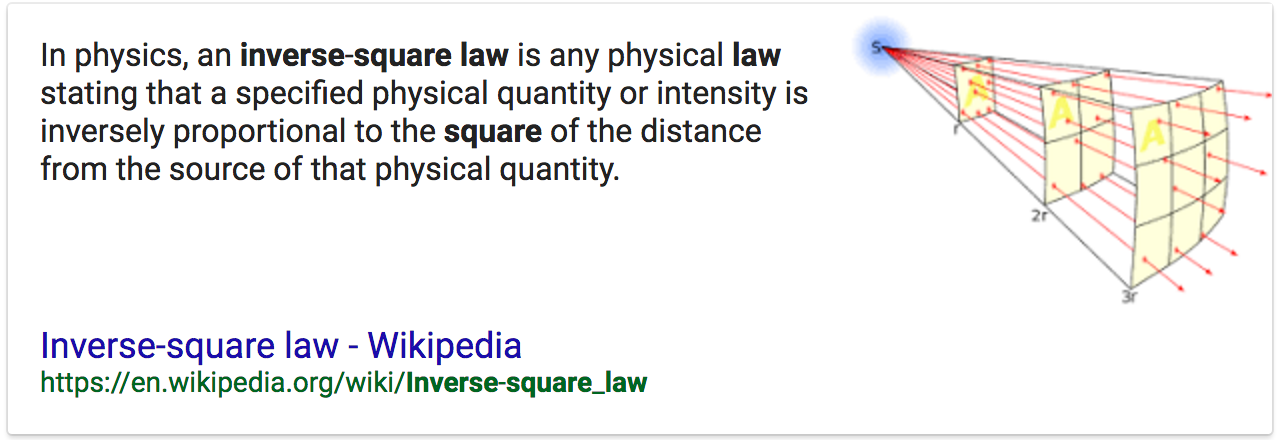
As you can see in the illustration above, at twice the distance the light has to cover four times as much space making it four times less powerful.
Four times less = 2 stops less in f-stops.
So if the light was f-8 on your subject at 4 feet, and you moved the light back to 8 feet, the amount of light on the subject would now equal f-4. If you started at f-4 at 8 ft and moved the light in to 4 ft it would be f-8.
What if instead of moving the light from 8 ft to 4 ft you decided to move it in 6 ft? Well, that would be half way between f-8 and f-4… f-5.6.
Now look at what happens when we apply the rule to a set of distances.
THE IMPORTANCE OF KNOWING RECIPROCALS
A reciprocal is simply understanding the relationships between all the numbers we throw around in photography.
F-stops, shutter speeds, ISO – all work hand in hand with each other to make the image with correct (for you) exposure. Changing any one of these three will necessitate a change in one of the others to compensate.
Let’s look at ISO:
f-4 / 1/125 @ ISO 100
If we change that to ISO 200 one of those above will have to change. Either the f-stop or the shutter speed. Since the ISO is now one stop more powerful, we either have to change to f-5.6 or change the shutter speed to 1/250. Both of these changes have the affect of decreasing the exposure setting one stop due to increasing the ISO by one stop.
Simply knowing the basics of one set will make it easy for you to re-configure for a new set.
I use ISO as my constant. In this case, I will use the settings of Sunny 16 (f-16 at 1/ISO).
ISO is 100 for these reciprocals.
f-16 @ 1/100
f-11 @ 1/200
f-8 @ 1/400
f-5.6 @ 1/800
f-4 @ 1/1600
f-2.8 @ 1/3200
These are committed to rote memory.
Changing the ISO compels me to make associated changes in these figures. If the ISO goes faster, I simply change the f-stop OR shutter speed to correlate to the amount of change in ISO. If the changes go out of the range of my camera, I will change one first, then catch up the other.
Example:
The light is getting a bit low, and I want to shoot with a shutter speed that allows me to hold the camera still. I take a meter reading and find that at ISO 100, my exposure for that shot is f-4 @ 1/15. Well, that aint’a gonna work for me handheld.
So first I decide that f-4 should be f-5.6 because of some Depth of Field issues (which moves the shutter speed down to 1/8), so that means I will have to move the ISO one stop for that aperture change to:
f-4 / ISO 100 @ 1/15 to f5.6 / ISO 100 @ 1/8 (reciprocal, one less stop in shutter speed to correlate with additional stop in aperture.
f-5.6 / ISO 200 @ 1/15
f-5.6 / ISO 400 @ 1/30
f-5.6 / ISO 800 @ 1/60
Learn your reciprocals for faster and more accurate decisions in the field.
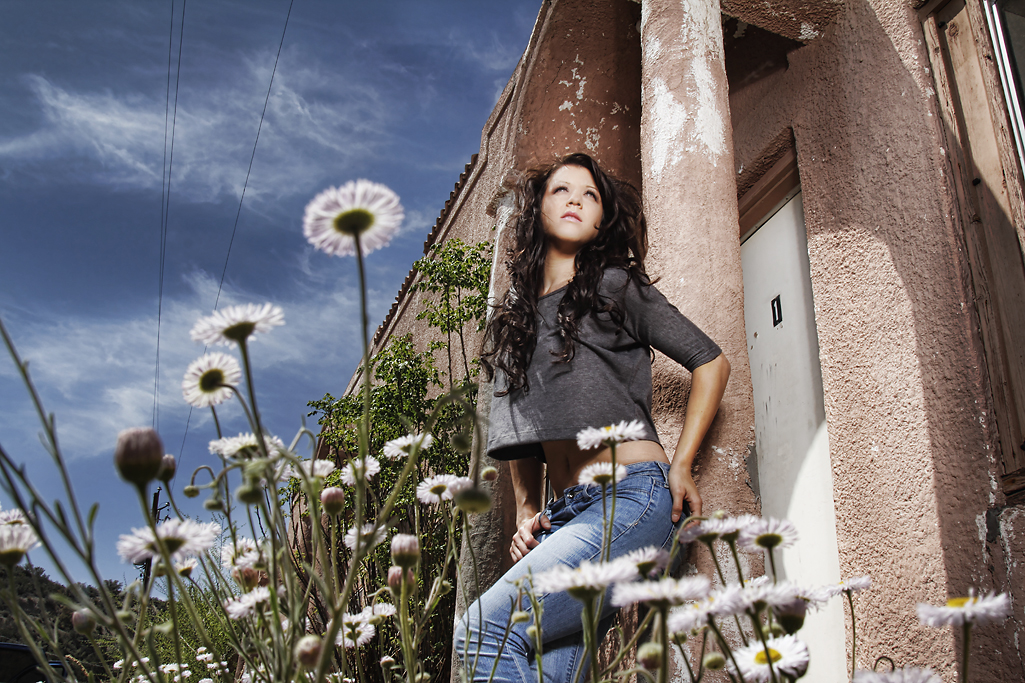
Bri in Miami.
I didn’t want the old building to go too dark behind her so I moved her next to the column. This gave me the ability to move the light in close to her, and let the background fall off fast – but retain the light and the texture right around her so she didn’t ‘pop’ out and look too overly lit.
This is a 4ft softbox with a Profoto 300 WS head and a single diffusion panel in the softbox. It is just above camera viewpoint in this shot – very close to her. You can see the light falling off as it reaches her knees.
I wanted the shot to appear somewhat realistic and not “strobed” so a careful blend of one stop over the ambient was chosen.
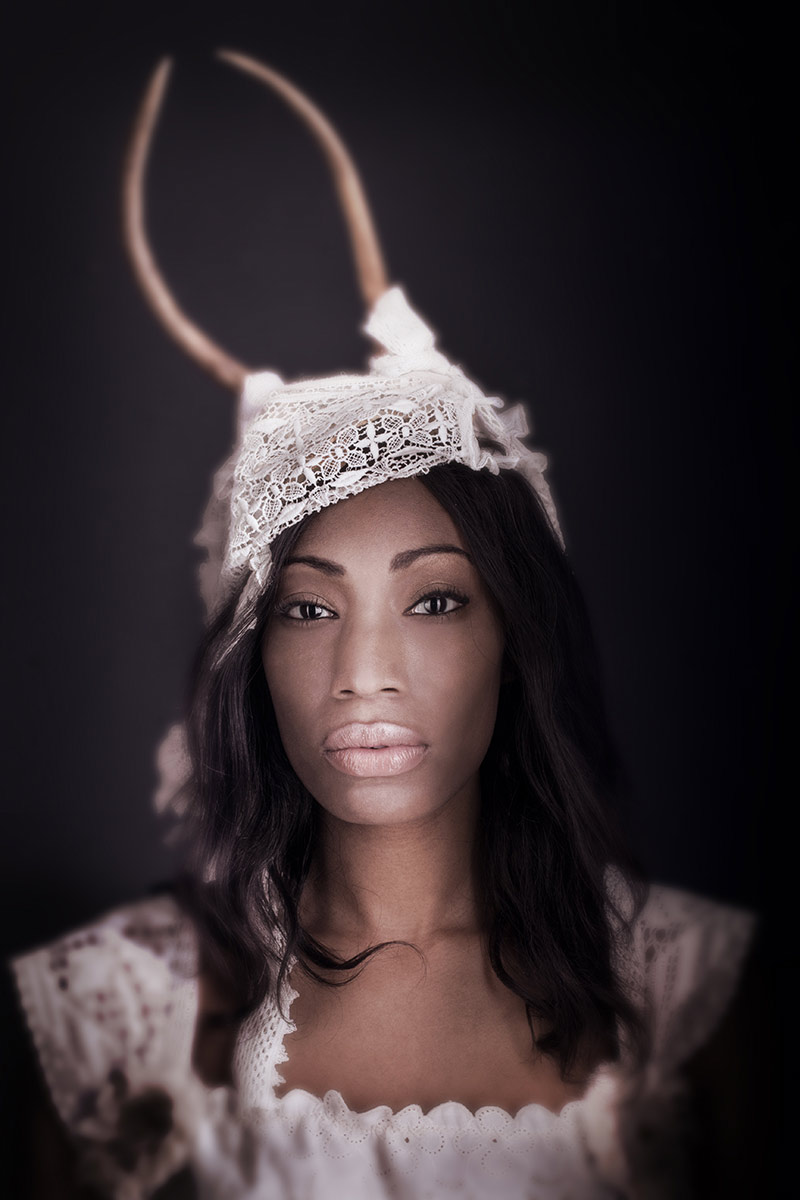
Ivy in the Studio.
My studio had bright white walls in a cove. I didn’t want this image to be on a white background so I moved Ivy far enough away that the light on her had no effect at all on the white wall behind her. It was simply way too underexposed to render at all.
Controlling the exposure through the Inverse Square Law is one of the more important tools you will have at your disposal.
And get this – it doesn’t cost a penny.
ASSIGNMENTS FOR THIS CLASS:
- Using a light source of your own: (studio strobe, speedlight, continuous light) place the light close to the subject and then move the subject AND light source closer to and farther back from a single background. Notice how the image presents itself as you go closer to the background with your subject and light, and what happens when you take subject and light farther away.
- Place camera and background at a fixed point. Then move your subject into the f-16 and make an exposure. Move back to f-11, then f-8, f-5.6, f-4 and if you can f2.8. What happens to the background as you move the subject closer to it and adjust exposure.
- Build your string meter. See below.
Find a piece of good, smallish rope. Clothesline will do nicely.
Put your light on a stand, and run the string straight out from the flash. The flash should be set at 1/8 power if possible. Not full. It should be on “normal” zoom setting neither on telephoto or wide angle.
- Using a meter and a remote flash trigger, find the exposure point for f-4 by going down the rope and aiming the ambient light meter dome directly at the strobe. Keep going until you find the point where f-4 is noted on your meter.
- Using a knot or marker, note that point as f-4.
- Now find the middle of the rope and note it with knot or marker.
- Between the end of the rope and the middle (left side) put a knot or mark in the middle of that area.
- Between the middle of the rope and the end to the right put a knot or marker
- On the right side, now find the middle between the end and the first mark, and knot it or marker
You now have simple rope meter that will be incredibly accurate in all situations.
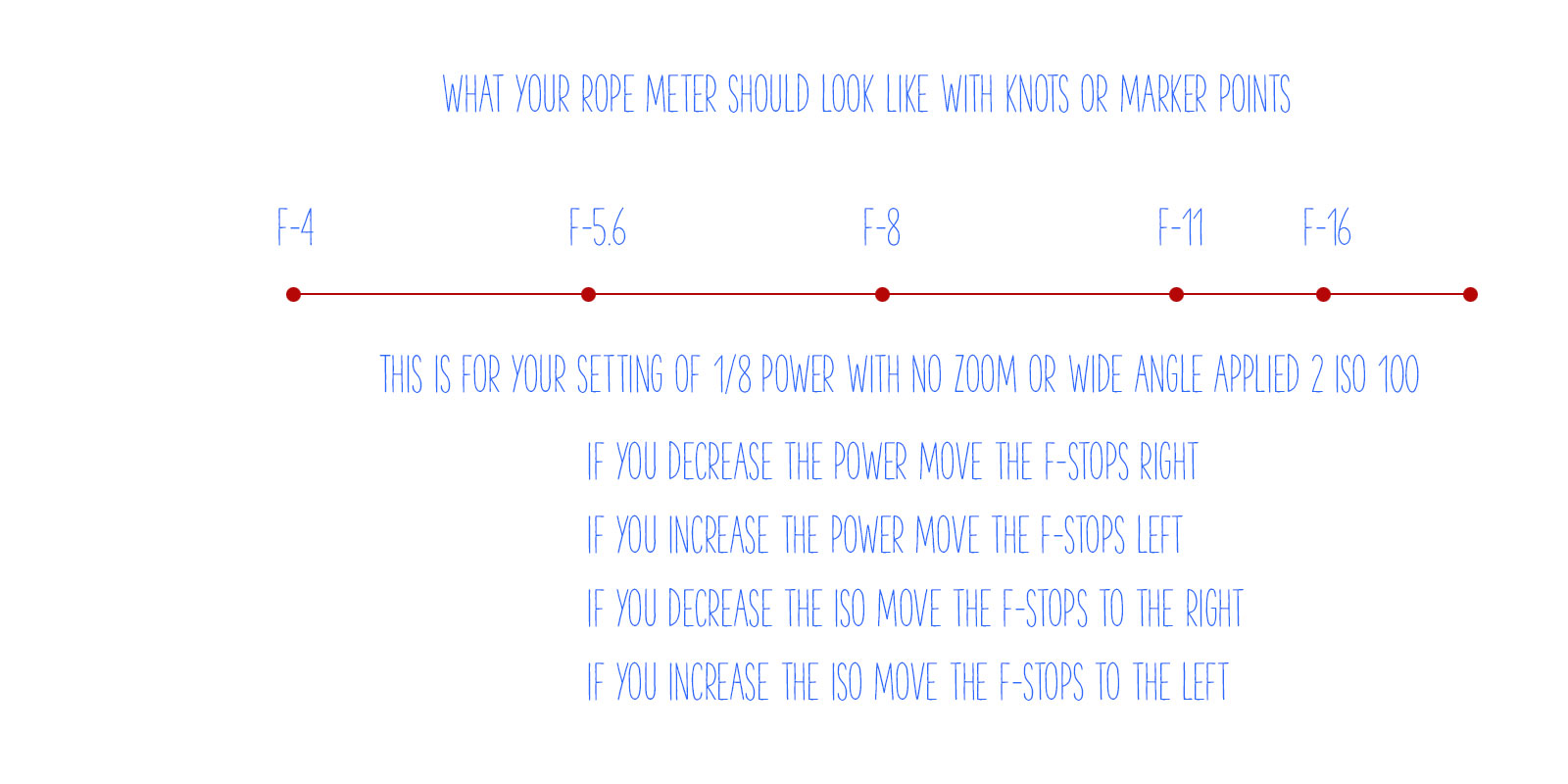
Finding f-4 is the most important part. Use a lightmeter for best results.
If you want to use a gray card, make sure it is at a very slight angle to the light source so it will not have a specular for the camera to see (the reflection of the light source). Shoot at f-4 until you find the distance that will render a single line of pixels in your histogram dead center. That is perfect exposure of a gray card.
Of course, you must fill the lens with the gray card, no extraneous stuff in the viewfinder – just the gray card.
Project 52 : Working to Go Pro With a Real World Approach
I just got off the phone with a wonderful photographer in the Midwest. Bill is working the direct consumer market, but looking to break into the commercial market. His area is not the most cosmopolitan, being a small town about an hour or so from Memphis, but Bill is...
On Location with the GamiLight: A New Softbox for Speedlights
I use a mix of lighting as anyone who reads these posts know. I do not favor convenience over ability at all. I will pack a ton of gear - and be fine if we don't use a quarter of it. It is there if I need it, and when I do, I really do need it. There have been some...
My Drive Through the Wet Foothills of the Sierras
Last weekend I did a workshop in Sacramento. It was a small, but very vibrant group. It also rained both days... all day. We made do with a nice rental studio on Saturday, and a hotel conference room on Sunday. When it would clear for a few minutes, we headed out to...
Lessons. Learned: How One Photographer Fought Back Against a Very Contentious Client
The article below was written by a friend of mine in the New England market. He has asked to remain anonymous, so we will respect that and only say that he is a damn fine photographer, and this story of determination against a client that had much more means, is a...
Six Photographer’s Blogs that “Get It”
I love blogs. I think they are a revolution in publishing, and the effects of a democratized publishing platform have not been truly revealed. They give people who may never have had a chance to publish an elegant and rich platform. Words, video, photographs, graphs,...
Why Being a Photographer is Like Being a Jazz Musician
I love jazz. I always have. I can remember the first recording of jazz my dad played on our brand new stereo. It was a recording of Benny Goodman's Quartet with Buddy Rich on drums. I thought it was fascinating and glorious music. I didn't tell a soul that I liked it....
Featured Photographs from Project 52: Part One
Project 52. 52 weeks of assignments and critiques for those wanting to go pro, or be more professional in their approach to photography. The site is Project52.org and there is a ton of stuff there already. Audio crits with images to follow along with, information on...
A “GPS” For Our Photography… Yeah, That’d Be Nice
I have been quite busy this past two weeks. Many, many distractions taking me away from the work - and lots of work to be taken away from. It has produced a quagmire of challenges. I rarely miss a deadline, and I work very hard for my clients. Even the ones I don't...
Deciding What “ART” Is, Or Is Not, Can Be Quite Instructive
A Little Rant today. "I saw Cady Harran wearing army pants and flip-flops, so I bought army pants and flip-flops" -- Mean Girls. Recently at APE a post entitled "Why We Love Bad Photography" made me pause and consider what that meant to me. It ended up consuming quite...
Setting Goals: Is It Important for Photographers?
Yeah, we heard it all through our early schooling; "Set you goal to achieve..." And there are countless gurus out there teaching seminars and workshops and holding 'retreats' on the "Art of Decisive Goal Planning and the Strategic Paradigm of Unilateral Ubiquity..."...
The Sassimi Collection: The Ins and Outs of Shooting a Catalog
I recently completed a job for Tera at Sassimi, a boutique fashion designer in Seattle. And while she is small for now, she wants to grow her business. I think she will do well. Oh, and you can visit her site here at Sassimi.com. (For those looking for Project 52,...
A “Visionary Website”: My Talk with Selina on Clarion Call on Saturday, 2-12-11
Thanks to Selina for a wonderful opportunity to discuss the 'visionary website' and how being engaged with your clients and prospective clients through your website can be a strong tool for photographers. I will be speaking at 11:15AM EST so for you in CST it is...
How to be Incredibly Average and Never Breakout as a Photographer
I work with photographers on a one to one basis. I will only work with those who are really interested so we have a discussion on what is expected from both sides before the engagement. This weekend I had a conversation with a young photographer who wants to be...
Still Life with One Light in the Studio: “LIVE” on LE
This article is a look at the creation of a simple still life with one light in the studio. See it after the jump. At this point I want to remind everyone of the incredible opportunity this week. Selina's amazing Clarion Call is this coming Thursday/Friday,...
Some Examples from the Still Life Assignment
Photograph by Chis Martin. NOTE: If you are looking for this week's assignment, please go to Project 52, assignment five. You can see it here on LE as well. We are entering the month of February, and we are already at assignment number five... "the weather". The work...
Project 52, Assignment #4 Photograph an ‘Entrepreneur’.
Assignment Number Four: Entrepreneur Portrait Due before February 7, 2011 Posts at images at Flickr Lighting Essentials Group. Tag image LE52Weeks-4 You have been assigned by a national magazine for a photograph of a local entrepreneur, you have two weeks to put...
Photographing A Dancer: Guest Post by Josh Brewster.
This and all photos in this post copyright Josh Brewster, Austin TX. (Looking for Project 52? Hit the "52" link in categories for all the linky goodness. Visit Project52.org for ongoing assignment notes.) Josh took my workshop in Houston a couple of times. His work...
Project 52, Assignment #3 Still Life
Project 52: INFORMATION. It is important that you all go to Project52.org for assignment notes and more. We have a page there that will show all upcoming LIVE shows as well as other information that we will be giving out as these projects go along. Our schedule for...
Real Estate and Architectural Photographer Scott Hargis Has a New Book
The Essential Guide to: LIGHTING INTERIORS Techniques for lighting with small flash by Scott Hargis Architectural photography has always interested me. I have done a substantial amount of it over my career and I still enjoy doing it when I get an opportunity. I wish I...
Project 52, Assignment #2 Photograph a Stranger: and Selina Maitreya Interview
Audio from this past week's discussion. This is from the Friday afternoon chat. I had a wonderful opportunity to discuss the upcoming Clarion Call 2011, a free teleseminar for photographers, with the talent and brains behind it, Selina Maitreya. You can listen here on...
52 – A Project For Photographers: Assignments, Discussions, Critiques and Portfolio Building. Assignment Number 1
UPDATE: Thanks to all the folks on the Project 52 LIVE last evening. As promised, here is the audio file. It will be linked here for one week, and one week only. Part One Part Two Some things we talked about. 1. The reason we do a 'vision' statement for ourselves it...
2010 Is Done, 2011 Presents New Opportunities and New Challenges
I am flying to Portland for a shoot as I write this end of the year blog. Outside the window it is blue sky above a gray mass of clouds that stretch the entire way from Phoenix to Seattle. Snow in the desert tomorrow. I will be downtown Portland having warm Brandy...
Things I’ve Learned About Photography, Writing, Gear, and Life This Year
Perhaps I should have said learned and re-learned. I am hard headed, and some of the things I know still need a refresher course every once in a while... ya know. This will be my second to last post of 2010. The last post will be on New Year's Eve. I am taking next...
Dispatch from Florida: Anna Maria Workshop Wrap Up
Anna Maria is the last workshop of the season for me. For the past three years we have done that workshop on Anna Maria Island, Florida. We will do next years last workshop of the year on Anna Maria. I love that place and it has so many places to make images. Next...