
First up, the size of the light source in relation to the size of the subject.
Imagine looking out the window at the front yard and without seeing the sky knowing whether it is sunny or cloudy. We do know, right?
We don’t have to see the sky to know if it is sunny or cloudy, we can tell from the way the light is behaving on the subjects in our yard. The car has a deep shadow below it if it is sunny and very little shadow at all if it is cloudy.
The plants are either casting long shadows or seemingly no shadows. The sun makes everything have a shadow, while the cloud cover acts as a shadow reliever.
We know this because we have observed the world for our whole lives and we understand how light works when it is sunny and when it is cloudy.
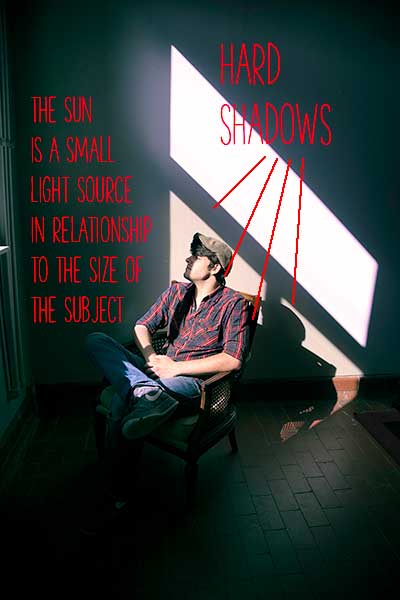
The sun is a tiny light source. (Yes, science nerds it is way huge, but I am talking about from where we look at it.) No more than a coin in the sky.
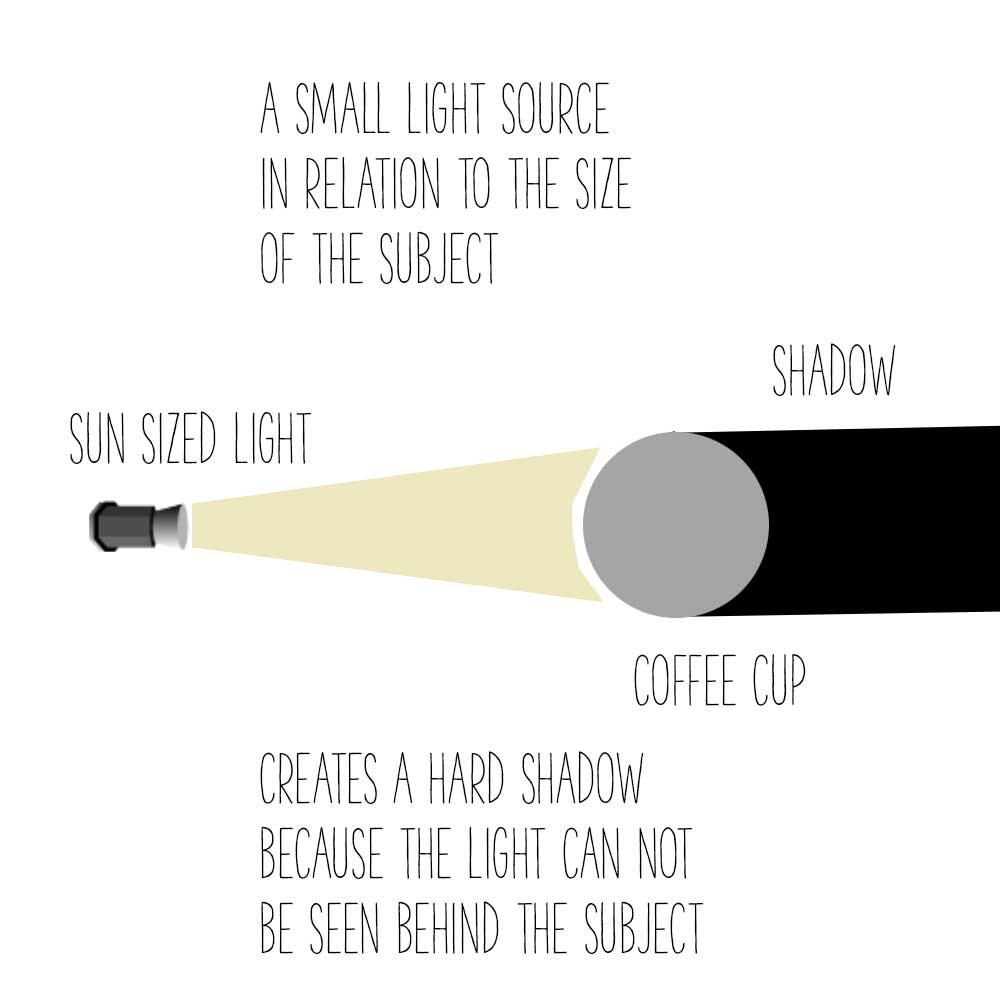
That is a very small light source. And it can be totally blocked out by the smallest of items: a branch, or a rose, or even a butterfly. That means that the light cannot go around the subject and is instead blocked by the subject.
Here is the equivalent of the sun in the studio. A small, unmodified light at a distance from a coffee cup.
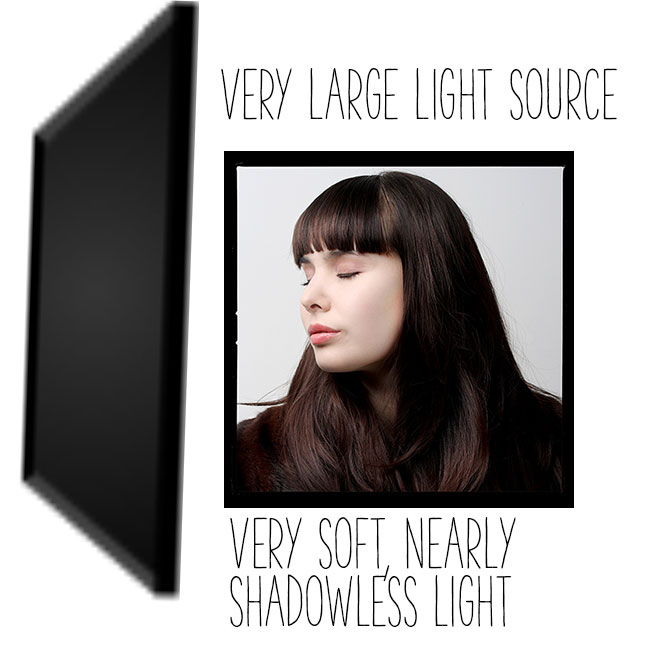
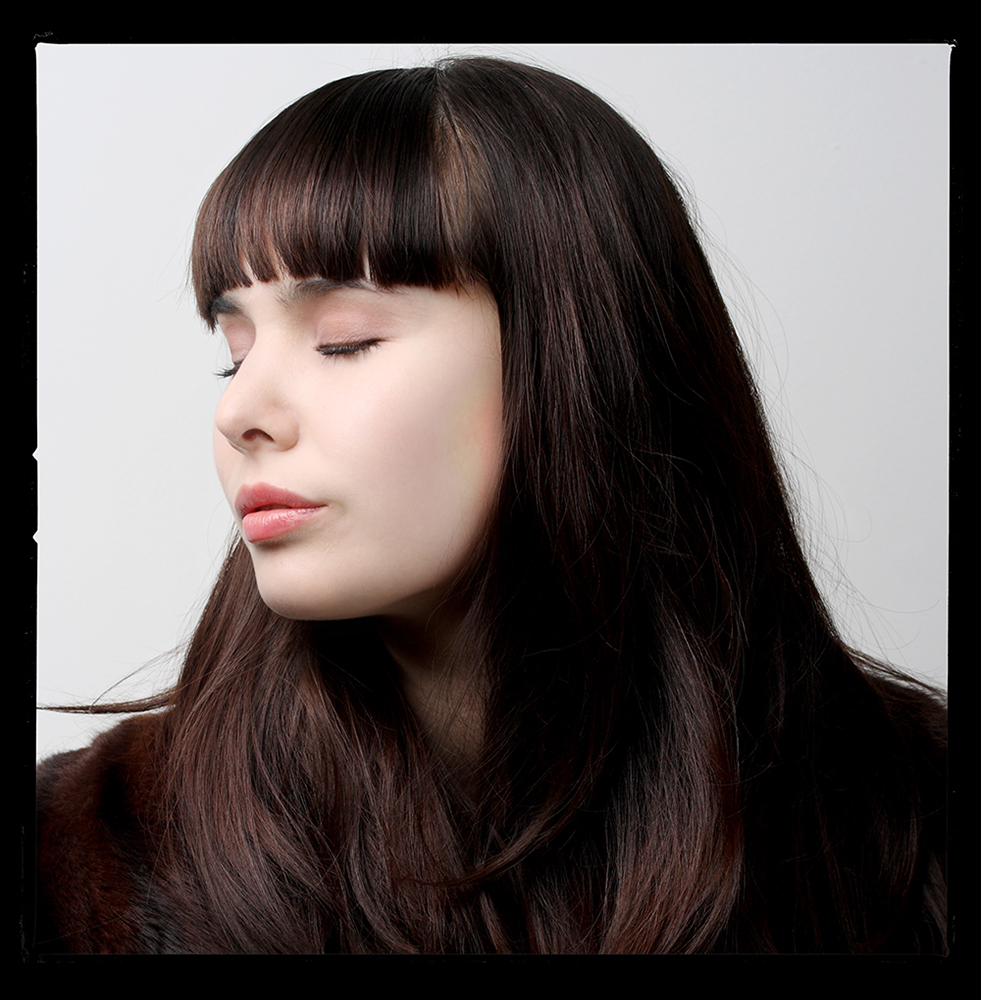
And here is how the shadow falls on a small coffee cup when a very large light is applied. The light wraps around the coffee cup because the light is so much larger than the subject.
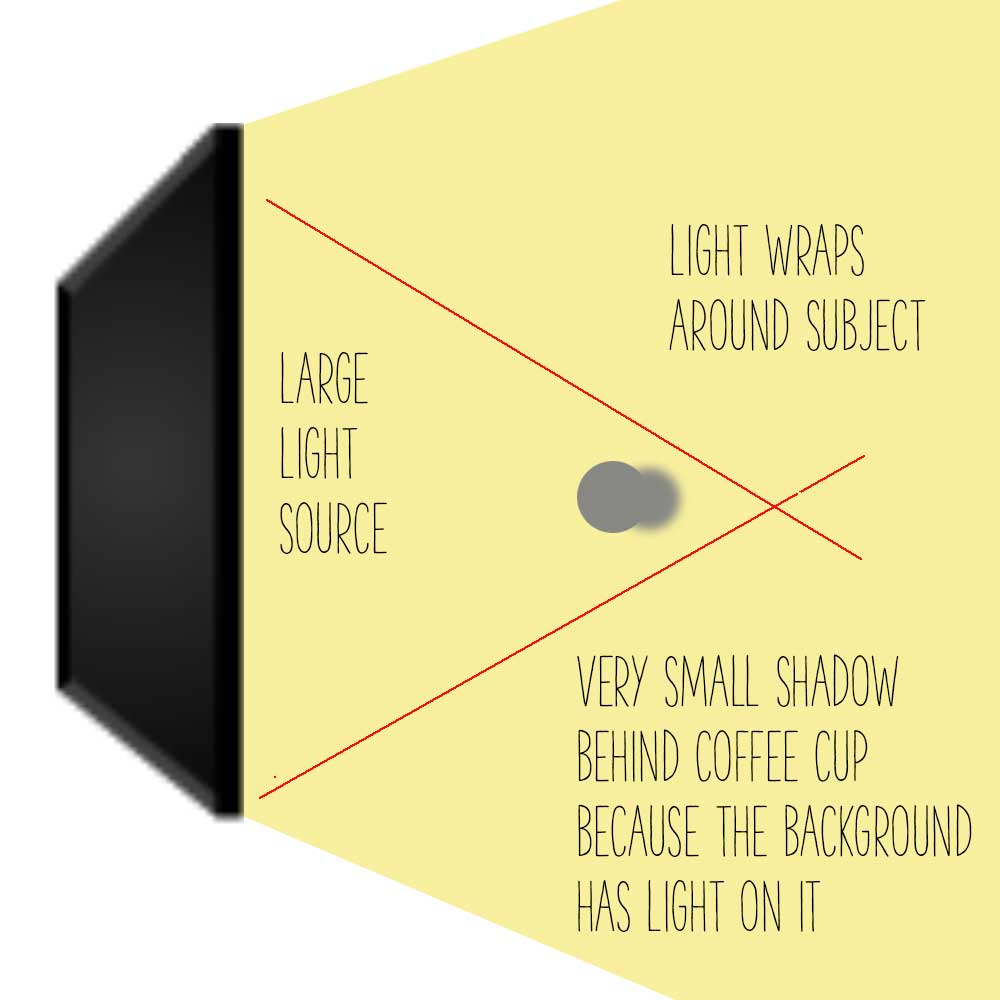
That is how the sun works as well.
The sun is the very small light source, and when the clouds come over the land, the sun lights the back of the clouds and they light the earth with no shadows because they go from horizon to horizon. Light is wrapping all around all the subjects it is seen by.
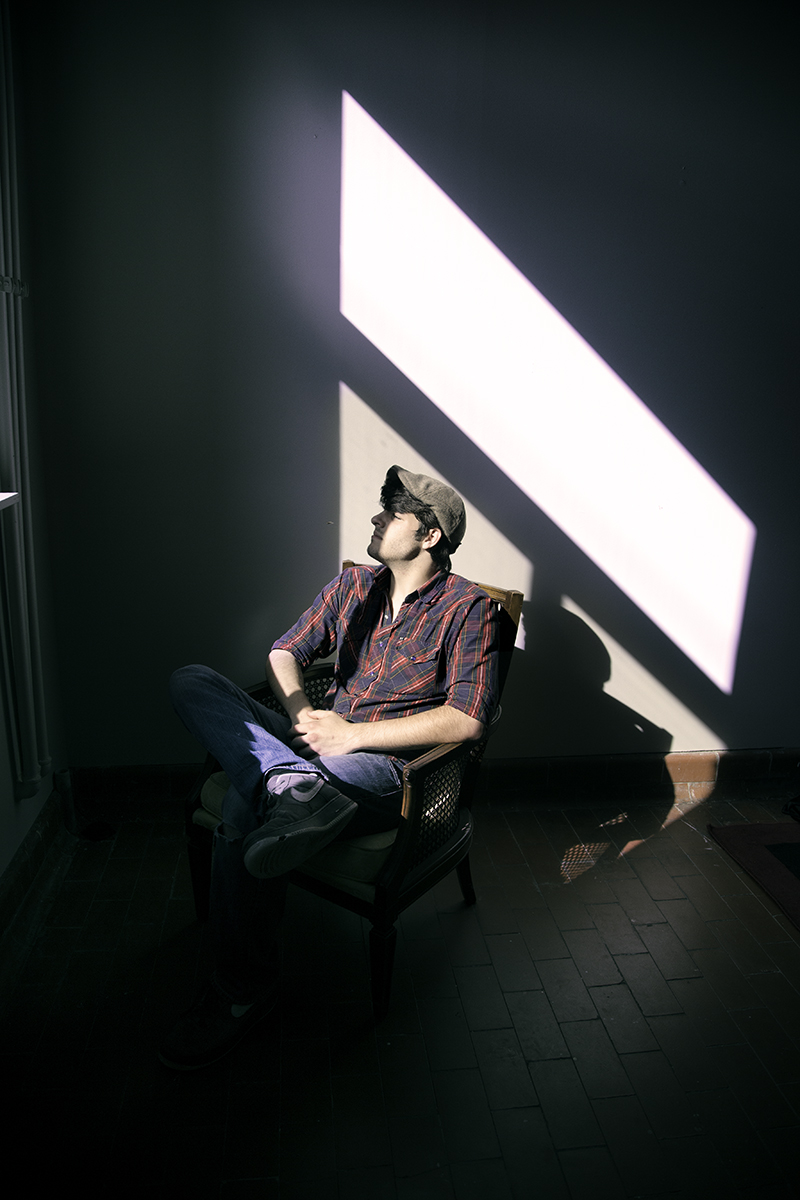
Think of your softbox as a “cloud cover” for your light (the sun) and it makes more sense to you.
Question: is a 4’x5′ softbox a large softbox or a small softbox?
The answer is compared to what? Other softboxes? Yes.
The subject? Well – that depends. What is the subject?
If the subject is a Hot Air Popcorn Maker, then it is indeed a very large light source.
If our subject is a jetliner, then no – it is not a very big light source at all.
And then… how far will it be from our subject?
Distance makes the perceptual size of the light source diminish as it gets farther away. And it is that perceptual view is the one that matters.
A 20″ light source very close to a 1″ watch is a large light source. A 72″ x 72″ source far away from a 14′ square box is a small light source.
And the light will render that way as well.
LIGHT DOES THE SAME THING EVERY TIME – IT IS THE SUBJECTS THAT CHANGE THE GAME
ASSIGNMENT FOR THIS CLASS:
- Choose a subject less than about 8″ – like a shoe or a water bottle. Light it with a small light source (speedlight) to see how the shadows fall. Then light it with a softbox (24″ or so) in close. Very close.
- Move the softbox 6″ away and take another shot. Then do it again at 6″ intervals until the softbox is 6 feet away. Notice the changes in how the subject responds to the light, and how the shadows get sharper and deeper.
The size of the light source in relationship to the subject is one of the four principles of light.
Legacy Article: A model in the surf – the full shoot.
NOTE: This is a legacy article. Please click the "home" button at the top of the page to return or use your back button. HOUSTON is coming up fast. If you haven't signed up for our last western state workshop this year, I would advise you that time is running out....
“Why did you light it that way?”
A friend and fellow photographer and I were sitting and having some overpriced coffee when he asked me a question about one of my shots that we were looking at. "Why did you light it that way?" It took me a bit by surprise because most of the time I am asked "how" not...
Model Behavior: Shooting in Mexico. Some Thoughts
Bri takes us on a look at some of the images she did on the Mexico workshop. We all had a blast and Mexico was outrageously fun. We had lots of photographers and she shot with all of them. Before we get to the Model Behavior article, I want to let everyone know that...
Deconstructing a Portrait on Location
A direct contrast to the previous image with two strobes and lots of drama, this shot of Christina is simple and direct and with a more natural feel to it. Shot in Miami, Arizona, I wanted this shot to be very naturally lit and with a great natural feel to it. Before...
Deconstruction: Briana on the Pier (Spotlight Effect)
Let's take a single image today and deconstruct it out to see exactly how it was created. The shot is of Briana in Mexico while we were doing the September workshop in Puerto Penasco, Mexico. Also known as Rocky Pointe, the little town had become a favorite shoot spot...
Ask Briana: October Q&A from our readers
(This page will be continuously updated throughout the month of October, with newest posts to the top. We hope you enjoy this new column by our resident model/author. -- Don) Got a question for me about modeling, working with models, or anything related to being on...
Natural Light for Natural, Subtle Beauty
We are going to take a look at how we can use simple, natural light for some beauty shots of Bri on location in Miami, Arizona. This sleepy little town has such great old walls and patinas to work with. That and the fact that it is about 12 degrees cooler than Phoenix...
Using a Flash to Add a Little Snap with Natural Light
I love natural light. It has a quality that is so unique and fits with my vision so well. Lots of terrific pics made with only the light that is there at the time. Learning to use natural light and make it work for you is one of the most important things that a...
Images from the Lighting Essentials Flickr Pool
I love to go through the Lighting Essentials Group on Flickr and just being knocked out by the high level of imagery there. Most of the members there have either purchased the DVD or attended the workshop, so I take a little pride there. I am going to post a few of...
It’s Called Range: Part Two
NOTE: The Mexico Workshop and Houston workshops are just around the corner. If you are interested in attending one of these Two Day Workshops, take a look at the Workshop page. We have room in both workshops and they are going to be amazing. Briana will be going to...
September 08 Desktops from Lighting Essentials
We continue on with our free themes for your desktops. September is a strange month for me. I am getting tired of the heat here by then, and waiting for the cool nights to signal the end of the monsoon. However, we need the rain so I want the monsoon to continue for a...
On Location: Anatomy of a Shoot (with Video)
On location with speedlights, a model and a videographer. A warm, well, mostly warm December day and we are shooting in Tempe, Arizona. I will share the setups with you and also what I was thinking and working with here. Briana is the model, check out her Model...
One model? No worries, it’s called Range! (Part One)
Range beyond the ordinary: All the world’s a stage, and all the men and women merely players. And we each play our parts. And models? Well, sorry, Shakespeare, models can play any part. Modeling and acting are synonymous. It’s what makes us special. We don’t...
One Speedlight: Some Examples
I know, I know... late for the update on speedlights. I apologize a thousand times. Been unimaginably busy, and things have drifted. Bermuda workshop was so intense there was no time left for much other than sleeping (and a little dancing to reggae on the beach......
Bermuda Workshop: August 2008… What’s Happenin’
Two weekends in a row I have had workshops... three counting next weekend in San Francisco. Wow... that's some serious travel... Seattle, Bermuda, San Francisco. Sheesh, extreme distances... Seattle was a blast, even though we had a small group. Lots of models and I...
Dispatch: Seattle. (2008 Workshop)
Seattle's workshop was a blast. I wanted to share some images that the folks did there. We will update this page as long as I see fresh images. I arrived in Seattle to a wonderful 74 degree afternoon. Yeah, coming from 107 it was really refreshing. Got all in line for...
“Make the Shot.” A Pool Player in a Rainstorm
In keeping with this months major tutorial on using speedlights to their maximum, I thought I would take apart a shot that Briana and I did in Florida during a terrific thunderstorm. We were hot and it was very humid, but we decided to make the best of the down time...
Using Your Small Strobes for Professional Results: Part One
As we begin to start to find some ways to use our speedlights - or small hotshoe style strobes - for advantage, we need to learn all about them. (Welcome Strobist Readers... thanks David.) I'm not talking about the RTM stuff. Where to put the batteries and such. This...
Our August Desktops are Something to Dance About
Well in the tradition of the last 3 months... can we call that a tradition? Anyway, in the tradition of the last three months we present our August desktops. One features a morning scene we all can identify with and the other has nine tiny Briana's dancing their way...
Speedlights: Unleash Their Creative Power: Introduction
Unleash your Creativity with Small Strobes This begins our series on small strobes and location work. August will feature 4 large-scale articles on using speedlights in the field. Published on Monday of each week, they will include video, diagrams and assignments for...
On Location with Small Strobes and a Model Who Can Fly?
Let's look at a way to create some interesting, and somewhat 'ethereal' light on location without taking 200 pounds of lighting gear with us. We are going to use two strobes to 'sculpt' the subject and a bit of careful angling to get the image we want. Backgrounds...
Recent Workshop Attendees Show Off Some Great Work
Photograph by Yolanda Pucinski One of the coolest things I think can happen is when I see some work from a workshop attendee that is really getting great. We can open eyes in a workshop, and teach some skills as well as some solid technique, but it is the student that...
Performance and Posing, Part Two
Briana is back with Part Two of the Posing and Performance Column. Be sure to read her first columns and be looking for more as she helps photographers and models work together to create exciting imagery. Also be sure to check out the Lighting Essentials Magazine for...
Our Big Trip: Part One, Houston, Chicago and Boston
Our trip to the East was a really fun experience. I want to share a few of the images we made on the trip and discuss them as far as lighting and generally what we were doing. This trip took us on planes, trains, automobiles and boats. Every mode of transportation......