
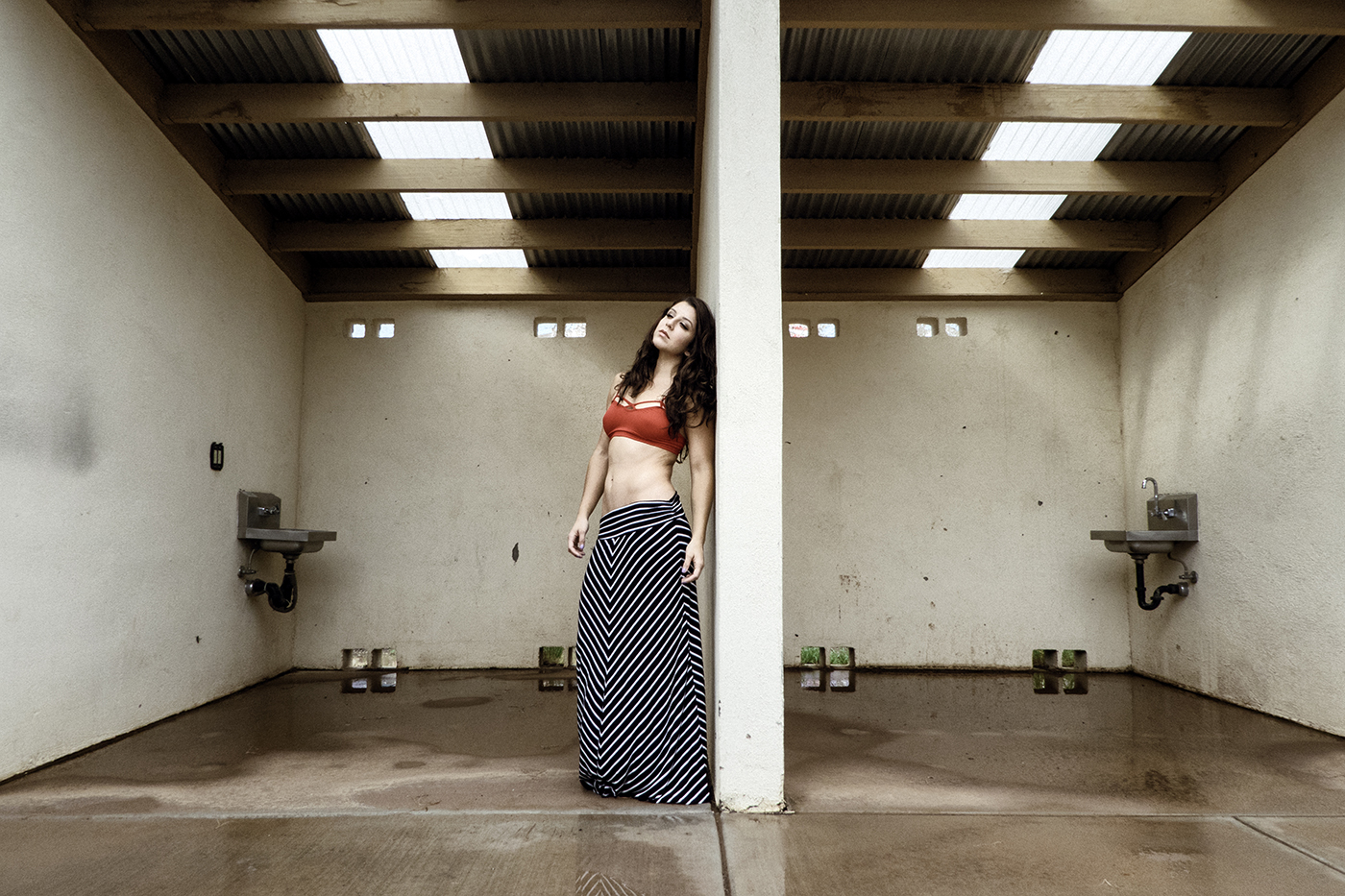
First up, the size of the light source in relation to the size of the subject.
Imagine looking out the window at the front yard and without seeing the sky knowing whether it is sunny or cloudy. We do know, right?
We don’t have to see the sky to know if it is sunny or cloudy, we can tell from the way the light is behaving on the subjects in our yard. The car has a deep shadow below it if it is sunny and very little shadow at all if it is cloudy.
The plants are either casting long shadows or seemingly no shadows. The sun makes everything have a shadow, while the cloud cover acts as a shadow reliever.
We know this because we have observed the world for our whole lives and we understand how light works when it is sunny and when it is cloudy.
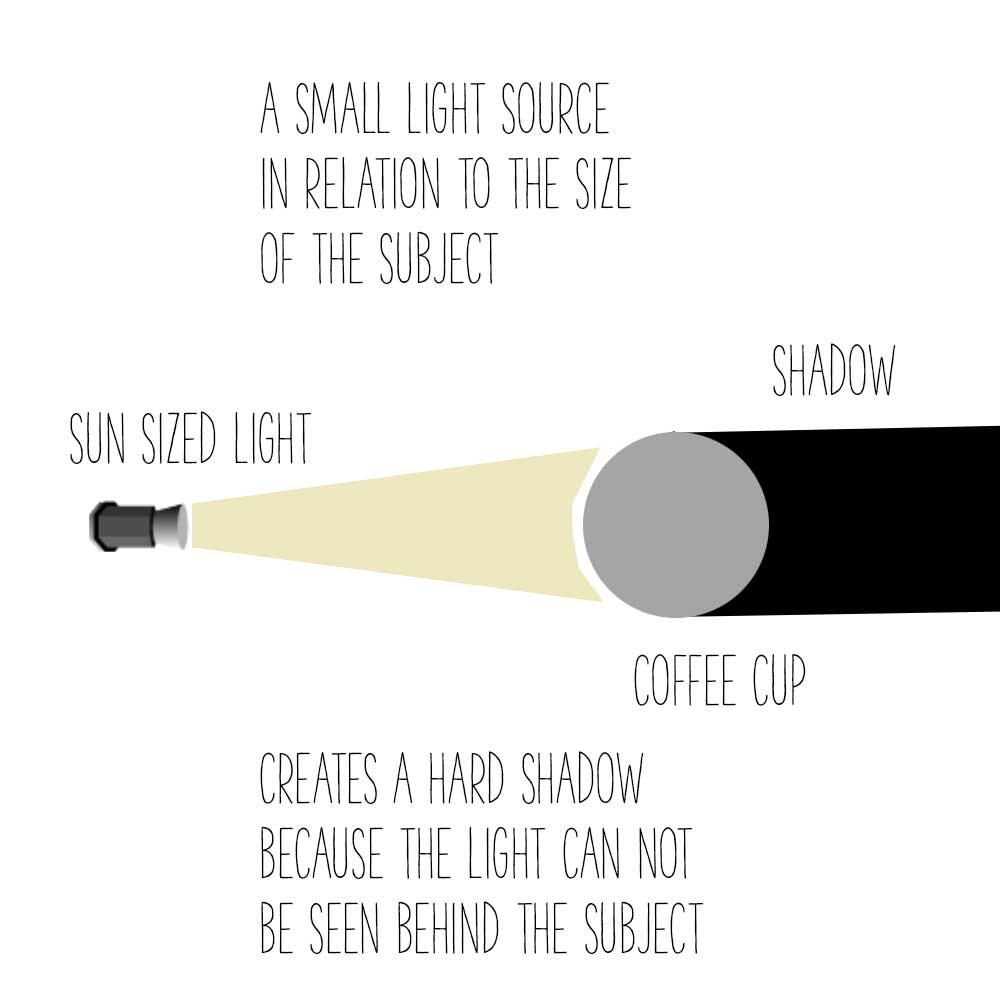
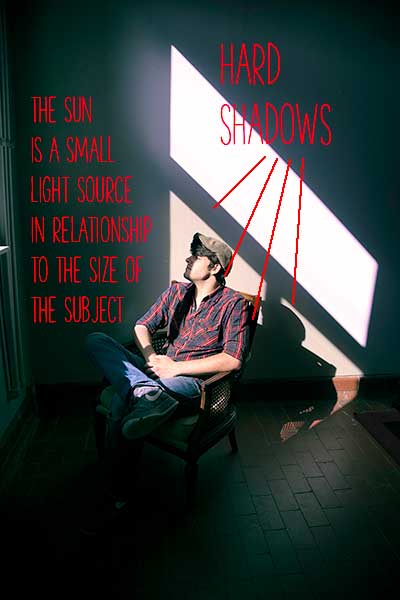
The sun is a tiny light source. (Yes, science nerds it is way huge, but I am talking about from where we look at it.) No more than a coin in the sky.
That is a very small light source. And it can be totally blocked out by the smallest of items: a branch, or a rose, or even a butterfly. That means that the light cannot go around the subject and is instead blocked by the subject.
Here is the equivalent of the sun in the studio. A small, unmodified light at a distance from a coffee cup.
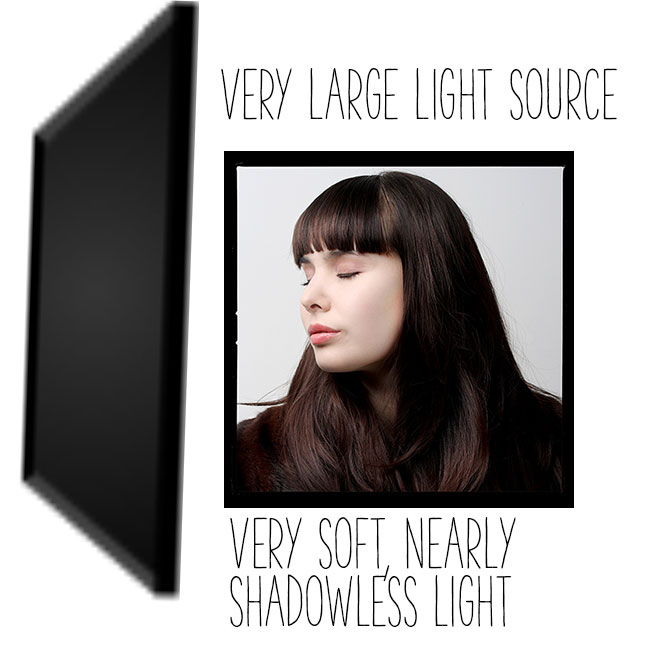
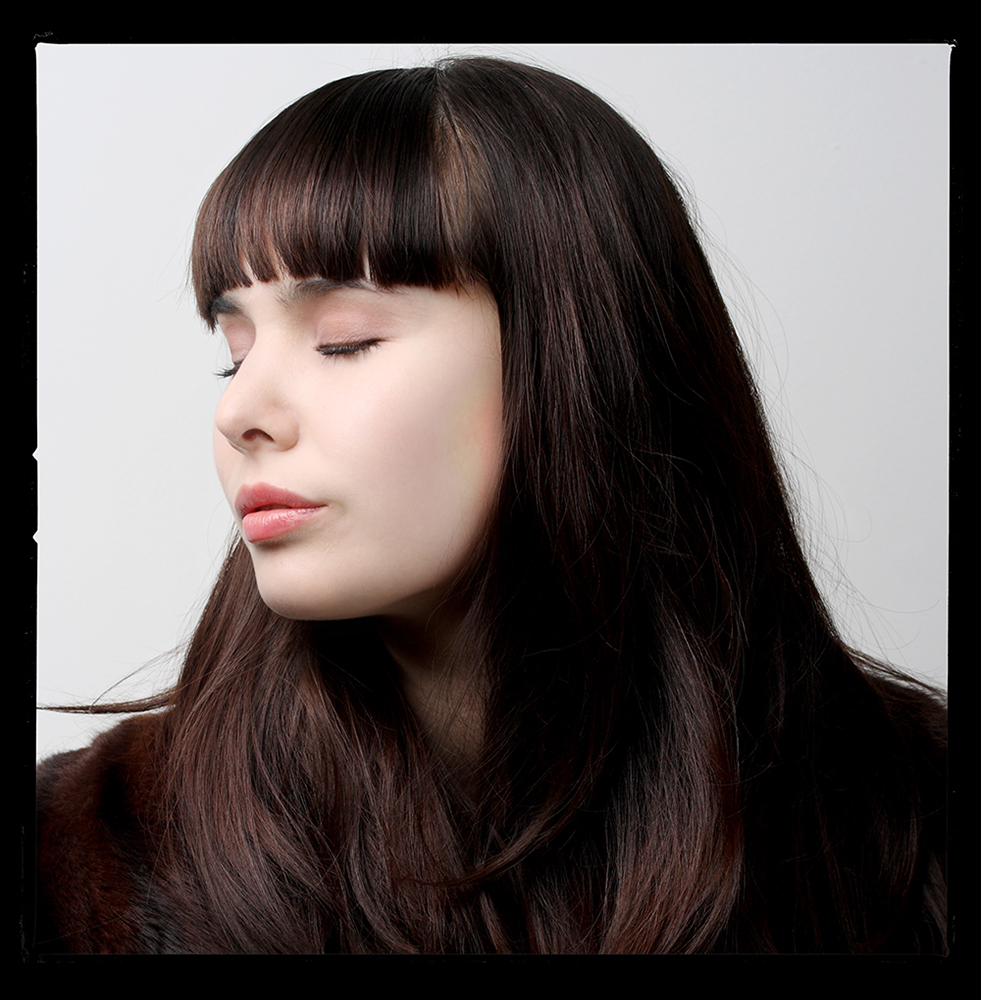
And here is how the shadow falls on a small coffee cup when a very large light is applied. The light wraps around the coffee cup because the light is so much larger than the subject.
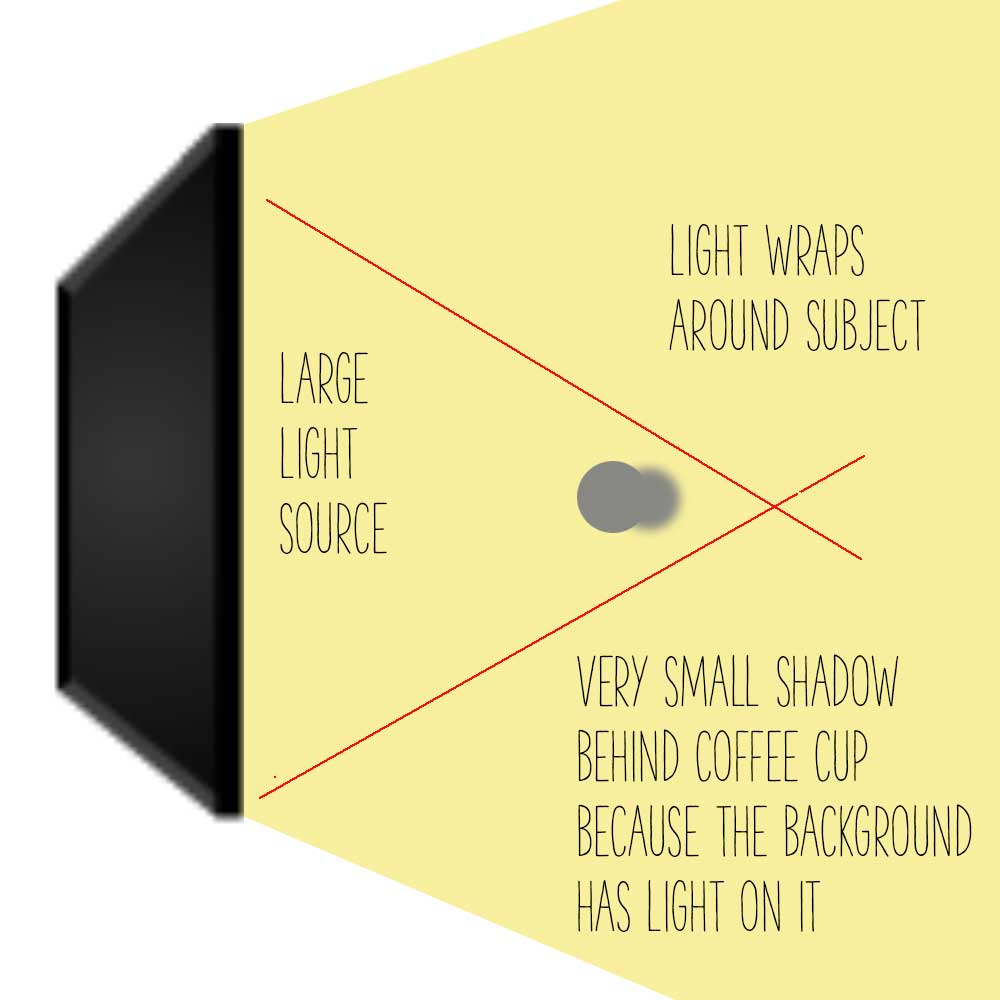
That is how the sun works as well.
The sun is the very small light source, and when the clouds come over the land, the sun lights the back of the clouds and they light the earth with no shadows because they go from horizon to horizon. Light is wrapping all around all the subjects it is seen by.
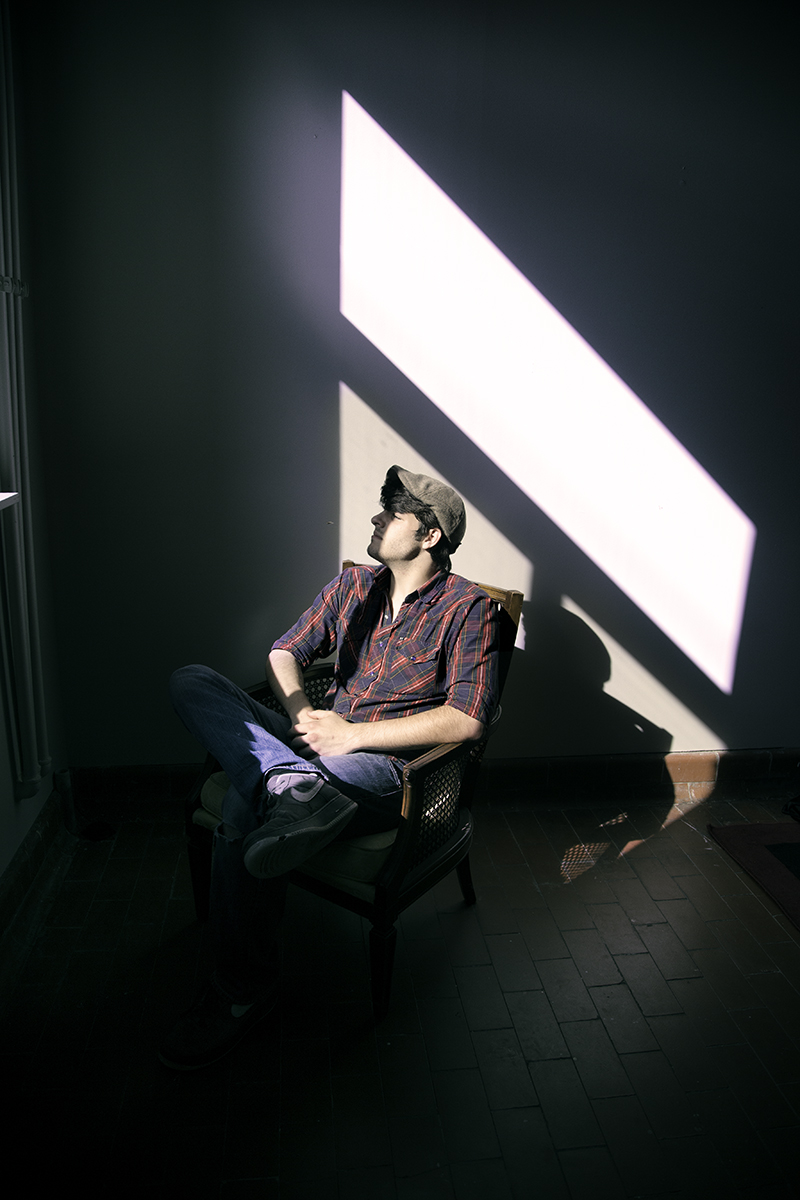
Think of your softbox as a “cloud cover” for your light (the sun) and it makes more sense to you.
Question: is a 4’x5′ softbox a large softbox or a small softbox?
The answer is compared to what? Other softboxes? Yes.
The subject? Well – that depends. What is the subject?
If the subject is a Hot Air Popcorn Maker, then it is indeed a very large light source.
If our subject is a jetliner, then no – it is not a very big light source at all.
And then… how far will it be from our subject?
Distance makes the perceptual size of the light source diminish as it gets farther away. And it is that perceptual view is the one that matters.
A 20″ light source very close to a 1″ watch is a large light source. A 72″ x 72″ source far away from a 14′ square box is a small light source.
And the light will render that way as well.
LIGHT DOES THE SAME THING EVERY TIME – IT IS THE SUBJECTS THAT CHANGE THE GAME
ASSIGNMENT FOR THIS CLASS:
- Choose a subject less than about 8″ – like a shoe or a water bottle. Light it with a small light source (speedlight) to see how the shadows fall. Then light it with a softbox (24″ or so) in close. Very close.
- Move the softbox 6″ away and take another shot. Then do it again at 6″ intervals until the softbox is 6 feet away. Notice the changes in how the subject responds to the light, and how the shadows get sharper and deeper.
The size of the light source in relationship to the subject is one of the four principles of light.
The Lighting Essentials Forum Rocks Another 40 Hot Images
John Groseclose shot our cover this post. Fitting, since John and I are teaching a CLS (Creative Lighting System) workshop tomorrow at my studio. It will be an event to remember. For me anyway... for a lot of reasons. If you want to know all about how incredible the...
Tom Miles, London. An Interview with an Editorial Photographer
Tom Miles joins us for an LE Interview that I know you will find fun and inspiring. August is traditionally a slow month for me, but not this one. Big event taking place all month (secret - you'll have to wait) and it is keeping every spare moment filled. Seriously....
Trust the Model – Part Two
Briana is back with part two of her article, "Trust the Model" and I am sure it will be of high interest to many of you who are starting down the road of fashion, beauty and editorial photography. Briana's take on the other side of the lens is kinda fun and brings...
Chris Bohnhoff: Interview with a Minneapolis Photographer
Welcome to Lighting Essentials interview with Minneapolis Photographer Chris Bohnhoff. I was cruising from a site I can't remember, and found Chris's photos. I really like the style and the interesting way he photographs food and people. I hope you enjoy his work and...
Model Behavior: Trust the Model
She's back - due to popular request. Briana has a new article on Model Behavior. She calls it "Trust the Model". Thanks Bri, for the article. On the Lighting Essentials front, it has been pretty hectic lately. I have several things to review and will get them reviewed...
Create an Antique Camera Look for Your Images: Photoshop Tutorial
We have been looking at business practices for a while now, and I have had some questions about the Photoshop Processing on a few of my recent images. I thought it may be a good idea to show a Photoshop Tutorial on how I create the Antique/Old Camera look. For those...
10 Web Site Strategies for Emerging Photographers
10 Website Strategies for Emerging Photographers As a photographer and web designer, I really believe that the website should be a vehicle for making business happen, and connecting with clients and possible clients, not just an online brochure or replica of a print...
Twenty+ Non-Photographic Essentials For Location Photography
We all know about checklists for our photography gear. Making sure we don't get 50 miles out in the desert and find we forgot our tripod mount, or sync cord, or stands or worse. Much worse. I have a checklist that I go through, and I also have started to keep packed...
10 Pricing Challenges and Strategies for Photographers
Let's start out with a universal truth. A digital photograph costs nothing. Nothing to make, nothing to store, nothing to transfer and nothing to see. Before you hit the computer and spit out your soda, I am obviously not talking about the gear and lenses and lights...
An Interview with Photographer’s Portfolio Consultant Selina Maitreya
Today is something special: an interview with Selina Maitreya, Portfolio Consultant and Photographer's mentor for nearly 30 years. Selina has been a photographer, a photographer's rep and a champion for style and substance in photographer's portfolios through her...
10 Things You Can Do Right Now for Your Photography Business
Today's post is on your business and your attitudes. Ten Things to Do Right Now for Your Photography Business These are slow times for a lot of photographers. I believe they are temporary, and will depart, leaving those who are still standing in a great place. But the...
Protected: Shooting for Your Portfolio: Presenting the Work
Password Protected
To view this protected post, enter the password below:
Style: It’s Not What You Shoot. It’s How You Shoot It.
Creating a Portfolio: What you shoot vs How you shoot what you shoot. Three exercises to sharpen your attention to style. One of the most difficult and challenging things we deal with as photographers is style. It is a defining point of our work. It is one of the...
Preparing Yourself for “Getting Out There” as a Professional Photographer
(This is part one of a continuing series on starting out in the world of commercial photography. I am a commercial photographer, not a wedding shooter, but most things would be similar in that genre as well. ) Even in these uncertain times, there are those intrepid...
Still Life Shot for an Magazine Ad
Well, my Volleyball client needed a new ad. That's great. We needed it to be concepted, shot, and produced in one day. A day that had me doing other things as well. Stressful? A little, but I have been at this game long enough to know that it will get done. It always...
Grant Lovett: Fashion and Music Photographer in Nashville – an Interview
Working in Nashville means music, fashion, celebrities and more. And Grant Lovett is in the middle of it. A soft-spoken shooter with a deep portfolio, Grant keeps the bills paid with shoots of musicians and fashion models. We have an interview with him that you will...
40 Portraits from the Forum
We are back with another post from the Forum. 40 portraits and a few extras. 40 wonderful portraits with some interesting lighting, concepts and presentation. I am in Omaha today for the second day of the workshop. Looks like we may have a weather challenge. But,...
Adding Texture to a Portrait for Added Drama
We haven't done a lot of Photoshop tutorials on LE, but I plan on doing more. The amount of requests I have been getting tell me that there is a lot of interest. And we will be responding. This tutorial shows you a simple way to add a texture to an image. As with...
Interview with Kirk Tuck, Austin Photographer and Writer
This post we get a glimpse into the working world of a commercial photographer. Sometimes referred to as a generalist, a commercial photographer must be able to handle a lot of different idioms when working in a smaller market. Portraits, fashion, still life, food,...
Strobe and Ambient: Finding the Mix for Portraiture
I get asked a lot about how my methodology works. What am I thinking about when setting the light? How do I know what the settings should be. For this post I have pulled some shots from last years workshop tour. I will explain the exposure planning as we go along....
Creating a Dramatic Dance Shot with a Speedlight and the Sun
I thought I would break down another shot I did that involved pre-visualization, overcoming a challenge and using small lights for a big light look. The shot was for a dance Calendar for Briana. In the calendar images she presents 12 different types and styles of...
Creating an Ad From Layout: Shooting for Print
This post looks at creating an ad from a very simple layout. The client, Dimensional Software in Palo Alto, CA, needed to have an ad produced in nearly no time. An opening in a magazine came up last minute and a fax was sent to me with a sketch of the ad that we had...
Interview with Steve Korn, Seattle Photographer
This weekend's interview is with Steve Korn, a photographer and musician living in Seattle. I think you will find his work and his words interesting. Being a creative person in music and photography can bring a different perspective to things. Steve presents his work...
Thinking about Portraits: 6 Studies in Beauty
This post is about portrait lighting and some of the things I think about when shooting a portrait... whether in the studio or on location. The shot above was done in Mexico at the Workshop in April. Christine had been walking with me and when she turned to talk to me...