
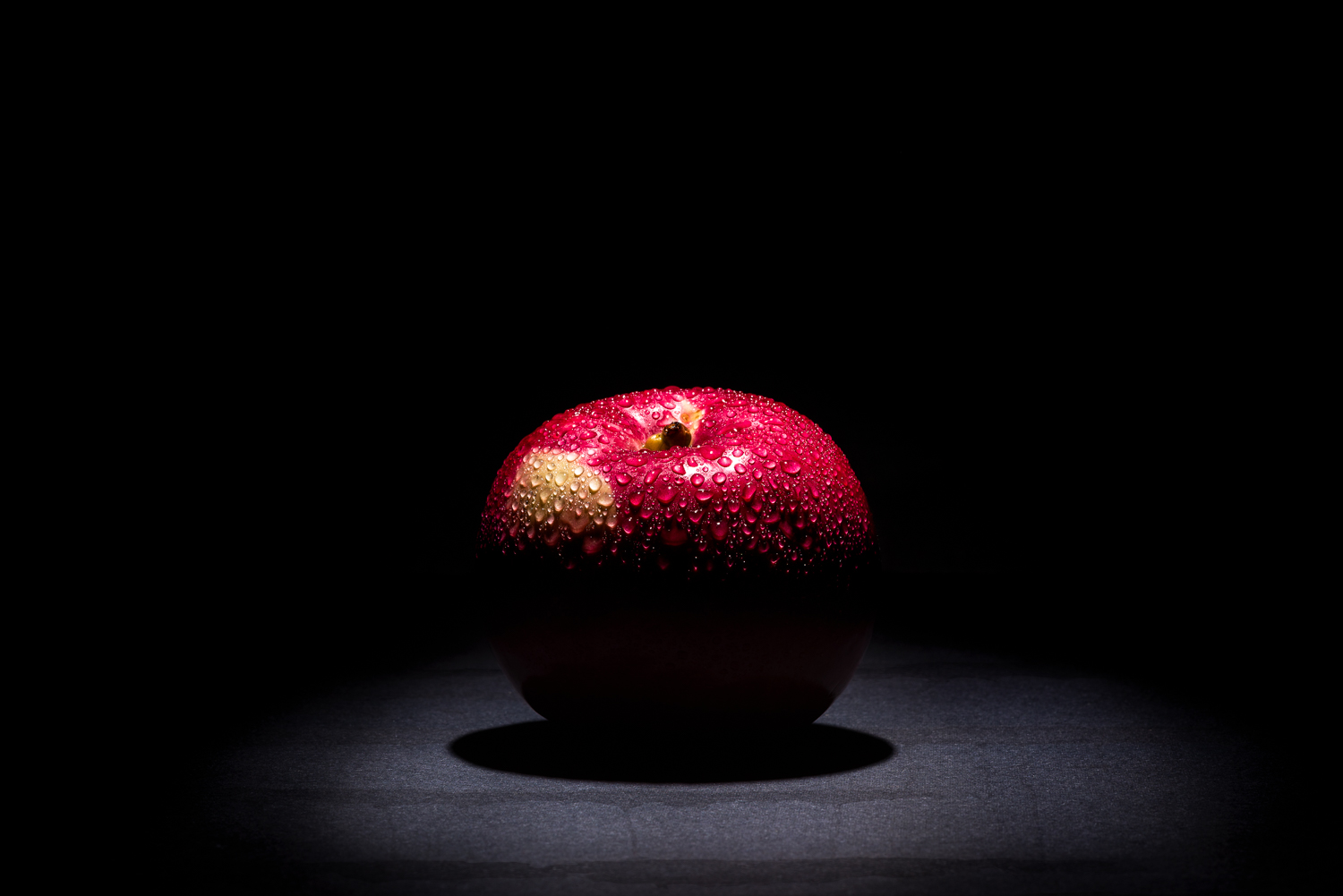
Subject Centric Lighting: The Five Areas of Light Presentation
Cover image by Project 52 student, Gabriel Alvarez.
When the lighting choices we have made are used, the light is ‘presented’ back to the camera in expected, and controlled ways. There are five parts of the light presentation, and we use them in every image we make.
True Subject Value:
What the subject looks like when not in specular or shadow, this is the area that shows us the color of the subject as well.
Specular:
The exact or absolute reflection of the light source.
Specular Transition:
The point where the specular reflection transitions to the true subject value
Shadow Transition:
The transition between True Subject Value and Shadow
Shadow:
The places on the image that are not lit, the opposite side of the light source.
These areas of light are found in nearly every subject. By understanding what they do, and how they are controlled, we can understand much more about the light that is used to present these areas in the ways we want to show them.
In other words, knowing what causes a shadow transition, how to present true value, and how to control a specular highlight means we have control over our lighting and we can create the looks we want. Whenever we want.
Photographers and artists use these representations of light to show texture, shape, dimension, color, clarity and mood. Illustrators use highlight and shadow in their work to create their own light. And they use the same tools to light their drawings, although quite imaginary, as photographers do.
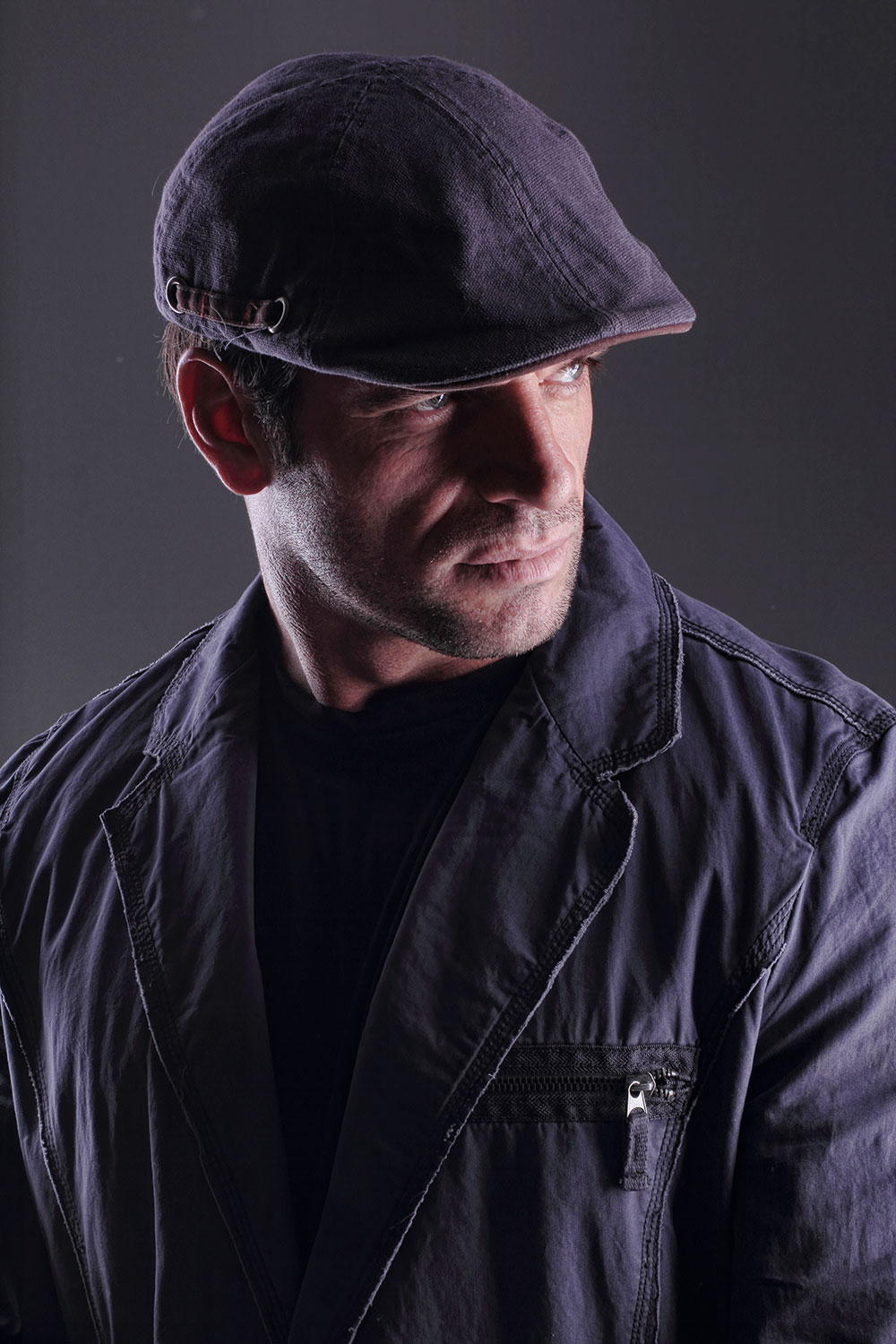
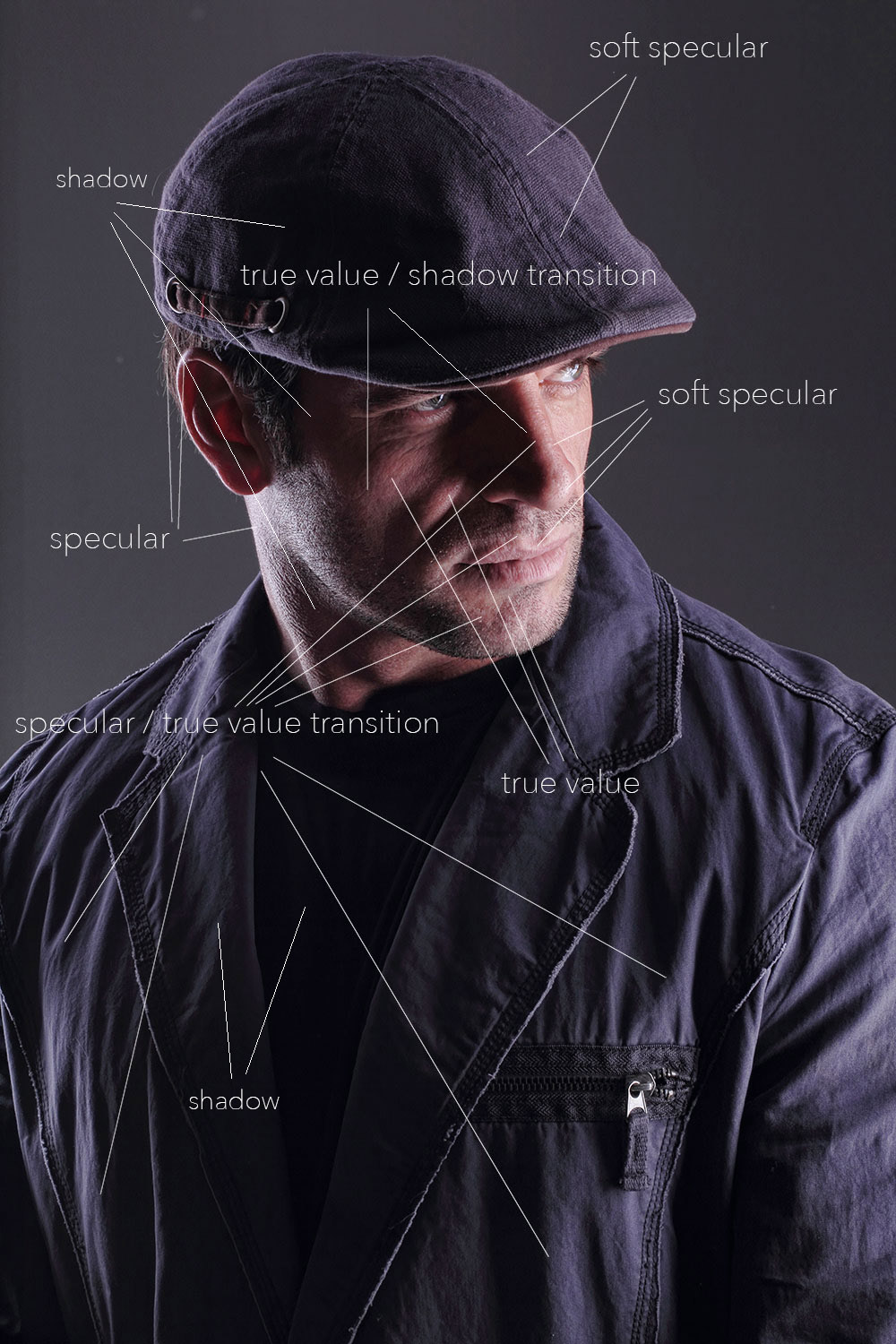
We can see all the presentations of light in this image of Inaudia.
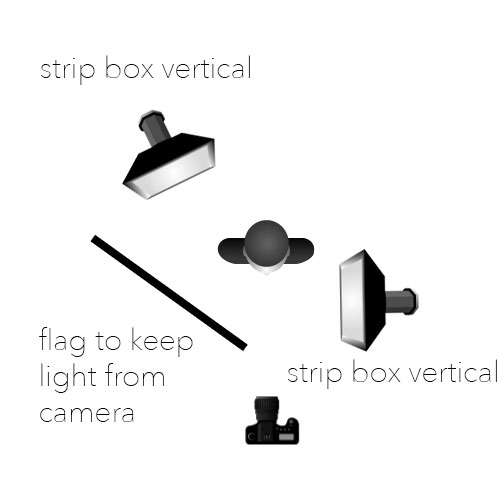
Lit with two strip lights (one on each side), the one on camera left is behind Inaudia and aimed forward just bit. The one on the right is slightly in front of him, and angled at an oblique angle.
This renders two different kinds of specular presentations, the absolute one on his neck and left side, and the softer one on the right side.
All of the transitions are there, and these transitions are what we see when we are determining soft light from hard light. A fast transition is a hard light, where a softer transition – as in the picture below – is a softer light. We would call this image a hard light image because of the fast fall off in the transitions between highlight and true value, and true value and shadow.
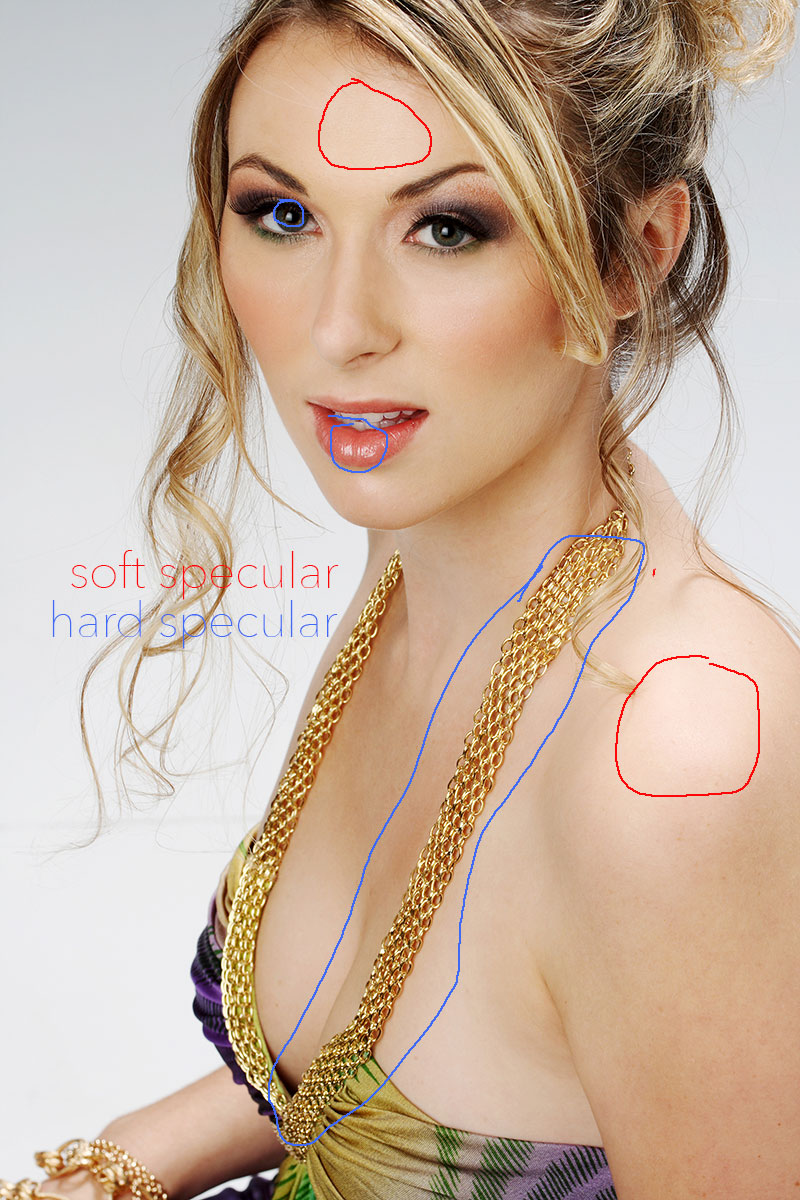
This image shows a lot of true value skin tone. One of the reasons is that the model is not shiny (wet) or perspiring to cause a shinier surface. Powder is used to intensify the diffuse skin (true value) so the speculars (in red) are presented softly. The blue speculars, however, are presented with very sharp transitions. Note that the specular on the shiny lips is absolute, with no soft transition. The gold jewelry on the dress shows as highlight/black because the reflection of the light source from the shiny metal is absolute.
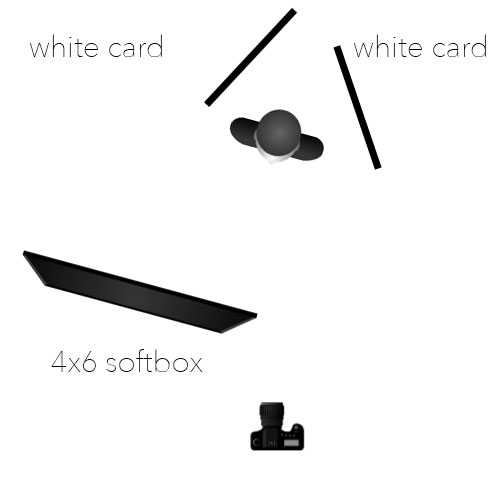
Lighting: Very large softbox directly in front of the model, and back 5 feet. White cards are positioned on either side of her, but pulled back to a point where they will not reflect in her eyes.


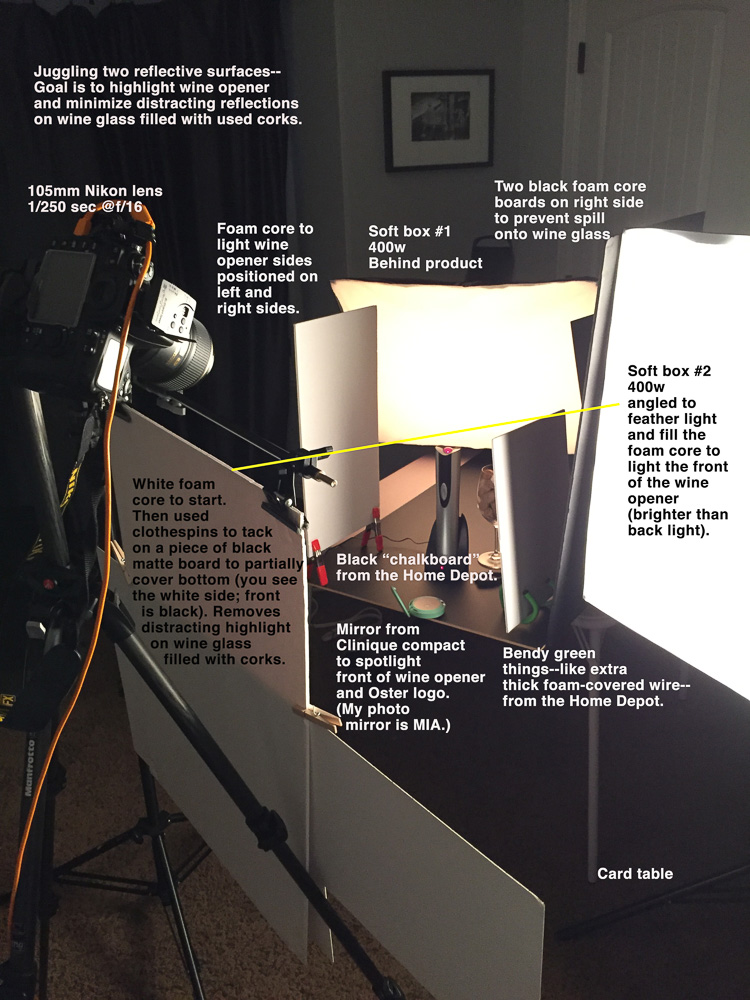
Photographer Anne Stephenson shows how to control the specular, true value, shadow and transitions in this seemingly simple table top product shot. As you can see, nothing done well is simple. Every kind of surface is in this shot.
Let’s start to put all of this together now.
Hey Amazon… REALLY? Are You Kidding Me?
WHAT THE FUCK?. "On March 18, 2014 Amazon Technologies, Inc. (an operating subsidiary of Amazon.com, Inc.) obtained a United States Patent (8,676,045) for a “Studio Arrangement” and a “method of capturing images and/or video.” ibook-store-widgetMany photographers will...
My Favorite Film Cameras and Film Choices
We do so many cool things in P52 and this idea is one a lot of the photographers are picking up on. We are going to have a fun little 'assignment' to shoot 24 frames of film in May. Just 24... but we want all of them to be 'good shots'. What started as a one shot per...
“Air” by Meggan Joy Trobaugh
At the Project 52 2014 group, the assignment was "Air". There were many wonderful submissions. This one by Meggan Joy Trobaugh was exceptional I thought. She carefully planned out the work and made the elements for the final work with a previsualized image already in...
A Fall Workshop in the Canyons Announced
The workshop is a blast. We all pile into a large, comfortable van and head off to Northern Arizona. Our first night is in Flagstaff, then off to the reservation lands of the Navajo, Vermillion Cliffs, Marble Canyon, Kaibab Plateau and more. We spend an afternoon and...
“Black Angels” – An Assignment for a CD Cover
This week the Project 52 PROS for 2014 are working on an CD album cover for a faux assignment. The music is George Crumb's "Black Angels" for Electric String Quartet. It is very challenging music. The students for this morning's Friday class really knocked it out of...
A Life, A Lifetime, and a Tie
John Thomas Banta had over 200 ties. Most were bold, loud, occasionally whimsical and always hard-to-miss. In short, they were very much like him. He dressed for occasions, often wearing his wildly interesting ties. And he lit up the room with his presence. He was a...
Is Giving One’s Images Away for Free a Brilliant Marketing Move?
... or a very very bad idea? Trey Ratcliff (Lost in Customs) has always given his images away on the Non-Commercial Creative Commons License. What is new today is his link to grab ALL of his favorite 500 images for free and download them in full high res form. See...
“What Should Photographers Charge in 2014?” – A Discussion with Rosh Sillars
My bud Rosh Sillars' recent article on "What Should Photographers Charge in 2014?" really hit home with me and a lot of my Project 52 PRO's. Pricing and figuring out what to charge is always a very difficult part of starting a photo business, and Rosh takes a very...
Shooting a Beer with Rui Bandeira
We have so many talented people in the Project 52 PRO group. Meet Rui Bandeira. He shared this shot with my last night and I knew I had to share it with you all. Here is Rui: "Hi, I had 3 goals for this shot: 1) it had to be fresh and make the viewer desire to drink...
Photoshop Repair: Bri in the High Desert
I like to play around in Photoshop a lot, and when I do I am going to start sharing what I do with my Project 52 Pros. And anyone else who wants to know what I do. I am not putting myself out there as a Photoshop Guru by any stretch of the imagination. I am simply...
WHY I AM CHUCKING ALL MY GEAR AND RETURNING TO SAND PAINTING AS MY VISUAL MEDIUM.
I have always loved sand. When I was a kid I would play in it, except when mum let the cat play in it first, and then it smelled sort of like my little brother, but... I digress. Cameras are obsolete. We hear every day about this new gizmo and that new gizmo, and how...
Project 52 Summer Group Opens For Registration
More Information on this page.
Book Ideas: “What If…”
What if. What if you created a magazine instead of a book? Told a story or two in the magazine, showed a subject in depth, then printed 10 copies for influential art directors in your town and offered all who came to the site a PDF? (Blurb does magazines for as little...
ISLA: A New Book by Ernesto Bazan, Photographer
"No, I don’t [do assignments]. I stopped doing that, more or less, when I decided to become a teacher in 2002. Because of my workshops, I had to leave Cuba in 2006, which is ironic. I fund all my work thanks to the generosity of my students. This will be the third...
What Is The Biggest Problem with Your Photography?
The biggest problem may also be the one that most people focus on. No pun intended. "So let’s get the elephant out of the bag most of you keep it in and into the room where we can discuss it: most people are complaining about their cameras because otherwise they’d...
Photographs = Communication = New Creative
Photographs as communication. The new uses of photography continues to grow. "It’s not that my memory improved but, instead, that I started archiving these events and ideas with my phone, as photographs. Now, if I want to research the painter whose portraits I admired...
Omaha
I have been asked by Christopher Tierney to come out to Omaha for a workshop. I have not done workshops for a while, but I really like the midwest and look forward to spending some time there. REGISTRATION PAGE IS NOW READY. For more information, please click on the...
Documentary Photography with a Fresh Twist
PHOTOGRAPH BY MICHAEL DAVID FRIBERG Michael Friberg and Benjamin Rasmussen find a fresh way to explore the conflict in the Middle East. Part reportage, part editorial, they create a powerful new way of communication on a contemporary problem. “The way that we shoot...
The Last Project 52 Assignment for the 2013 Group
"Cooking With Chili" is the name of the faux cookbook. The assignment was to shoot to the layout. The students did a magnificent job with this, and I want to share the work with you all. You can see the layout, and it was provided as a layered PSD file to the...
Irene Liebler’s “Cooking With Chili” BTS Work
Irene Liebler is a photographer/designer in Connecticut. She is also a Project 52 member and has developed quite a unique style. This is a recent image for an assignment on P52, a "Cooking With Chilis" Cookbook Cover, shot to layout. In this post, she walks you...
Art And Its Detractors
"How has your art been received in your community? Do you have any detractors?" "Oh, yeah. That comes up all the time. If you really, really commit to something, someone will hate you for it. And that’s ok. But the further you pursue your art, and the more you come to...
“NO” versus “YES” – Which Got The Most Response?
On the previous post I mentioned, almost in passing, how negative articles and stories are more highly engaged than are positive ones. A few minutes later, this catches my attention: Just Say NO "So, one answer to my student’s rhetorical question is “Just say NO.” As...
On Change Changing What was Changed…
... or something. My friend Jan Klier (NYC) and I were discussing the recent Getty move to grant access to millions of images for only a byline. He feels it is a good move for photographers, and while I am still somewhat ambivalent we both agree that the worst thing...
Chocolate: Two Shots
Photographer David Price shows us two ways to light chocolate. In the first shot, he is using a very large light source. The source is above and behind the chocolate, and that masks the individual color of the items. This is because the specular - the reflected light...