
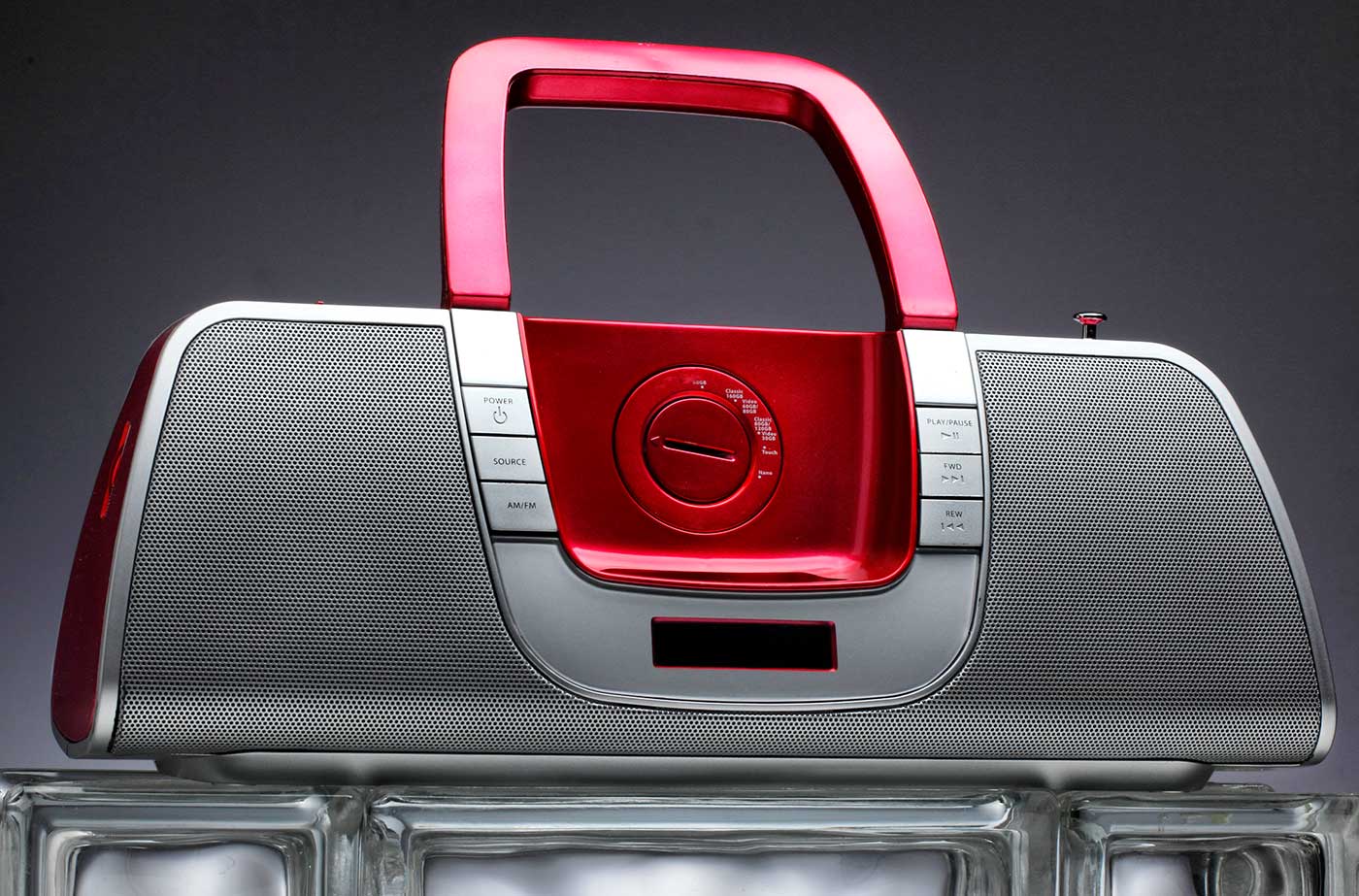
Lighting Principle Number Four: The Angle of the Light to the Subject and the Camera
Law of Physics: Angle of Incidence equals the Angle of Reflection.
This is an axiom that a lot of people hear and repeat without taking careful note of what it means to their photography.
And yet it is one of the most basic and important physical rules of subject centric lighting.
What does it mean and how can we use this to our advantage?
It means that if the light is angled toward a subject, the reflection of that light will be presented back to the camera at the same angle.
Think of the game of billiards or pool. If you hit a ball into the wall at a 30% angle, the ball will come off that wall at a 30% angle. And that completes a triangle. Understanding that triangle is key to making quicker, smarter lighting decisions.
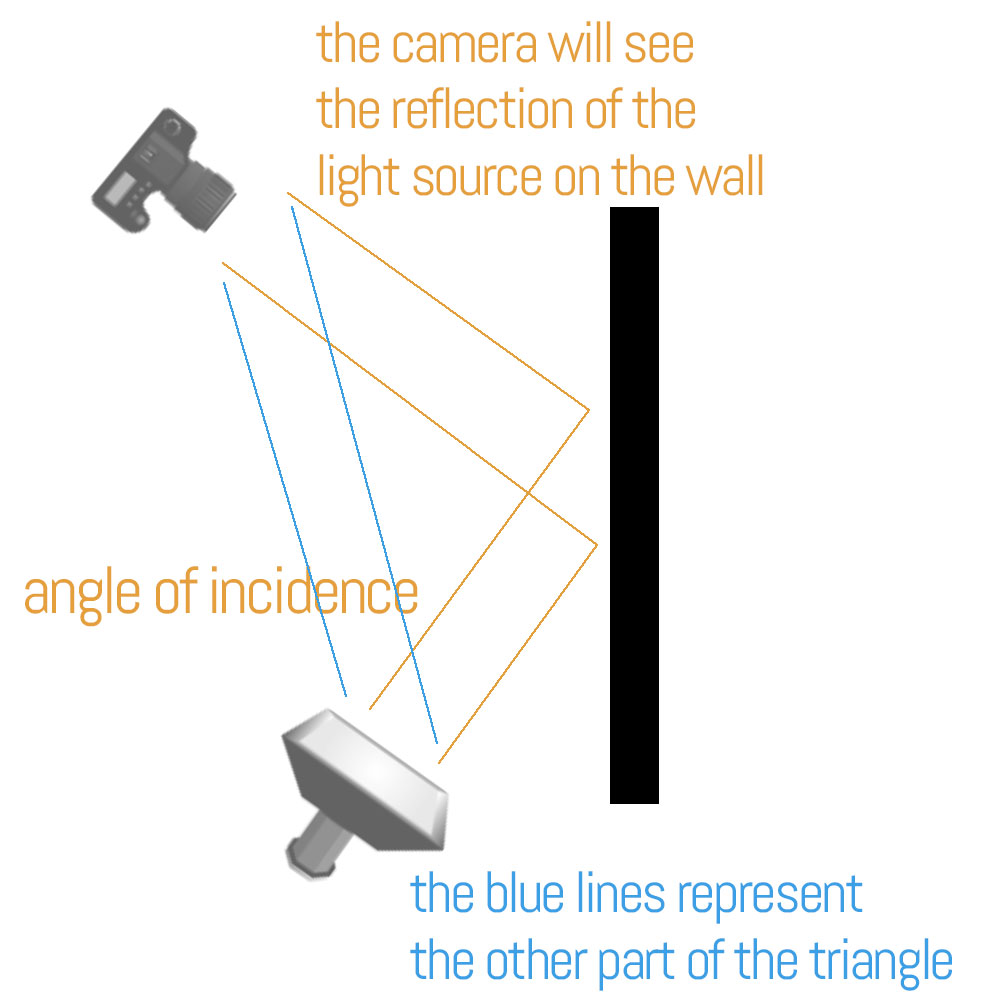
It means that you have to be able to judge the angle of the light as it strikes the subject and understand what that light will do once it strikes the subject. If there is something being reflected in your subject, look at the camera angle from the other side and you will find what it is.
EVERYTHING REFLECTS. EVERYTHING.
Some things reflect more than others, but everything you see is simply the reflection of the light from its surface.
I call it ‘presentation’, and when I discuss lighting, I use the word presentation to talk about how the light looks to the viewer.
Once we realize that the angle of the light source to the subject, and the incident angle of that light source to the subject is going to present to us in ways we can control, lighting becomes so much easier to create.
Think of the way the light strikes hair on a slightly backlit portrait. The reason the hair becomes so much brighter is because it is round in shape, and somewhere on that round, shiny hair is going to be that same angle of incidence that the camera is seeing.
An example.
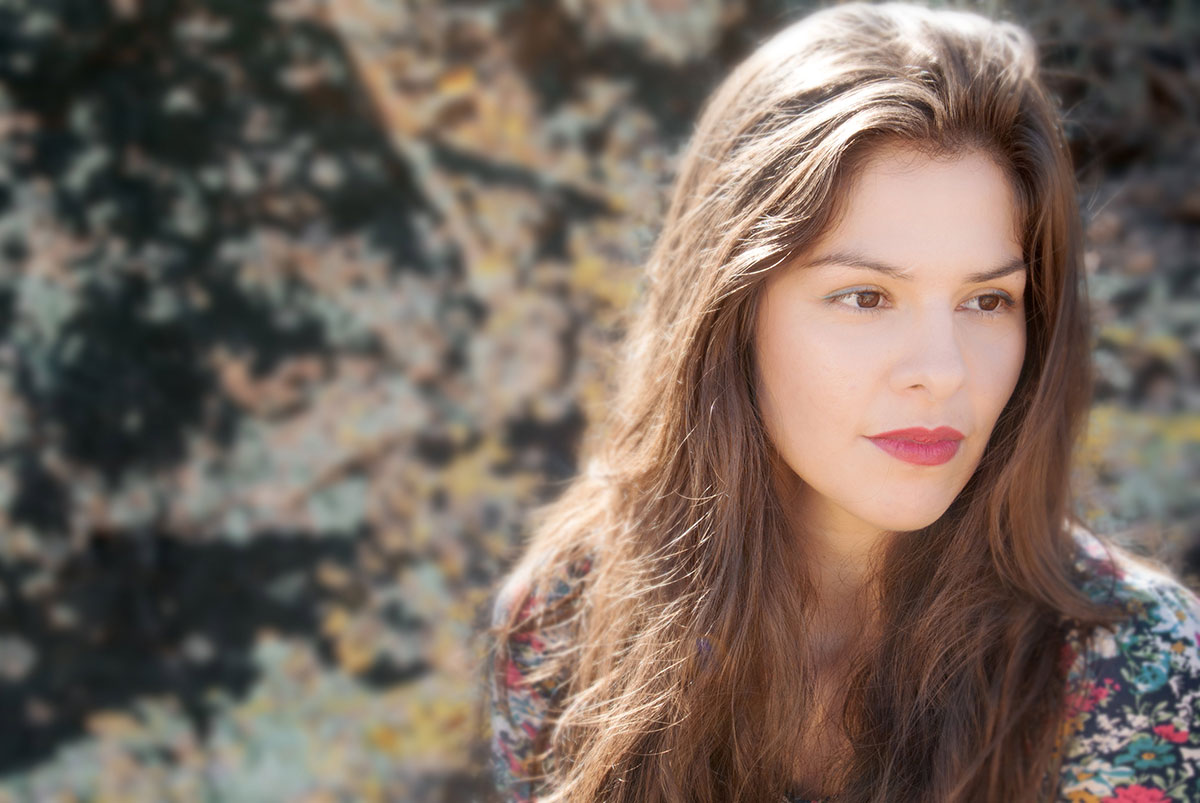
You can see how bright that hair is with the sun shining on it, and each tiny hair reflecting that sun back to the camera.
In the image below, I used a large softbox in order to get a shiny, reflective area off of the wall behind the subject and create a gradient to the background. You can see in the illustration that the angles of reflection come back to the camera on the left side of the model, but not on the right side of the model. The wall is a semi-gloss wall and provides a nice, soft reflection of the light source.
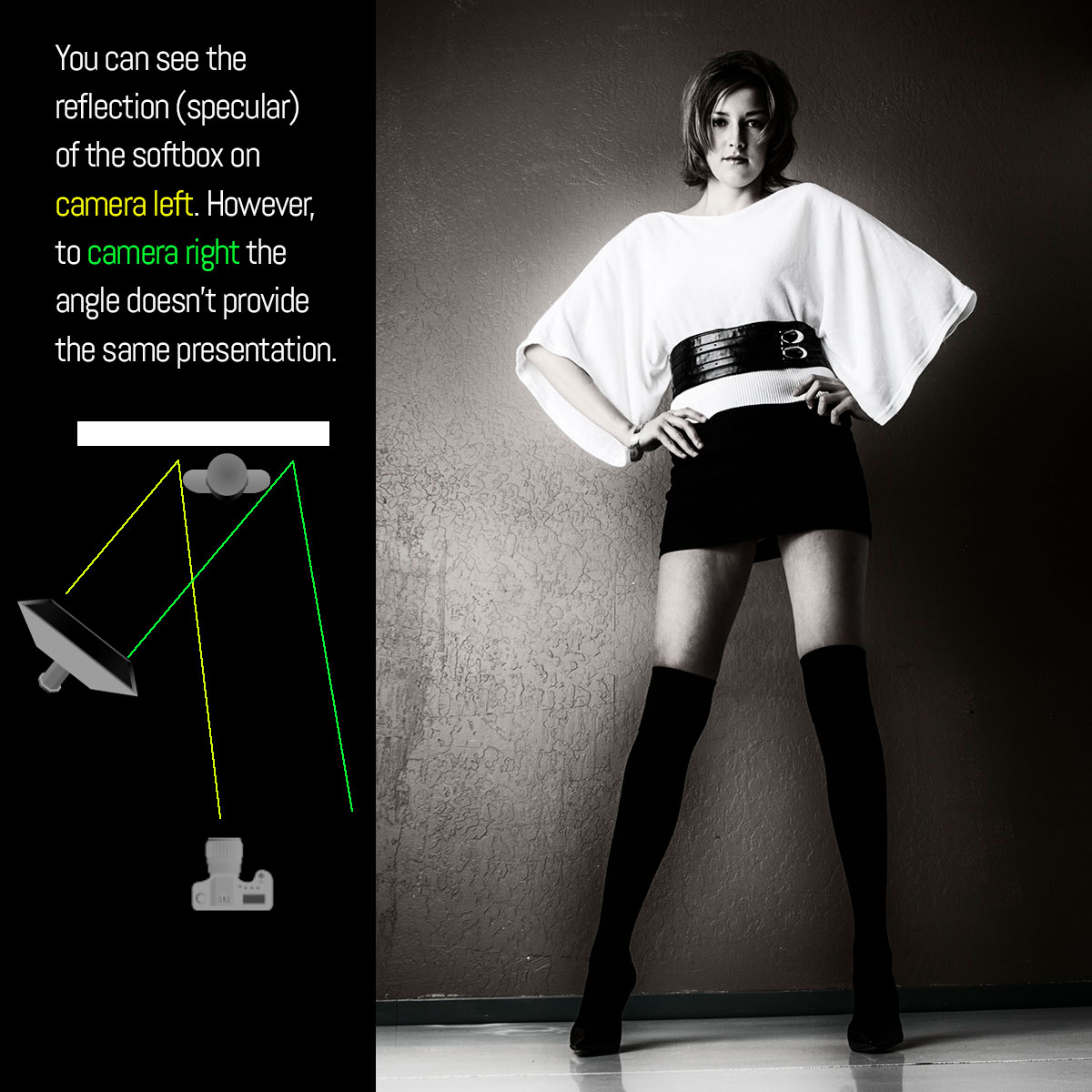
Let’s take a closer look at that triangle that is formed by the light to the subject, the subject to the camera, and the light to the camera.
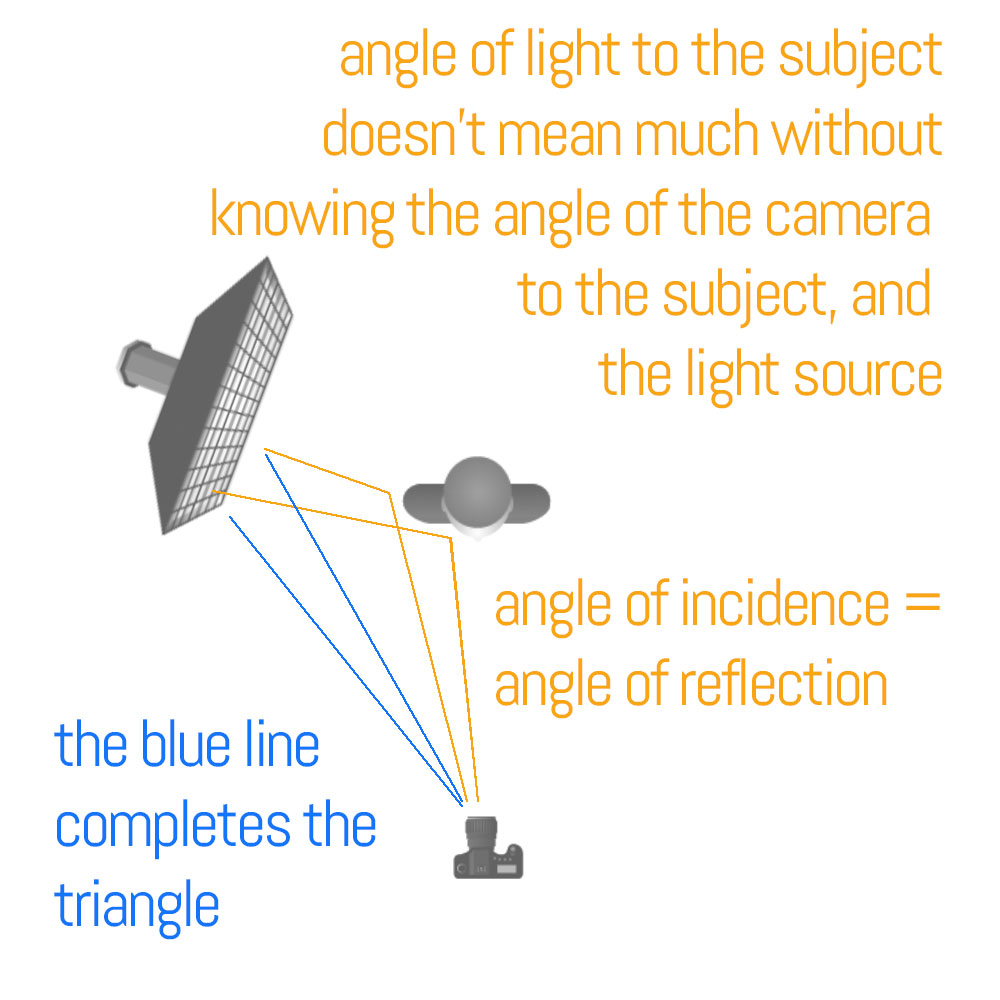
It is being able to see that triangle (shown above with the blue line) and to then visualize the presentation of the light that makes it easier to control. Once you begin to see those angles, and the way they will present back to the camera, lighting can become much more of a finessed technique rather than a flailing exercise.
Let’s talk about direction.
There are three major directions of light and one that doubles as a direction. I will explain.
This is front lighting. The light comes from the side of the camera, and it can be angled quite a bit (90 degrees). The presentation is full angle of incident / angle of reflection, and you can control that fall of incidence by where you place the camera in relationship to the light and to the subject angle.
Front light:
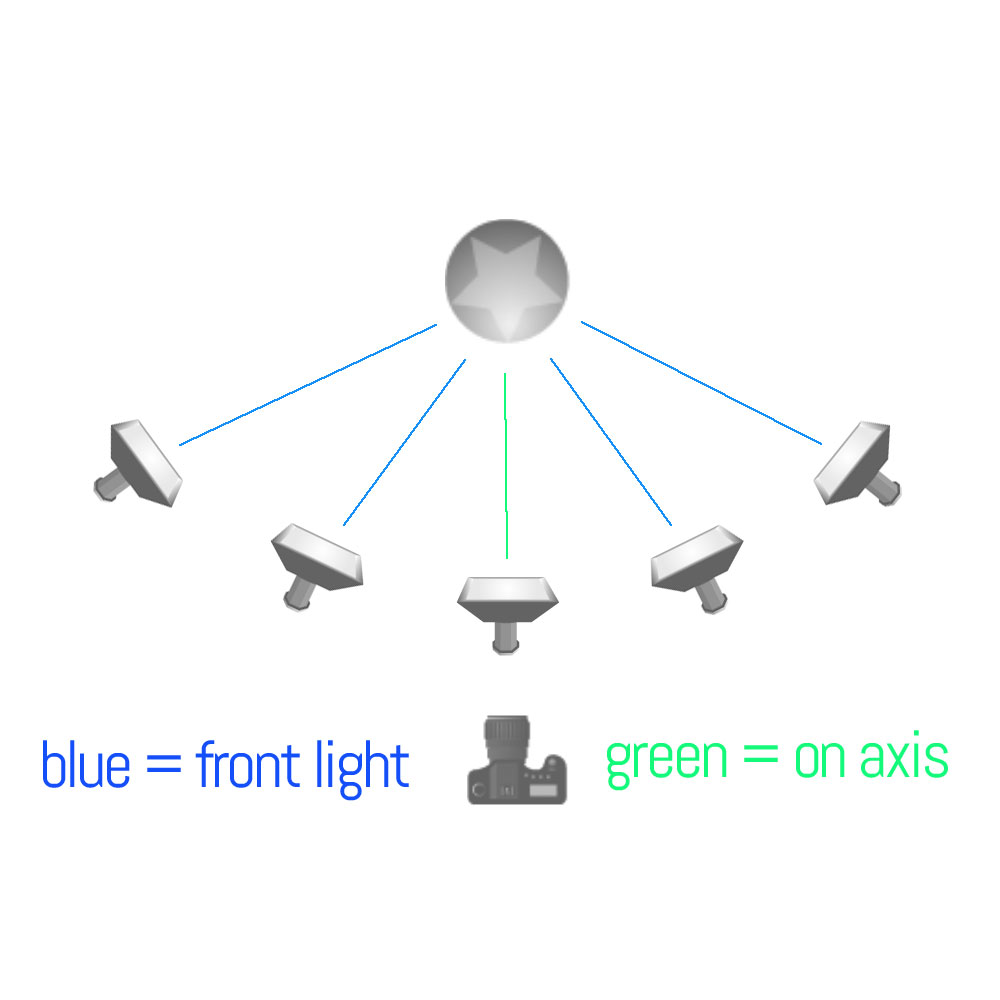
You can see that from right to left there is 180 degrees of placement that will allow you to have front light. There is one point in the middle, however, that is at the same angle as the camera. We call that “on-axis” lighting and is a favorite of beauty and fashion shooters.
On-axis lighting is from the position angle of the camera to the subject, not necessarily at the distance of the camera. That means there is no triangle (horizontally) from light to subject to camera. As you can imagine the reflection is straight back into the camera. A wide, soft light with few shadows.
In the diagram below we see side lighting and backlighting. Side lighting is as its name suggests, directly from the side of the subject creating a 90-degree angle to the camera angle.
When we move the lights farther back from sidelighting, we have backlight. Backlight has all the same angle variations as does the front lighting.
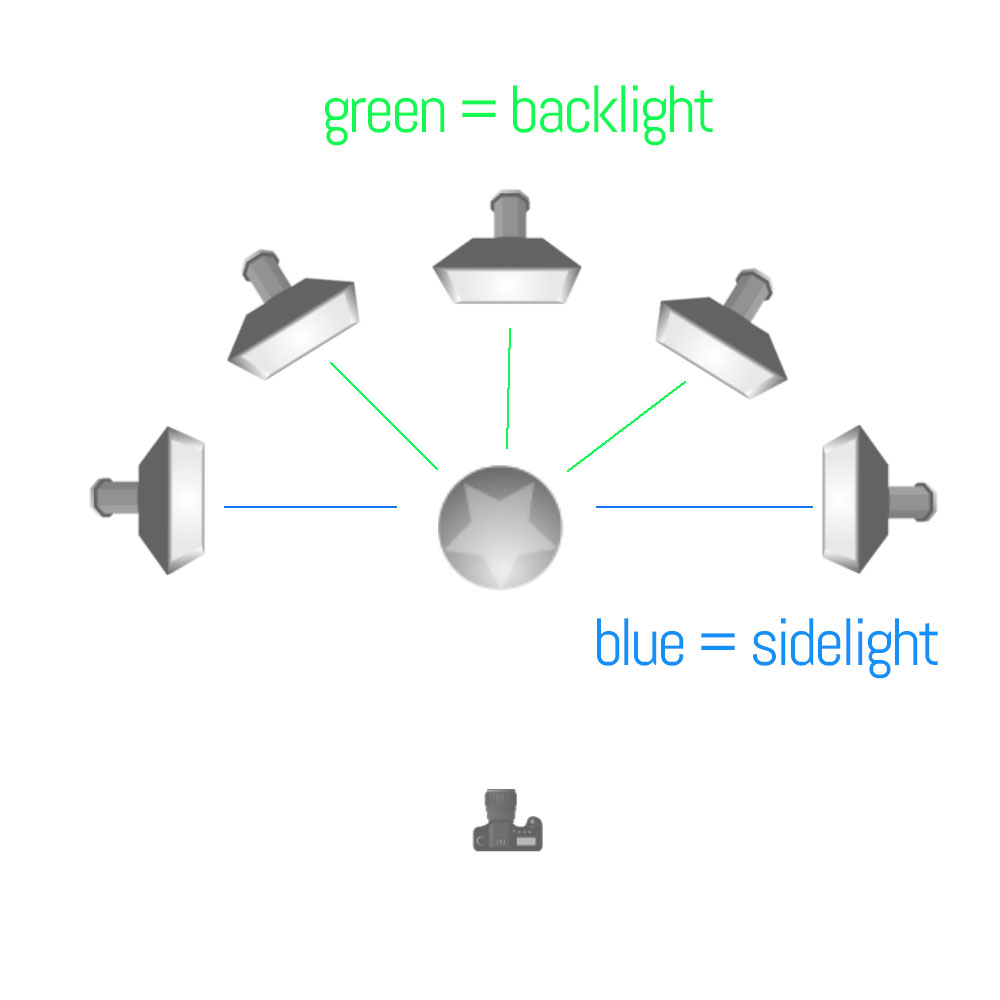
Top lighting from directly above is the same as side lighting if it is at a 90-degree angle to the subject/camera. If it is slightly in front it is front light, and slightly behind it is backlight.
Front Light One
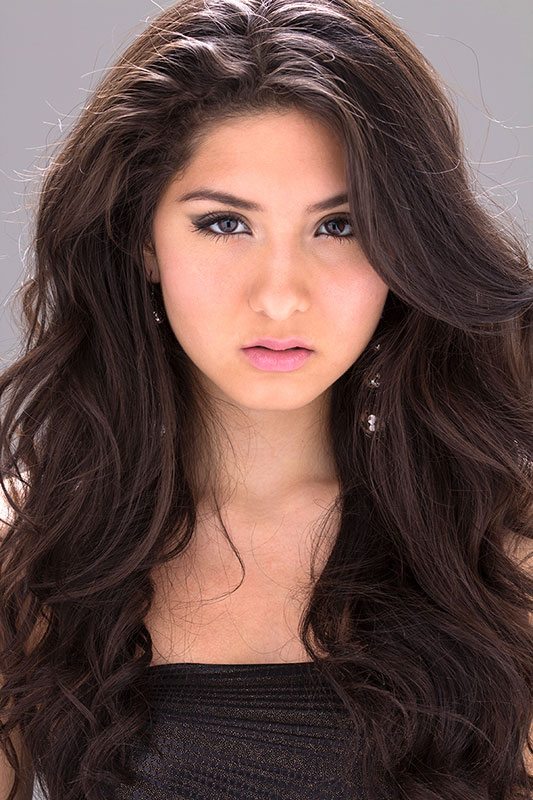
Front Light Two
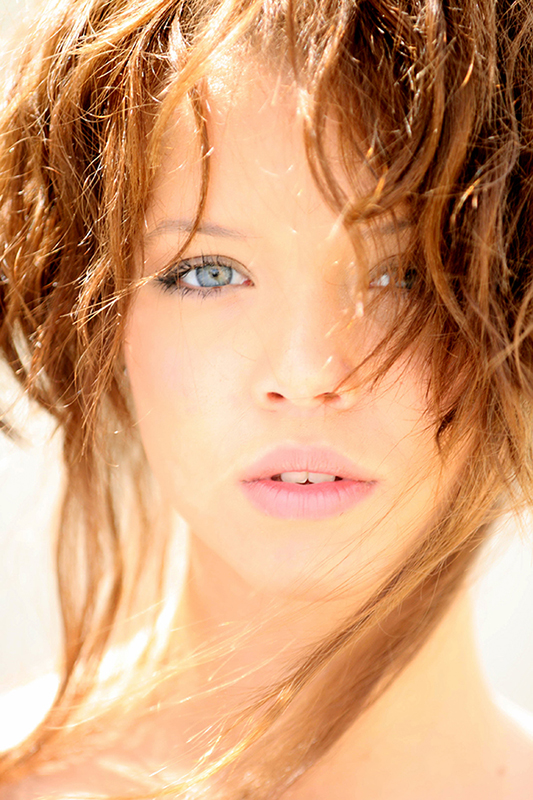
Side Light One
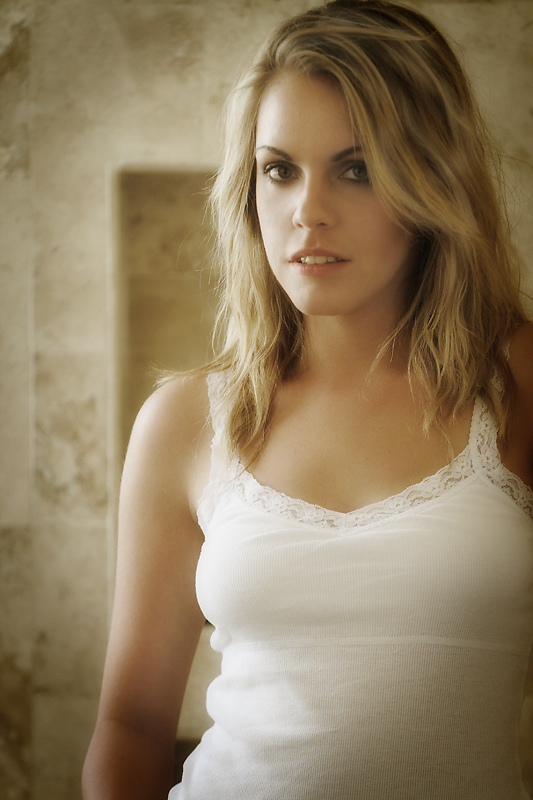
Side Light Two
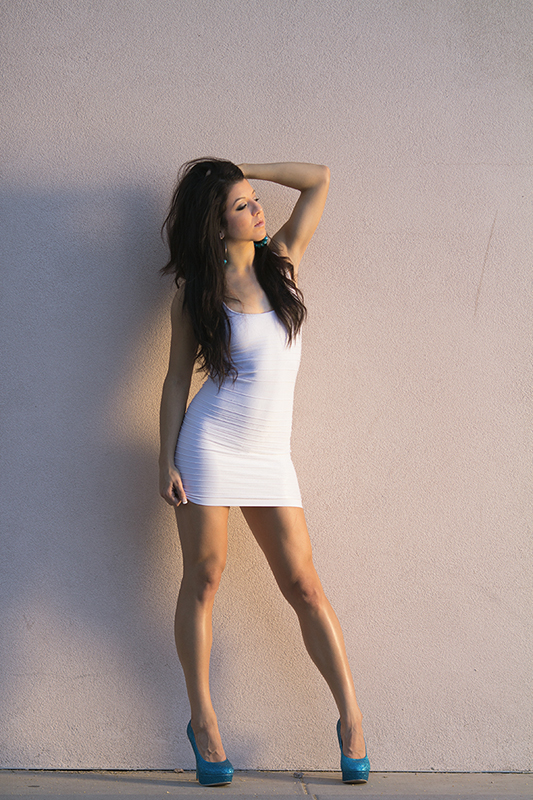
As you can see above, the angle of the light to the subject, and to the camera, makes a big difference when you are working toward making the shot look a specific way.
Let’s wrap it up:
The four different properties of lighting are:
- Size of the light source in relationship to the subject.
- Distance of the light source from the subject.
- Color of the light, and its relationship (if any) to the prevailing ambient.
- Angle of the light source to the subject, and to the camera.
And NONE of them are the most important – they are all equally important. We don’t think of them in an hierarchical way, we think of them in a holistic, symbiotic way. Change one, you may have to indeed change another. Change that one, and you may have to alter two others to make it work for you.
All of this only matters to you if you know what you want your image to look like. Do you want soft light, or do you want hard-edged light? Do you want a mixed light image that looks natural, or do you want to play with color temps in a creative way? If we move our light closer or farther away, what does that do to the look of the image? Do we need to bring out texture, or is a flatter look our goal?
These questions are usually not asked in order in our brains. All of them are asked at the same time, and we react to these creative decisions by utilizing the tools we have for creating them.
And now, with these basics, we can begin to create the images to present OUR vision of the subject in front of our lens.
ASSIGNMENTS:
- Find a subject that allows you to move around it and make images from all the different lighting positions. Do this either early in the morning or late in the afternoon so the sunlight is closer to your head height to the subject.Shoot front light, side light, back light, axis light. Study the images to see how the subject changes in the different lighting positions. Print the images and make notations on how it, and the background, look to you. What changes do you see?
- Using your flash or continuous lights, do the same thing with a subject inside. You can choose something as a still life, or – if you are a people shooter – grab a subject and start moving that light from on-axis to back.Note that when your light is backlight ONLY, the subject is quite dark, possibly even silhouette. You can adjust for that or not – your call. but remember that your adjustments will play the same role as the main light in the angle of light to subject to camera.
Strip Lights, Fools and Wrapping up the Second Book
A kind of a hodge-podge post this morning. I am deep into the final shooting for the Lighting Essentials II book to be published by Amherst Media sometime in the moderately distant future. These days it seems like a year from completion to seeing it on the shelves. I...
Time to make the jump to full time shooter… the 80’s
I discuss the third decade of my love of photography.
Learning the Ropes: My Earliest Commercial Photography Experience
The 70’s and 80’s were a heady and exciting time for me as I started my commercial photography career. This is part two of the series on how I got started.
My First Brush with Photography
It was 1963. We were on a vacation in California, and my dad wanted to see the town of Carmel. We would do that as a family. Head out from Phoenix to places (usually west of us) and find things that were interesting to my dad. Mom didn't really care where we went, she...
Summer’s Here: Some stuff to read, see and do to keep “Cool”
Well, the hot days are here. Believe me. 110 in Phoenix today. We experienced three of the heat wave days in New York, and then some great respite up in Old Orchard Maine. This is a gathering of some things I think you may enjoy as we prepare for the long hot days of...
Somewhere, Right Now, at This Moment…
A photographer is preparing to make a photograph that may change someone's life, forever. An art director is considering a new photographer for a substantial editorial assignment. He is a little nervous about it, but he also knows that this is the right shooter for...
Our Second Annual Photography Contest, “Summer in My Town” Begins Today, June 1, 2011
IMPORTANT NOTE: Registration for the contest has ended. If you missed it, look for our next contest in the Spring. If you did register, an email with important information was sent out on August 11. If you did not get that email, please let me know and I will find...
Two Different Approaches to Discussing Art and its Future
Well, it seems we have had some interesting discussions on the future (or lack of it) of photography as a career. I personally find the whining very unattractive, and somewhat arrogant. I found two different approaches to discussing the difficult changes facing those...
Kirk Tuck and I are doing a Workshop in San Diego: Focus on Portraiture and Light
OK... this has been in the works for a while, but it is time to take off the wraps and announce a truly special workshop with yours truly and Kirk Tuck of Visual Science Lab. We discussed it a bit last month when I was in Austin, and yesterday we decided to pull the...
Creating an Asset List for Your Photography Business
We are all familiar with lists. Lists of gear for our insurance agencies and reporting. Lists of our clients. Lists of our images. Lists of all kinds of things. When I talk about an asset list, I mean to also consider the assets that are not 'tangible'. Sure that...
Two Book Reviews on Styling for Food
Today we look at two books on food styling directed toward the photographer and the commercial approach to food images. With the lowered budgets these days, the commercial photographer is being called on to style food on many assignments. And while the pure food...
Featured Photographs from Project 52: Part Two
We are really having a blast with Project 52 - "52 weeks to go pro" and I need to share a few of the images from a few weeks projects. If you aren't participating, you should be. Whether or not you go pro, or want to, it is a mind-sharpening, skill enhancing...
Dave Siegel: Photographer. Arizona and the West
Meet my friend Dave Siegel. Dave is a photographer in Phoenix, but works all over the country for major advertising agencies and destination resorts. He has several specialties over the course of his career, and is now focused on the spa/resort industry. I met Dave a...
Gary Crabbe, Enlightened Images: Interview and Images
I am so glad to welcome Gary Crabbe to Lighting Essentials. I met Gary last summer when he contacted me to discuss designing a new website for him. We hit it off pretty quick and I was really happy when he selected me to do the redesign of www.enlightphoto.com. Gary...
Clarion Call II, and getting ready for the new LE Contest
Selina Maitreya, a great friend to Lighting Essentials, is having a second Clarion Call. If you were on the last one, you will remember how cool it was. And if you missed it, you missed one of the most important two days of photography information in a long time....
A Strategy for Going Pro as a Commercial Photographer: Part Three – Engage
A Strategy for Going Pro as a Commercial Photographer: Part Three – Engage We have gone through a basic discovery process in part one, finding out who is doing what in your area. Are there clients and agencies buying photographs and are you able to make photographs...
“Can’t We All Just Get Along?” – Well, no… apparently. SPAM rage in Adland.
(Photograph by Ryan Hyde.) (As was noted in the first comment, the CD who was the focus of this flap has replaced the website with something less onerous. That may take the heat off of the current situation, but it does NOT change the underlying situation, does it. I...
A Strategy for Going Pro as a Commercial Photographer: Part Two – Preparation
This part two of a series on Going Pro from my perspective, experience and research. (Part One here) This one we call "preparation" because before we can launch into strategical and implementation, we must be prepared. Just as a surgeon prepares for his craft with...
Potpourri Friday: Some new and some old – but all about Photography
From the series: Girls looking off camera at stuff." Well, it is Good Friday, and this weekend will be a blur. But I wanted to get some thoughts down before I hit the schedule for the upcoming Project 52 and workshops. First from the web: Some really good reads: From...
Need Inspiration: Try “Immersion”
Have you ever needed some inspiration? Maybe the batteries were a little low and the doldrums of creative deadlock begin to swirl around your camera. Maybe you had to do something really creative and simply needed to see some stuff to “get the juices going.” And then...
What Do You See When You Look at a Photograph?
What do you see when you look at a photograph? Simple question. How you answer it may reveal what you find important in imagery. I was once in a gallery at a large Arizona University. We were looking at a show of a photographer who had just completed his Master’s...
Some thoughts on Photography as I wait for a plane in Omaha
I am in a hotel in Omaha as I write this. Kind of a jumble of ideas and notes I wrote while thinking about my place in the world. I know what you are thinking… right now my place in the world is Omaha. Right, but I was really thinking a bit more metaphysically, so...
A Strategy for Going Pro as a Commercial Photographer: Part One: Discovery
It is one of the paradoxes of our business that one cannot get assignments until one has done assignments. “How do I get assignments if I don’t have any work to show the clients” is an often-heard complaint. And it is a complaint not without merit. It is tough to get...
One Light Portraits: Examples and Discussion
There is something about a one light portrait that gets to me. I don't really know why, but I do love the look. Sure, I can use the sun as a second light, but that's OK - I still let it be a single light portrait with a lot of backlight or sidelight or whatever. Heh....