
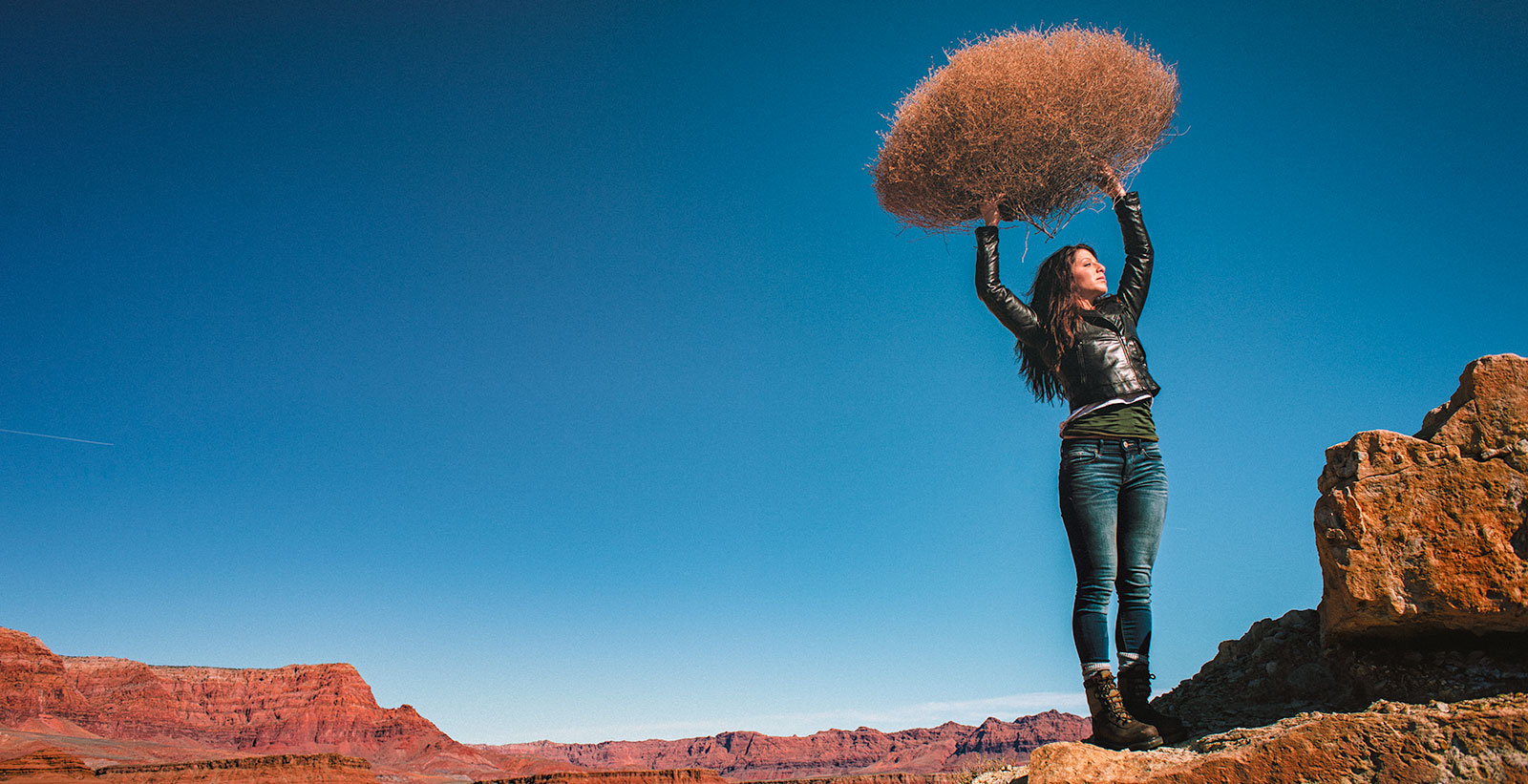
LIGHTING PRINCIPLE THREE: THE COLOR OF LIGHT
We see light usually as a white source, or at least a neutral source.
It isn’t. neutral, it has a color to it and that color can influence all the parts of your image, from shadows to highlights. We don’t see the color of light because our brain changes it to a neutral “white” color as we see it.
Here is a wonderful article that explains the way that the color of light affects your image. Read it now.
When we look at the color of the scene in front of us we can change it globally by changing our color balance in the camera, or using a filter. What “globally’ means is that everything in the photo is changed to the same setting. All the colors are altered by this global change to the color of the light.
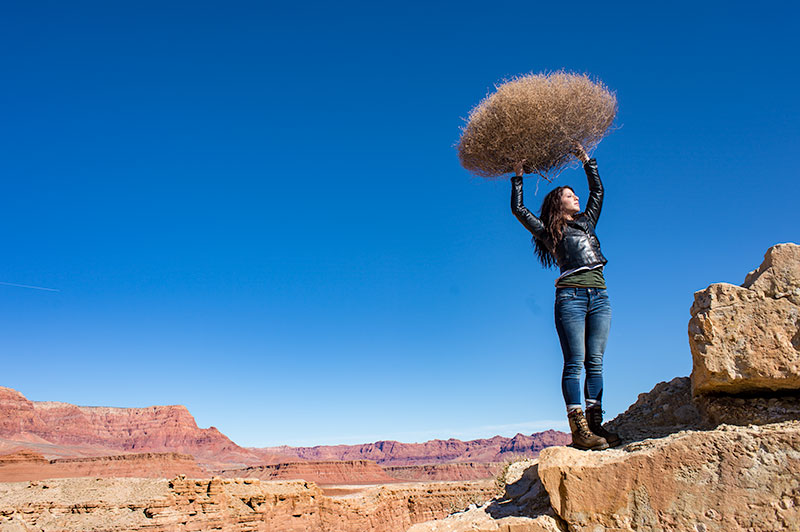
On the left is a photograph taken near Mable Canyon. The sun was quite bright, and there was a bit of warmth to the image because of all the warm browns and oranges of the topography all around us.
This image is as shot. I have applied global changes to the color of the light source so you can see what that does to the image.
Below from left to right:
Daylight / Shade / Tungsten / Flourescent
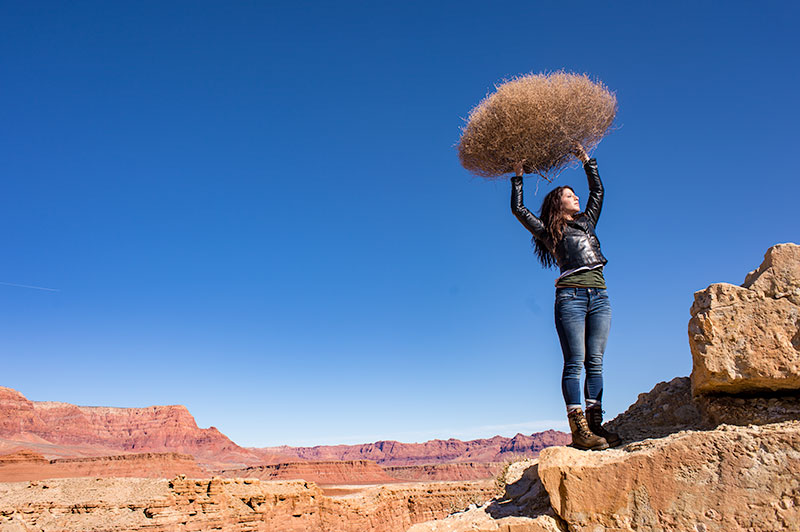
DAYLIGHT
Changing from As Shot to Daylight shows very little difference, although the daylight color balance makes it a bit more warm.
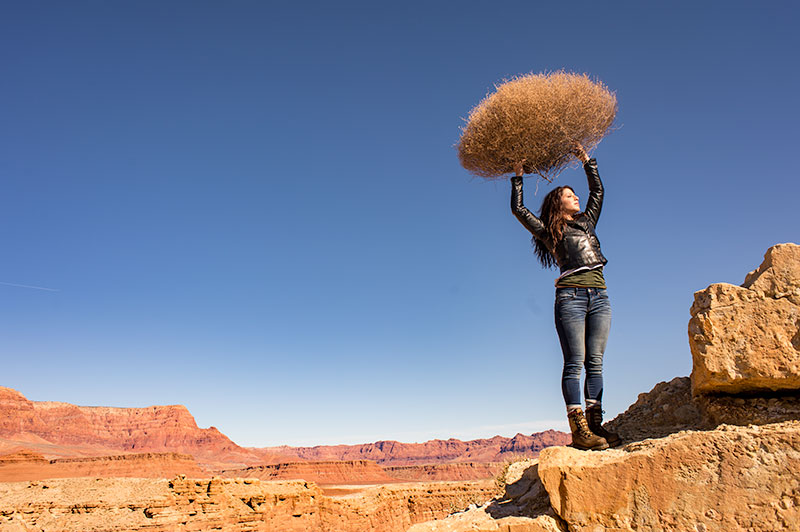
SHADE
Since the color of the light in the shade is a bit more blue, we add some warmth to the overall image to compensate for it. In this shot you can see the global warmth is not going to work because the image was not shot in the shade.
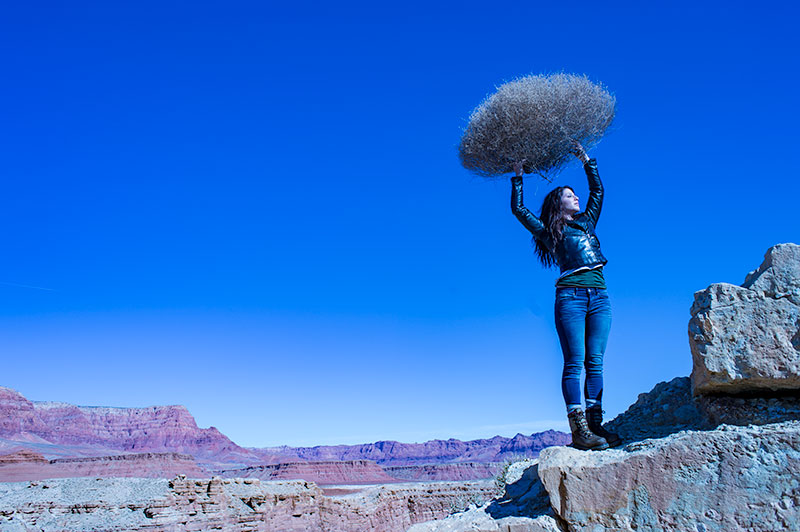
TUNGSTEN
Tungsten light is very orange, so when we apply a tungsten color balance to a shot that is not too orange, we get this very blue looking shot. This is a good reminder of just how ‘warm’ tungsten light is if it takes this much blue to make it correct.
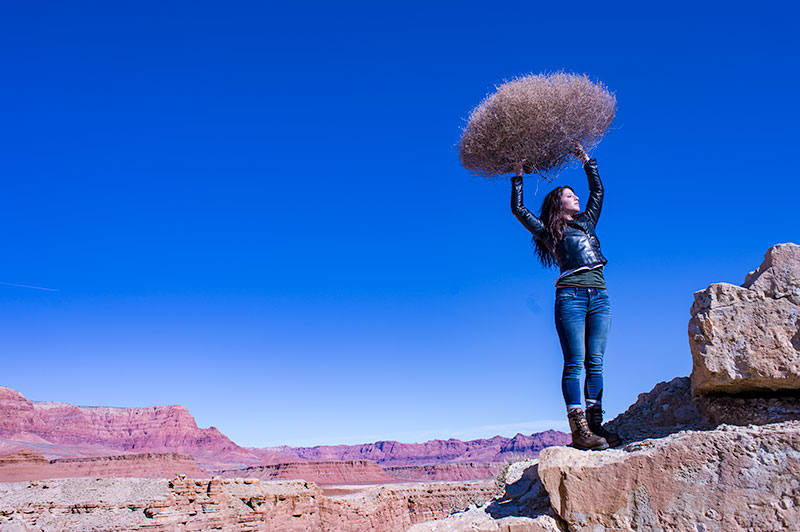
FLUORESCENT
Fluorescent light is blue/green so it makes it difficult to compensate for. In this application of the fluorescent color balance, we can see the sky going a deep blue, while the desert mountains behind become more magenta.
LOCAL LIGHT SOURCE MATCHED TO AMBIENT
Working with a secondary light source that may be a different color presents us with a challenge. We cannot change the image globally because adding a correction to the image to correct for the different light source will affect the entire image.
We must then change the different light source to the ambient (or overwhelming light) in order to ‘balance’ the subject in the ambient setting.
The ambient setting is the overwhelming light that we usually cannot change: the sun, a large warehouse, a home. Bringing in our own lights means we must know how to match what we bring to what is there.
ASSIGNMENTS FOR THIS CLASS:
- Using the color settings on your camera, take the same image with each of them. Shoot with Daylight, Shade, Tungsten, Flourescent at least and do this in places where those colors exist. In other words, shoot some images outside, inside with regular household lamps, and some place that has Flourescent. (NOTE: Many big box stores use a light source known as Mercury Vapor. Mercury Vapor is blue/green so it is very difficult to adequately address. We can add magenta to offset the green, but that turns the blue part of the light to purple. If we address the blue with something warm, we add that to the green part of the light.For Mercury Vapor correction, try “auto” on your camera setting. It is the best I have found for correcting most of that blue/green color shift.
- Using a strobe (speedlight), take a photograph of someone while the sun is going down behind them. Do not alter the strobe setting, just let it keep making the shot as the light turns warmer and warmer. You will then see how “blue” the light source seems coming from the flash.You may have to change the settings as the light gets dimmer, but I think you will see the changes pretty well.
We will be addressing color balance in all of the upcoming classes.
What I’ve Learned So Far; Seventeen; “Funk In, Funk Out, Funk Off”
I know that being a professional photographer should be a bed of roses, a magical place where unicorns and rainbows are interspersed between the Bentleys and mansions. A place where creativity is simply something that everyone has in spades, and no one is ever without...
What I’ve Learned So Far: Sixteen; “Devil’s In The Details / Don’t Sweat The Small Stuff”
Two old sayings people like to throw around a lot without really listening to what they are throwing around; "The devil is in the details" means pay very close attention to the minutiae... it is where the challenges will be hiding. "Don't sweat the small stuff" means...
What I’ve Learned So Far: Fifteen; “Own Your Set” – Or Be Prepared for Chaos
As a commercial and advertising photographer, one of the most important responsibilities you have is to be in control of your shoot. It can mean the difference between a very successful shoot and one that gets by. (Keep in mind there are no failures - it isn't an...
What I’ve Learned So Far: Fourteen; “Rolling With The Punches While Dancing On a Wire”
One of the challenges of commercial photography is that you are obligated to hit a home run every time your number comes up. You are the clean up hitter, or the "go to" guy when the team needs a guaranteed win. It can be a little stressful at times. Like standing on a...
What I’ve Learned So Far: Thirteen; Life’s Too Short for Asshats
You know, it really is too short for most things. Life. Four letters, and yet it means so much to our very souls. One of the things I loved about being a photographer was all the amazing people that I got to meet. I photographed the guy who invented the mechanical...
What I’ve Learned So Far: Twelve; “Nice Shot… Who Cares?
Back when I was first starting out in this business, I shot nearly every day. Maybe for an hour or two, maybe only for a few minutes. When I wasn't shooting, I was in the darkroom developing film, making contact sheets or printing. Lots of printing. There was a lot to...
What I’ve Learned So Far: Eleven; “They Don’t Pay Me Enough To…”
Have you ever heard someone say this? "They're not paying me enough to do my best work." Possibly some variation of that? What a terrible, awful, self-defeating way of doing anything. It's an amazingly stupid, self-absorbed sense of entitlement that brings nothing but...
What I’ve Learned So Far: Ten; Listen to Your Gut
... it knows what the heck is going on. That place deep inside you where you just know something is not right. Listen to that feeling. It is right more than it is wrong. Now I know that your head will be arguing with you the whole time. There is a reason for that is...
What I’ve Learned So Far: Nine; Loyalty Should Be a Brand Attribute
I am a pretty strict believer in loyalty. I live it and I demand it. Not in harsh, 'kingly' sort of way, but more of a gentle 'I am way too busy for your call' way. I can list loyalty as one of my strong traits. I may sometimes be loyal to a fault. I have always felt...
What I’ve Learned So Far: Eight; Life – Through a Lens…
... is different - depending on what lens you choose. Choose wisely. One of the joys of photography is being able to use a different lens for a different perspective. Something very far away can be brought 'closer' by a long (telephoto) lens. We can add depth to a...
What I’ve Learned So Far: Seven; Gear Envy Sucks
Gear envy takes two major forms; 1. "I can't do what I want with this crummy gear." 2. "I can't believe that guy/gal has such great equipment when their work sucks so bad." Actually envying someone by what their gear collection is - "I so wish I was him, I...
What I’ve Learned So Far: Six; Self Sabotage and the New Photographer
(This is an ongoing series that I am writing for the month of December, 2014. After nearly 40 years in this business, I have learned a couple of things. I am sharing that knowledge here.) What is "self-sabotage"? It is the premature destruction of a talented...
What I’ve Learned So Far: Five; Step Up, or Step Aside
In photography, as in most things in life, there are moments when you hesitate for reasons you may never know. Those small hesitations can be driven by fears, or unknowing, or simply because you had too many beers and are partially paralyzed from playing some...
What I’ve Learned So Far: Four; You Can’t Please Everyone
Not only can you not please everyone, you shouldn't even try. Why? Because all those "anyone's" can't even agree what they like anyway. The first seven or eight years of my photographic career were spent trying to figure out what "they" wanted to see. Should I have...
What I’ve Learned So Far: Three; It Ain’t Brain Surgery
When I first started I met a photographer who was what I call a "prima-donna", or asshat in today's world. He would rant and rage while shooting. All of his assistants would cower as he belittled them, humiliated them and treated them less than anyone should ever be...
What I’ve Learned So Far: Two; Partners Maybe – Maybe Not
There is nothing better than a great partner. Finding someone who fills in those blanks in your business acumen can be a life saver. Whether it is a rep, or a second shooter/first assistant, or a full business partner, working with someone who helps you stay focused...
What I’ve Learned So Far: One; Photography Ain’t Easy
Starting today and for the duration of December 2014, I will be making one post per day on ideas and thoughts I have had about this business of photography. And it is directed toward the professional practice of commercial photography. I have been kicking around in...
Thinning Down, Weeding Out… Hopefully
Gettin’ Skinny and Lovin’ It I bet you're wondering if this will be about a new diet program, and how I am slimming down and getting to be a lean mean fighting machine. And it is… sorta. It’s a diet of all things photography. I am moved out of the big studio I share...
Industrial Assignment: Project 52 Pros
One of the most under-rated and least mentioned genre of commercial photography is Industrial/Corporate. It isn't sexy, and models don't flock to the studio after hours. The travel is usually not to some awesome resort or fancy hotel, but rather to out of the way...
Photographing Mundane Subjects
I have always been a ‘commercial’ photographer. While that included some wonderful editorial and fashion along the way, the bulk of my income was from good old commercial photography. Photographs made for advertisements, brochures, product sheets, illustrative uses...
The Summer 2013 Project 52 Yearbook (Free Download)
Proud to announce the arrival of the Summer 2013 Project 52 Pro Yearbook. If you would like to purchase a hard copy, it is available at cost at Blurb. PROJECT 52 PROS SUMMER 2013 YEARBOOKbyDon Giannatti | Make Your Own Book If you would like to download a free screen...
What If The Problem Is That You Suck?
Photo of the author by Mike Eller Even More Advice for the Aspiring Professional Photographer. These days a lot of people seem to be offering advice in the area of becoming a full time professional photographer. Some of those folks like Greg Heisler, Jay Meisel, Gail...
“Money, Money, Money” A Difficult Subject
The subject was money. And the assignment was for a brochure cover for a financial services company. Layout was included, but optional. The important thing was to not be totally cliche' about the image, and also not to succumb to a boring shot. This is a most...
Are We Clear About What We Do as Photographers?
Are We? Two things recently formed today’s article. One was a note from a commercial shooter who was being setup to fail, and the other from a consumer shooter angry that the client kept wanting more and more retouching… and feeling trapped that it must be done. To...