
DISTANCE OF THE LIGHT SOURCE FROM THE SUBJECT
The second principle of light is the distance of the light source from the subject.
One thing for sure, if it is artificial light, the distance of the light source from the subject can change the size relationship, but there are other things that happen as well.
With artificial lights, one of the most important rules is The Inverse Square Law.
And it can be kinda scary that one. First, it’s a law. That seems pretty definite. And of course it has something to do with math – ‘squared[. But the word INVERSE? What the heck is that?
Let’s not sweat that right at the moment.
Let’s just acknowledge it for what it means to us.
Essentially, the Inverse Square Law (ISL) means that the farther the light is from the subject, the less bright it will appear. We know that, right. The closer we get to a light source, the brighter the reflectance of that source from whatever we are bringing close to the light.
Say you are in a very dark room, and there is only one small light in the corner. You are desperately trying to read the calory count on your small bag of Cheetos but it is way too dark where you are. Well – simple, we take the Cheetos bag over to the light and as we get close to the light, we can instantly read that we are never allowed to eat Cheetos again.
Now that is way too simple for any rule, or LAW, especially one that concerns math and something called Inverse.
The ISL is a way of measuring that light fall off and it shows us that there is actually a formula to how much that light falls off. Formulas are great. They are like systems. We can use them over and over to achieve the results we need.
This formula is way simpler than the name implies:
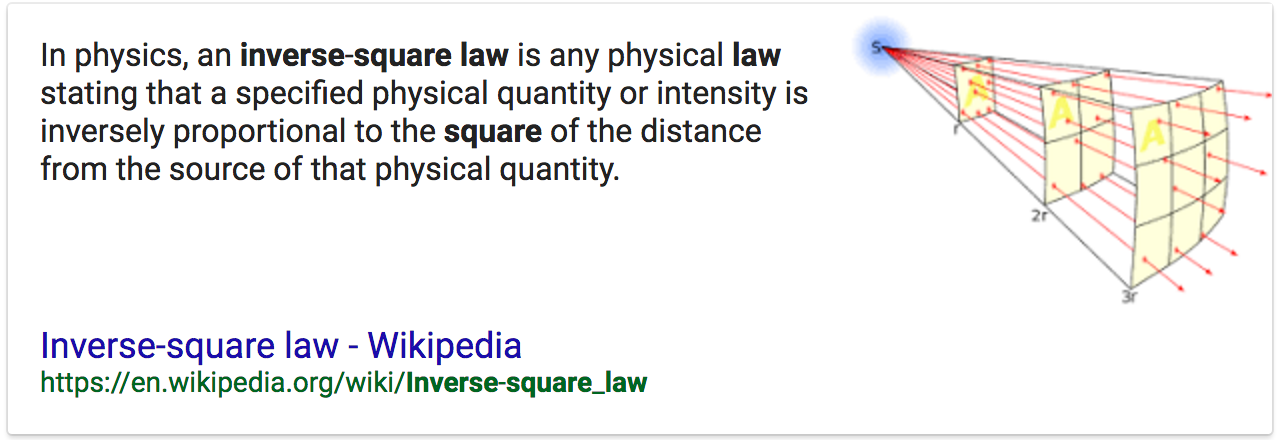
As you can see in the illustration above, at twice the distance the light has to cover four times as much space making it four times less powerful.
Four times less = 2 stops less in f-stops.
So if the light was f-8 on your subject at 4 feet, and you moved the light back to 8 feet, the amount of light on the subject would now equal f-4. If you started at f-4 at 8 ft and moved the light in to 4 ft it would be f-8.
What if instead of moving the light from 8 ft to 4 ft you decided to move it in 6 ft? Well, that would be half way between f-8 and f-4… f-5.6.
Now look at what happens when we apply the rule to a set of distances.
THE IMPORTANCE OF KNOWING RECIPROCALS
A reciprocal is simply understanding the relationships between all the numbers we throw around in photography.
F-stops, shutter speeds, ISO – all work hand in hand with each other to make the image with correct (for you) exposure. Changing any one of these three will necessitate a change in one of the others to compensate.
Let’s look at ISO:
f-4 / 1/125 @ ISO 100
If we change that to ISO 200 one of those above will have to change. Either the f-stop or the shutter speed. Since the ISO is now one stop more powerful, we either have to change to f-5.6 or change the shutter speed to 1/250. Both of these changes have the affect of decreasing the exposure setting one stop due to increasing the ISO by one stop.
Simply knowing the basics of one set will make it easy for you to re-configure for a new set.
I use ISO as my constant. In this case, I will use the settings of Sunny 16 (f-16 at 1/ISO).
ISO is 100 for these reciprocals.
f-16 @ 1/100
f-11 @ 1/200
f-8 @ 1/400
f-5.6 @ 1/800
f-4 @ 1/1600
f-2.8 @ 1/3200
These are committed to rote memory.
Changing the ISO compels me to make associated changes in these figures. If the ISO goes faster, I simply change the f-stop OR shutter speed to correlate to the amount of change in ISO. If the changes go out of the range of my camera, I will change one first, then catch up the other.
Example:
The light is getting a bit low, and I want to shoot with a shutter speed that allows me to hold the camera still. I take a meter reading and find that at ISO 100, my exposure for that shot is f-4 @ 1/15. Well, that aint’a gonna work for me handheld.
So first I decide that f-4 should be f-5.6 because of some Depth of Field issues (which moves the shutter speed down to 1/8), so that means I will have to move the ISO one stop for that aperture change to:
f-4 / ISO 100 @ 1/15 to f5.6 / ISO 100 @ 1/8 (reciprocal, one less stop in shutter speed to correlate with additional stop in aperture.
f-5.6 / ISO 200 @ 1/15
f-5.6 / ISO 400 @ 1/30
f-5.6 / ISO 800 @ 1/60
Learn your reciprocals for faster and more accurate decisions in the field.
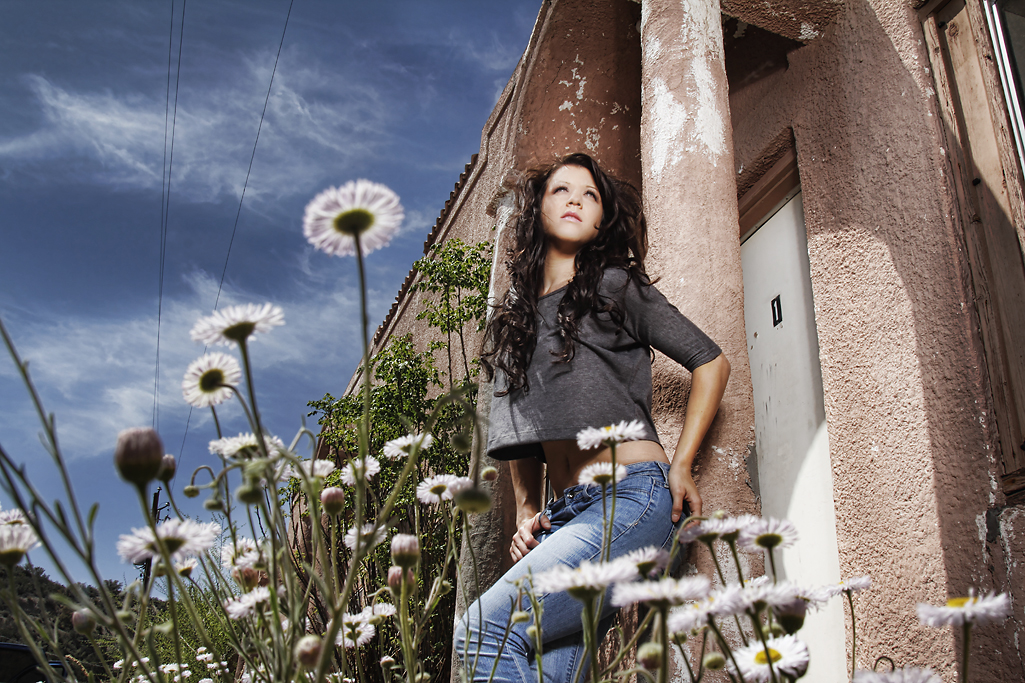
Bri in Miami.
I didn’t want the old building to go too dark behind her so I moved her next to the column. This gave me the ability to move the light in close to her, and let the background fall off fast – but retain the light and the texture right around her so she didn’t ‘pop’ out and look too overly lit.
This is a 4ft softbox with a Profoto 300 WS head and a single diffusion panel in the softbox. It is just above camera viewpoint in this shot – very close to her. You can see the light falling off as it reaches her knees.
I wanted the shot to appear somewhat realistic and not “strobed” so a careful blend of one stop over the ambient was chosen.
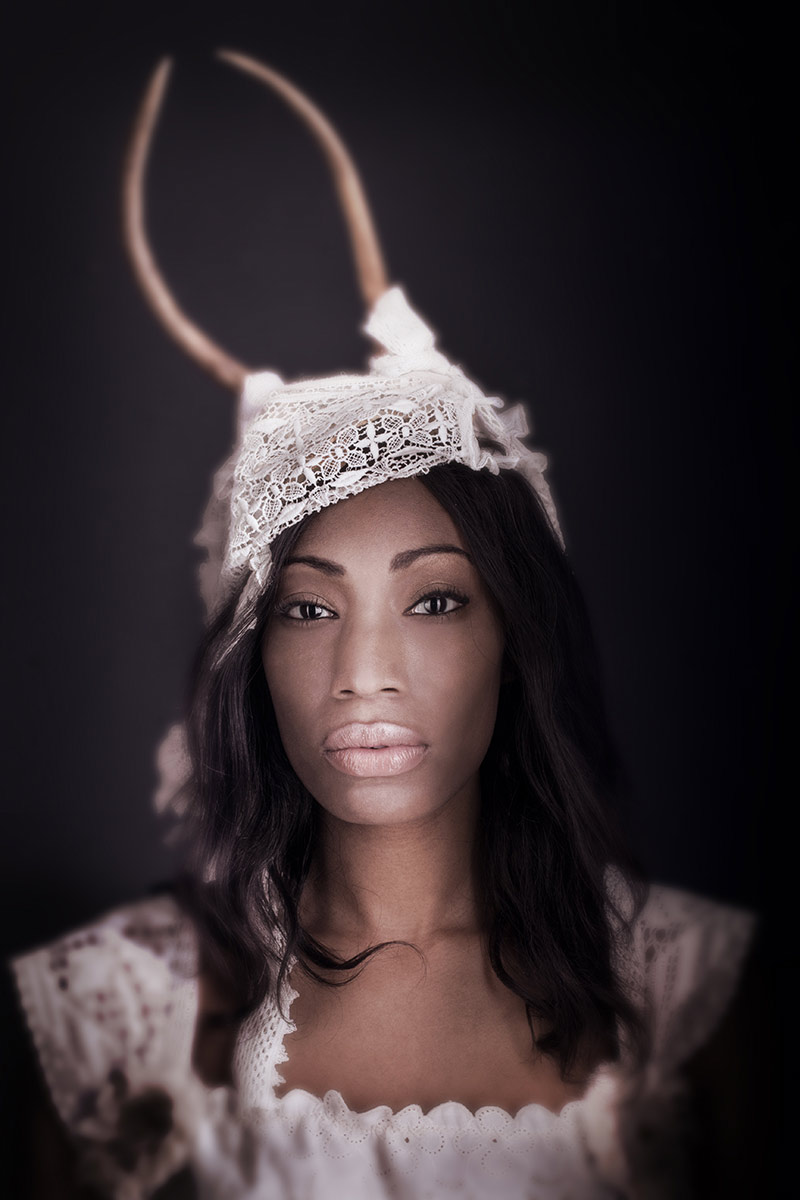
Ivy in the Studio.
My studio had bright white walls in a cove. I didn’t want this image to be on a white background so I moved Ivy far enough away that the light on her had no effect at all on the white wall behind her. It was simply way too underexposed to render at all.
Controlling the exposure through the Inverse Square Law is one of the more important tools you will have at your disposal.
And get this – it doesn’t cost a penny.
ASSIGNMENTS FOR THIS CLASS:
- Using a light source of your own: (studio strobe, speedlight, continuous light) place the light close to the subject and then move the subject AND light source closer to and farther back from a single background. Notice how the image presents itself as you go closer to the background with your subject and light, and what happens when you take subject and light farther away.
- Place camera and background at a fixed point. Then move your subject into the f-16 and make an exposure. Move back to f-11, then f-8, f-5.6, f-4 and if you can f2.8. What happens to the background as you move the subject closer to it and adjust exposure.
- Build your string meter. See below.
Find a piece of good, smallish rope. Clothesline will do nicely.
Put your light on a stand, and run the string straight out from the flash. The flash should be set at 1/8 power if possible. Not full. It should be on “normal” zoom setting neither on telephoto or wide angle.
- Using a meter and a remote flash trigger, find the exposure point for f-4 by going down the rope and aiming the ambient light meter dome directly at the strobe. Keep going until you find the point where f-4 is noted on your meter.
- Using a knot or marker, note that point as f-4.
- Now find the middle of the rope and note it with knot or marker.
- Between the end of the rope and the middle (left side) put a knot or mark in the middle of that area.
- Between the middle of the rope and the end to the right put a knot or marker
- On the right side, now find the middle between the end and the first mark, and knot it or marker
You now have simple rope meter that will be incredibly accurate in all situations.
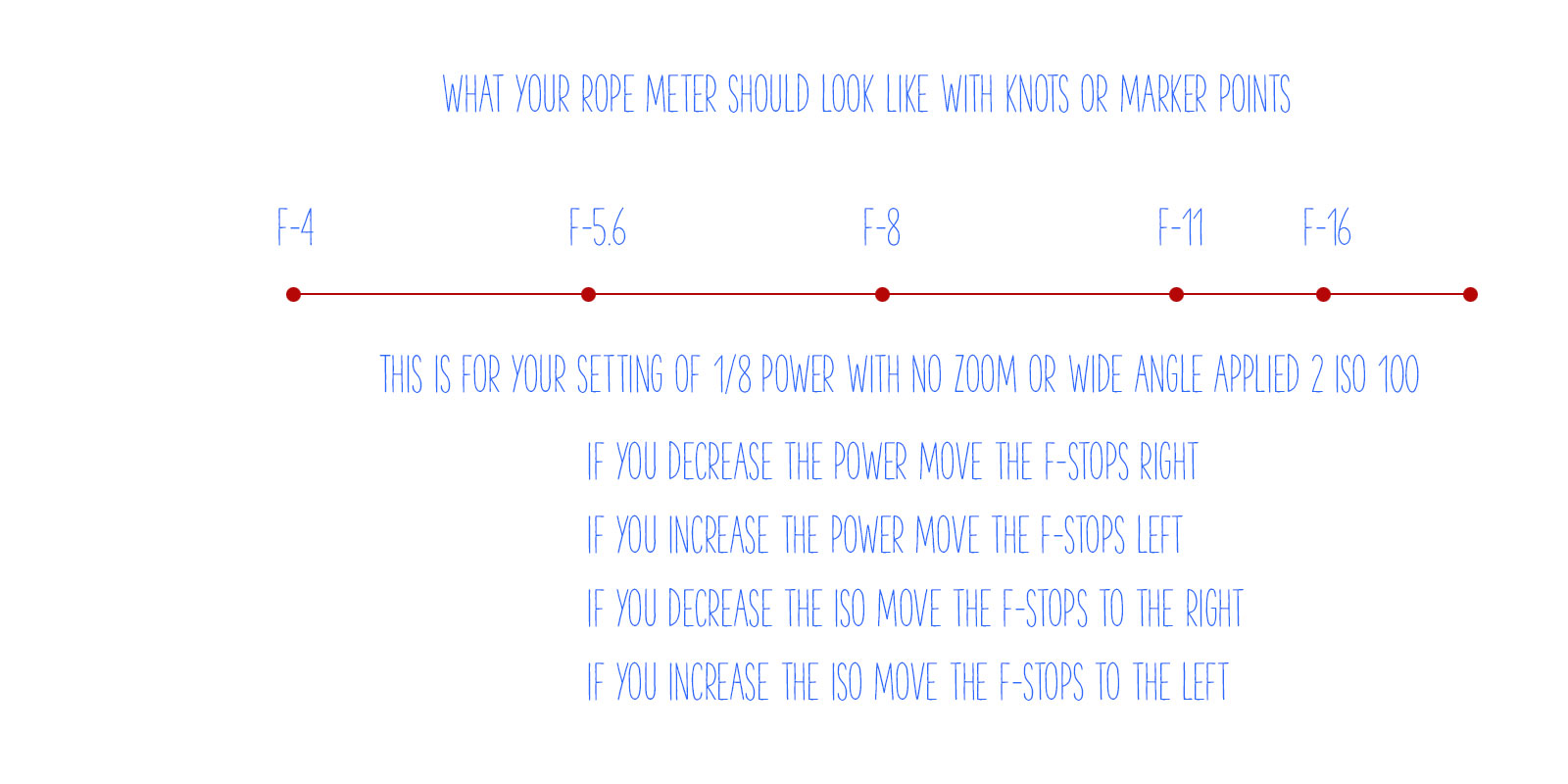
Finding f-4 is the most important part. Use a lightmeter for best results.
If you want to use a gray card, make sure it is at a very slight angle to the light source so it will not have a specular for the camera to see (the reflection of the light source). Shoot at f-4 until you find the distance that will render a single line of pixels in your histogram dead center. That is perfect exposure of a gray card.
Of course, you must fill the lens with the gray card, no extraneous stuff in the viewfinder – just the gray card.
Style Week on Lighting Essentials – Day Two; Daron
Style Week Posts: Selina Maitreya Day One Daron Shade Day Two Christian O'Dell Day Three Ivar Teunissen Kirk Tuck Day Five If you have come in at this point, be sure to go back to the first post and start there. I believe that style is innate within each of us. It is...
“Style” Week on Lighting Essentials – Day One; Selina
It is "Style Week" On Lighting Essentials. Each morning at 10AM Pacific we will post a new set of images and an audio interview with a photographer. Style Week Posts: Selina Maitreya Day One Daron Shade Day Two Christian O'Dell Day Three Ivar Teunissen Kirk Tuck Day...
Five Ways to Differentiate Your Photography Business
... and 5 ways you shouldn't differentiate. There are a lot of photographers out there. Actually, there are a lot of really talented photographers out there. What separates you from them? How can you differentiate yourself from the throng? How to stand out, be...
How Do Photographers Learn the Business? Some Thoughts…
My friend Trudy posted a great little article with the question "How Do Photographers Learn the Business? I read it and asked Trudy if I could take a few of her questions and answer them here on my blog. Wednesday evening, September 1, we will have a show based on...
Ten Myths of Professional Commercial Photography
Err... at least the 10 that I hear a lot of chatting about. I get questions about these at nearly every workshop. So a quick post on what some folks think is reality and what IS reality. Yeah, I know... you saw it on the interwebs. Shoots with all the latest and...
Speaking in Seattle Tonight, Teaching Tomorrow
NOTICE: Because of a late plane schedule today, there will not be a Lighting Essentials LIVE show tonight. I will still be in the air at 6PM, and doing it later will mean it is too late on the East Coast. There will be a LE LIVE this Wednesday evening at 6PM. Sorry...
Increase the “Power” of your Speedlights with Photoshop
Lighting Essentials LIVE: Tonight we discuss pricing strategies for emerging photographers. Log in to ask questions. Thanks all for joining us this evening. This post from a year ago has some good information. Yeah... that's right. We can actually create an impression...
John Ricard, NYC Music Photographer: Interviewed on Lighting Essentials
The interview with John Ricard comes after the jump. Click on the "more" link below. Our next Lighting Essentials LIVE Broadcast, Sunday, Aug 22, 2010. Expanded edition (90 minutes). Here is the pre-show material you may want to read before the show. Up first is a...
10 (More) Website Strategies for Photographers
A little over a year ago I posted "10 Web Site Strategies for Emerging Photographers." I think the article holds up very well and is as relevant as it was when I posted it. So please read it if you haven't done so, then come back to this article for 10 more web...
Editing a Portfolio: Ed Z, Philadelphia Photographer
This is the audio discussion to introduce Ed to you all. A discussion with Ed Z, Philadelphia Photographer You can visit his website at EdZStudios.com. We are working on creating his print portfolio in this discussion. I will have done a preliminary edit before we get...
Keith Taylor: Atlanta Photographer. Interview
Meet Keith Taylor, a photographer out of the Atlanta area. Keith has done a bit of everything and his insights into getting started as a photographer are fantastic. Take a few minutes and view his work, and his words and meet this talented shooter. He will be live...
Finding and Identifying Clients for Commercial Photographers
OK... we got the gear and the portfolio is looking pretty good. So now we need to find clients to actually pay us for the images, and help us go from a part-time Pro-Am to a full time photographer. You see, clients may not seek you out - even if your portfolio is...
Then and Now: A Matter of Style
----------- (NOTE) Tomorrow, August 8, 2010 we will have a live discussion on how to go about identifying clients who would be consumers for your work. This is for commercial photographers, we will not be discussing direct-to-consumer photography (wedding and...
If You Have No Customer Skills, No Problem, You Will Soon Have No Customers
I saw the tweet above and just smiled. Yeah, I know what she is going through. I emailed the 'tweeter' and she sent me an email back (reprinted below). I have removed specifics so as not to cause any undue embarrassment of the people who should be embarrassed. So...
Interviews on Lighting Essentials: Get to Know These Photographers
I have had the wonderful opportunity to hear from lots of terrific, upbeat and successful photographers at Lighting Essentials. We have posted interviews with many talented people working in this most incredible business. They maybe aren't the most famous around, but...
Discussion: Social Media and the Emerging Professional Photographer
Well, we tried it with UStream and that was a bust. I think this solution may even be better. You will have the opportunity to ask questions live (and if you have a vidcam, you will stream right on up to me and be seen). I have tested it a bit and seems to work pretty...
Interview with David Giral, Montreal Photographer
Our Interview with Montreal Photographer David Giral. I met David in Toronto at the Workshop. I loved his work and asked him to do this interview with us. 1. How long have you been in business? Was it a slow transition or did you just open shop? Until recently, I...
First Live Broadcast: Discuss Photography and Promotion
This is for today's date: Thursday, July 29, 2010. It will not be archived unless I decide to, you know, archive it... we'll see. We are going to try a little something different. Recently we have discussed pricing and the perils of "shooting for free" and the perils...
Shooting Waverunners in Mexico – In the Ocean
Well, I am kinda with my buddy Kirk here. We have had some distinctly powerful discussions on working for free and what to charge. So we are going to lighten it up a bit with some discussions on images. So let's take a look at something I am working on right now. I...
Enough Negativity: Ten Things to Positively Affect Your Photography
While some pros are worried about kids shooting Facebook and concert pix for free, I think that the perspective is really skewed when we start to become more interested in what non-consequential folks are doing and forget to be excited about this wonderful thing...
No Assignments Without Experience, No Experience without Assignments… Yeah, That Makes Sense, Right?
Rant/Rave today. So it kinda sounds like this to a lot of young photographers: 1. You can't get gigs unless you have experience. 2. Without actual shoots you cannot get experience. 3. You must always charge for your work (see # 1 above) 4. Get an assistant gig. 5....
What is the Difference Between Shooting for Free and Shooting for Me?
And I should add to that headline... "and not giving a damn?" Today's RANT on common sense. A recent post at Blackstar Rising has created a mini fire-storm there. The post, by John Harrington, who runs the very popular and quite informative Photo Business News and...
Sometimes It Is About Being Able to Simply Get the Shot
A bit of a Rant - a bit of a Rave. Something for everyone. I just had lunch with a photographer friend of mine, Ken Easley. We were chatting about business when Ken brought up a recent assignment he had finished. It was a shoot of 13 or 14 corporate head shots. I will...
On the Matter of Style: Some Examples
We were talking about style and vision in the last few posts. I thought I would take this point to show some photographers who I believe show a lot of vision and style. This is as nearly a random sampling of the photographers I love as possible. There are a lot of...