
DISTANCE OF THE LIGHT SOURCE FROM THE SUBJECT
The second principle of light is the distance of the light source from the subject.
One thing for sure, if it is artificial light, the distance of the light source from the subject can change the size relationship, but there are other things that happen as well.
With artificial lights, one of the most important rules is The Inverse Square Law.
And it can be kinda scary that one. First, it’s a law. That seems pretty definite. And of course it has something to do with math – ‘squared[. But the word INVERSE? What the heck is that?
Let’s not sweat that right at the moment.
Let’s just acknowledge it for what it means to us.
Essentially, the Inverse Square Law (ISL) means that the farther the light is from the subject, the less bright it will appear. We know that, right. The closer we get to a light source, the brighter the reflectance of that source from whatever we are bringing close to the light.
Say you are in a very dark room, and there is only one small light in the corner. You are desperately trying to read the calory count on your small bag of Cheetos but it is way too dark where you are. Well – simple, we take the Cheetos bag over to the light and as we get close to the light, we can instantly read that we are never allowed to eat Cheetos again.
Now that is way too simple for any rule, or LAW, especially one that concerns math and something called Inverse.
The ISL is a way of measuring that light fall off and it shows us that there is actually a formula to how much that light falls off. Formulas are great. They are like systems. We can use them over and over to achieve the results we need.
This formula is way simpler than the name implies:
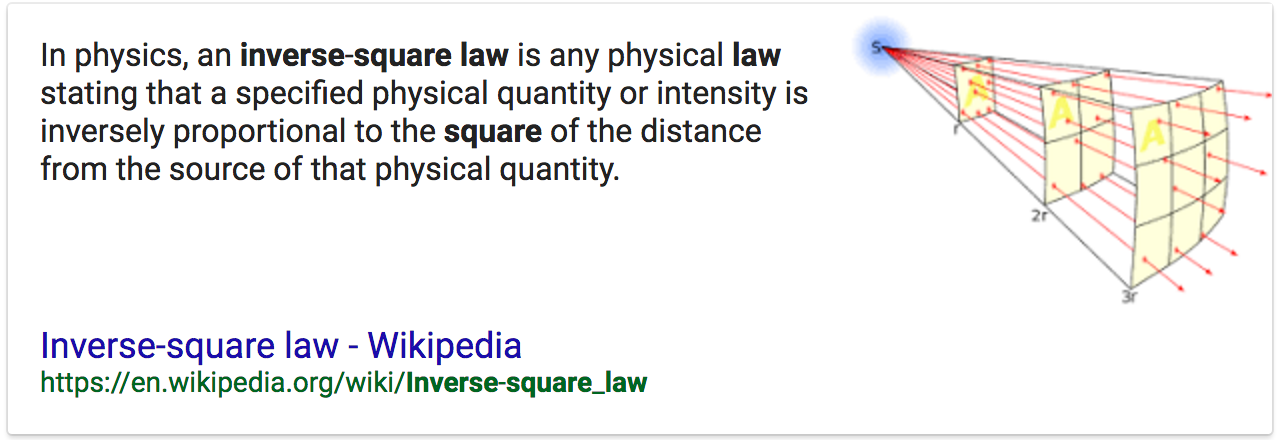
As you can see in the illustration above, at twice the distance the light has to cover four times as much space making it four times less powerful.
Four times less = 2 stops less in f-stops.
So if the light was f-8 on your subject at 4 feet, and you moved the light back to 8 feet, the amount of light on the subject would now equal f-4. If you started at f-4 at 8 ft and moved the light in to 4 ft it would be f-8.
What if instead of moving the light from 8 ft to 4 ft you decided to move it in 6 ft? Well, that would be half way between f-8 and f-4… f-5.6.
Now look at what happens when we apply the rule to a set of distances.
THE IMPORTANCE OF KNOWING RECIPROCALS
A reciprocal is simply understanding the relationships between all the numbers we throw around in photography.
F-stops, shutter speeds, ISO – all work hand in hand with each other to make the image with correct (for you) exposure. Changing any one of these three will necessitate a change in one of the others to compensate.
Let’s look at ISO:
f-4 / 1/125 @ ISO 100
If we change that to ISO 200 one of those above will have to change. Either the f-stop or the shutter speed. Since the ISO is now one stop more powerful, we either have to change to f-5.6 or change the shutter speed to 1/250. Both of these changes have the affect of decreasing the exposure setting one stop due to increasing the ISO by one stop.
Simply knowing the basics of one set will make it easy for you to re-configure for a new set.
I use ISO as my constant. In this case, I will use the settings of Sunny 16 (f-16 at 1/ISO).
ISO is 100 for these reciprocals.
f-16 @ 1/100
f-11 @ 1/200
f-8 @ 1/400
f-5.6 @ 1/800
f-4 @ 1/1600
f-2.8 @ 1/3200
These are committed to rote memory.
Changing the ISO compels me to make associated changes in these figures. If the ISO goes faster, I simply change the f-stop OR shutter speed to correlate to the amount of change in ISO. If the changes go out of the range of my camera, I will change one first, then catch up the other.
Example:
The light is getting a bit low, and I want to shoot with a shutter speed that allows me to hold the camera still. I take a meter reading and find that at ISO 100, my exposure for that shot is f-4 @ 1/15. Well, that aint’a gonna work for me handheld.
So first I decide that f-4 should be f-5.6 because of some Depth of Field issues (which moves the shutter speed down to 1/8), so that means I will have to move the ISO one stop for that aperture change to:
f-4 / ISO 100 @ 1/15 to f5.6 / ISO 100 @ 1/8 (reciprocal, one less stop in shutter speed to correlate with additional stop in aperture.
f-5.6 / ISO 200 @ 1/15
f-5.6 / ISO 400 @ 1/30
f-5.6 / ISO 800 @ 1/60
Learn your reciprocals for faster and more accurate decisions in the field.
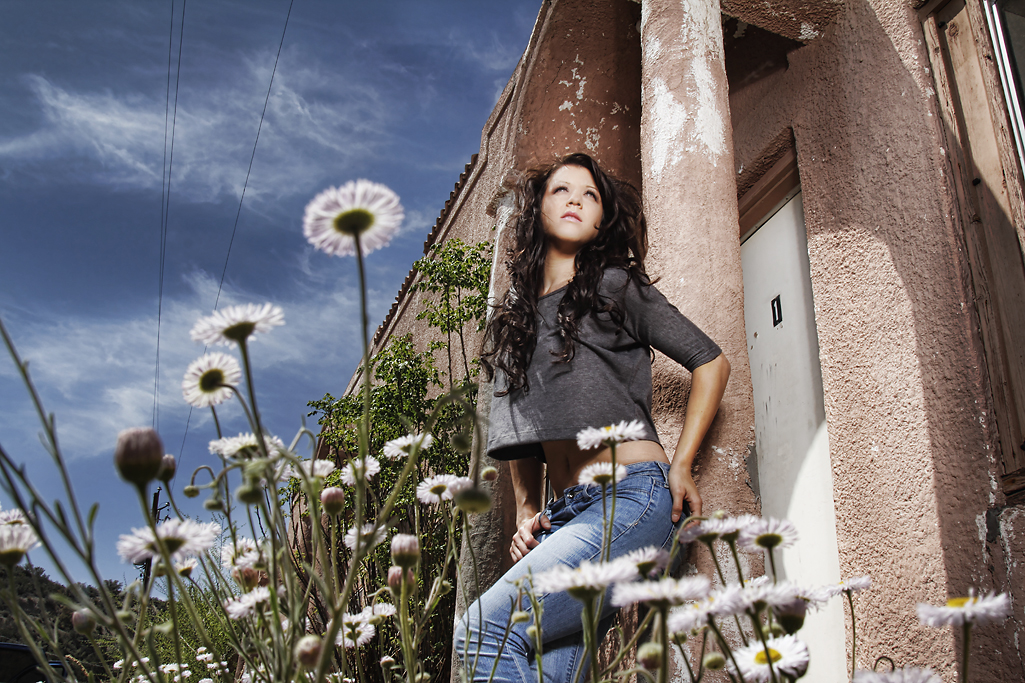
Bri in Miami.
I didn’t want the old building to go too dark behind her so I moved her next to the column. This gave me the ability to move the light in close to her, and let the background fall off fast – but retain the light and the texture right around her so she didn’t ‘pop’ out and look too overly lit.
This is a 4ft softbox with a Profoto 300 WS head and a single diffusion panel in the softbox. It is just above camera viewpoint in this shot – very close to her. You can see the light falling off as it reaches her knees.
I wanted the shot to appear somewhat realistic and not “strobed” so a careful blend of one stop over the ambient was chosen.
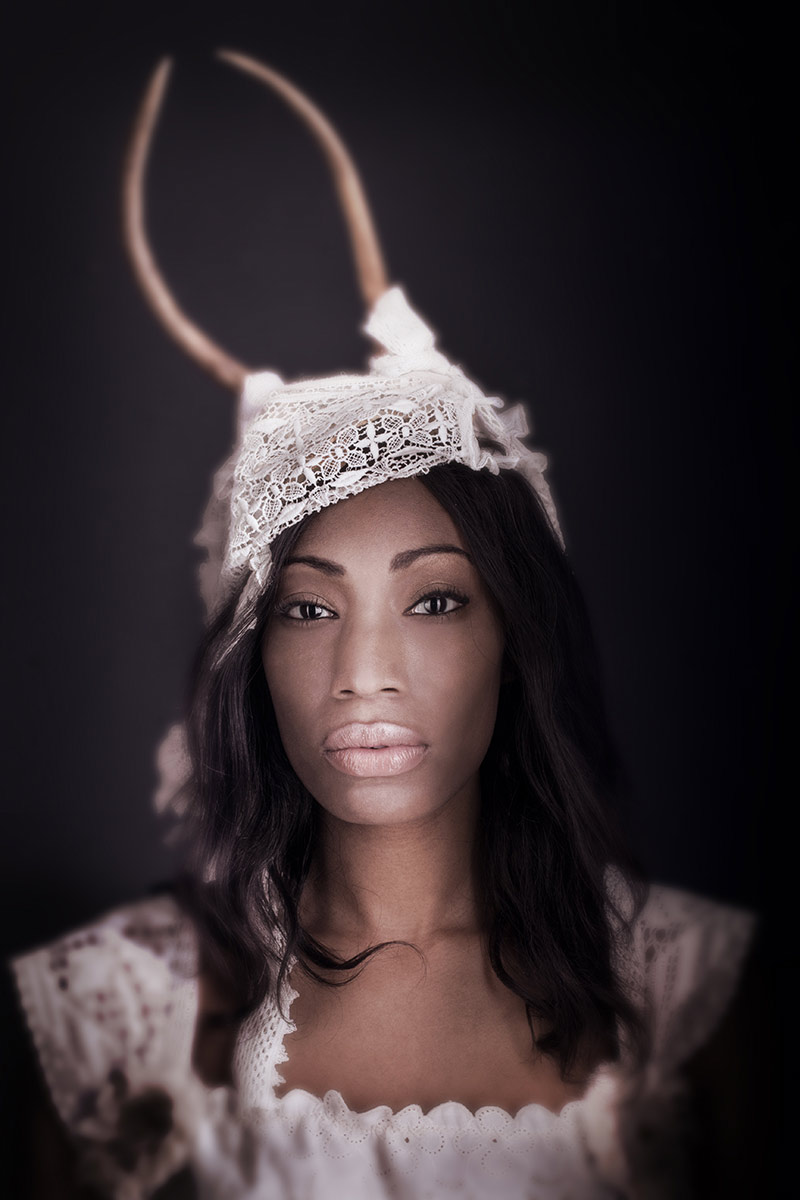
Ivy in the Studio.
My studio had bright white walls in a cove. I didn’t want this image to be on a white background so I moved Ivy far enough away that the light on her had no effect at all on the white wall behind her. It was simply way too underexposed to render at all.
Controlling the exposure through the Inverse Square Law is one of the more important tools you will have at your disposal.
And get this – it doesn’t cost a penny.
ASSIGNMENTS FOR THIS CLASS:
- Using a light source of your own: (studio strobe, speedlight, continuous light) place the light close to the subject and then move the subject AND light source closer to and farther back from a single background. Notice how the image presents itself as you go closer to the background with your subject and light, and what happens when you take subject and light farther away.
- Place camera and background at a fixed point. Then move your subject into the f-16 and make an exposure. Move back to f-11, then f-8, f-5.6, f-4 and if you can f2.8. What happens to the background as you move the subject closer to it and adjust exposure.
- Build your string meter. See below.
Find a piece of good, smallish rope. Clothesline will do nicely.
Put your light on a stand, and run the string straight out from the flash. The flash should be set at 1/8 power if possible. Not full. It should be on “normal” zoom setting neither on telephoto or wide angle.
- Using a meter and a remote flash trigger, find the exposure point for f-4 by going down the rope and aiming the ambient light meter dome directly at the strobe. Keep going until you find the point where f-4 is noted on your meter.
- Using a knot or marker, note that point as f-4.
- Now find the middle of the rope and note it with knot or marker.
- Between the end of the rope and the middle (left side) put a knot or mark in the middle of that area.
- Between the middle of the rope and the end to the right put a knot or marker
- On the right side, now find the middle between the end and the first mark, and knot it or marker
You now have simple rope meter that will be incredibly accurate in all situations.
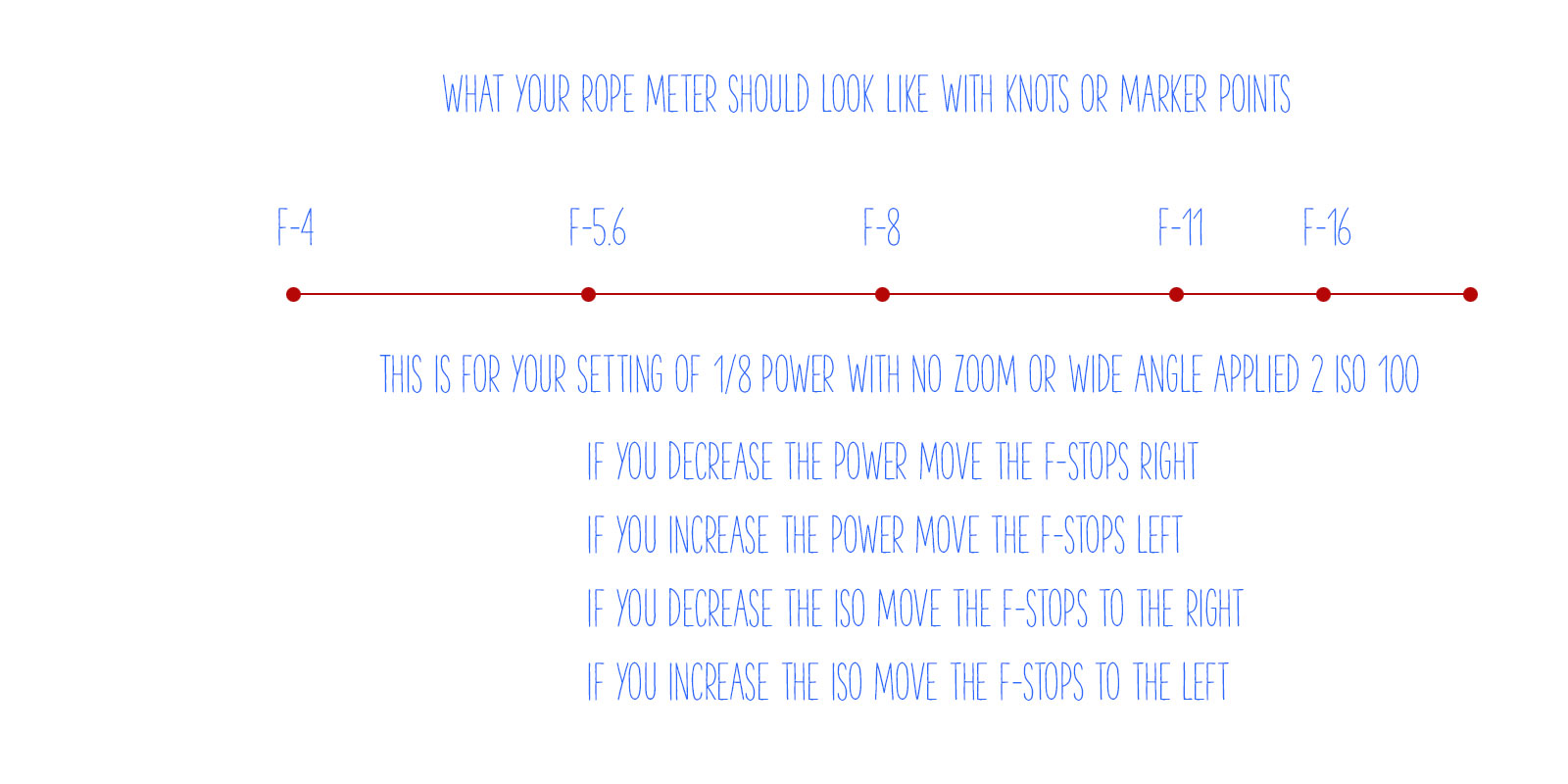
Finding f-4 is the most important part. Use a lightmeter for best results.
If you want to use a gray card, make sure it is at a very slight angle to the light source so it will not have a specular for the camera to see (the reflection of the light source). Shoot at f-4 until you find the distance that will render a single line of pixels in your histogram dead center. That is perfect exposure of a gray card.
Of course, you must fill the lens with the gray card, no extraneous stuff in the viewfinder – just the gray card.
Lighting Essentials Appreciation Weekend: January 28/29 2012: Workshops/BBQ/Fun
I have wanted to do this for a long time, and now that I am changing stuff up, it seems like a great time to hold our Lighting Essentials Appreciation Weekend. What it is: A weekend for us to have fun, make photographs, meet old friends and make new ones. There will...
October’s Gone, I Am Changing It Up, and Are You Up For a Visit From Me?
This is the last weekend of October. Only two months left till the new year, and hopefully some new directions. Seems like I always think of January, June, and September as transitional months. Maybe from all those years in school... I dunno. But change is in the air,...
“The Photographer’s Path” – A New Program from Selina Maitreya
Selina Maitreya's new course is something that is as unique as it gets. It is fresh, fun, exciting and with such a personal twist to the usual consultants approach, that you will be quite amazed. I have been working with the first month, and just received the second...
Why Simply Being “Better” Won’t Get You Assignments
There is a reason why the above was not chosen as a worldwide statement meant to inspire us to try a different method of computing... ya know. As photographers, we see this sort of thing all the time. "To get more work, become better than your competition". Really?...
It’s Nice to have Talented Friends (3 Photographers You Should Know)
It has been a long, hot summer here in the desert. Takes its toll on us sometimes. Creativity can be a little stifled when it is 120 degrees in the shade... heh. And yeah, I do have a studio to shoot in, but like that old adage about being careful what you wish for,...
Assignment Photography: a Strategy for Bidding the Gig
The phone rings a little before lunch. You answer it and a voice on the other end says, "How are you. You showed your book here at the agency a few weeks ago, and we have a job we would like you to bid on. We will email over the particulars if you are interested." The...
What Changed? What Remains?
I am very sad that my friend Kirk Tuck closed the door on his wonderful blog The Visual Science Lab. I sent a hearfelt note urging him to reconsider, but he has very strong and equally heartfelt reasons why he felt it was time to let it go. And I know that feeling. I...
Environmental Portraits: Be Ready for Anything, Use Only What You Need
I am working with a sculptor on some creating collateral and website materials. She didn't have any good images of her working, so we put together a shoot schedule that brought me to her studio in Paradise Valley. I love going on location to shoot portraits and I pack...
“… To See What The World Looks Like as a Photograph.” Works For Me
Garry Winogrand had a wonderful and unique way of thinking about photography. He was asked once why he seemed to photograph everything, seemingly without regard as to what he was photographing. His response:"I photograph to see what the world looks like in...
Why I Teach: A Personal Perspective
(NOTE: I would like to thank those students and alums who helped me become one of the top workshop teachers on Photo District News, Reader's Poll for September, 2011.) I was recently asked to discuss what I liked about teaching photography, and why I thought it was...
On Balance: Challenging the Nature of Gravity
There has been one strong thought in the back of my mind lately. It sort of hangs there like a candle that is almost ready to die, but keeps the flame going for another few seconds. Then it flickers nearly to extinction - and lights up again with the slight change of...
Green Tea, Rice Balls and Ancient Asian Cities
Photograph of sunrise in Kuala Lumpur, Malaysia. God I love iced green tea. Especially when it is really hot outside. And even more when I am outside with the extremely hot outside. The soft, gentle flavors and the coolness of the ice help with the - at times brutal -...
Cole Bennett: Photographer, Orillia, Ontario
(Photo by Cole Bennett: "One frame from the fairly extensive photography project I've been working on with the YMCA of Simcoe Muskoka (which is within my county." Meet Cole Bennett, a commercial photographer in a small town in east-central Canada. Orillia, Ontario is...
Project 52: Environmental Portraiture Examples
I am so enjoying working with the Project 52 photographers. It is one of the things I am having the most fun with. If you are not familiar with Project 52, it is an ongoing project that started last January, and is continuing till Christmas this year... 52 weeks, 52...
Time to View The Lighting Essentials Contest Submissions and Vote
Well it's that time. Time to choose the winners in our Summer contest: "Summer in My Town". The assignment was to make between 6 and 8 images to show off what summer is like in your town. We had a lot of entrants, but not so many uploads. But we got some good ones,...
Contest Submission Instructions and a big THANKS to our Sponsors
Hi everyone. It is time to wrap up the contest shooting. "Summer In My Town" has run from June 1 through the first 2 weeks of August. We now must collect the entries and get the site set up. Below are submission instructions. Please send the images to me by Tuesday,...
Guest Post: Selina Maitreya on the “Whole Enchilada”
You Need the Whole Enchilada © 2011 Selina Maitreya NOTE: This is a guest blog post by Selina Maitreya. At the end of the post is a special deal that will net you nearly $300 worth of valuable photographic information. I urge you to take advantage of this incredible...
A Photographer’s Decision: Take the Freeway or the Road Less Traveled?
Recently there has been some buzz about how to get noticed as a photographer. And more and more I see photographers doing images that look for all the world like some other guy's images that looks like a woman he really admires' images. And her work was copied from...
New Gear: Aputure Triggers and Gamilight Modifiers – Gear that WORKS
Dontcha just love gear that works the way you do. Intuitive design, ease of use, multiple applications... the things that make working with the gear simply an extension of what we are trying to do. And that is make photographs. When I am shooting I want to be involved...
Rediscovering the 50 – Working To Know My Least Favorite Lens Better
After neglecting my 50MM lens for a long long time, I decided it was time to get to know each other better. I spent a week with the lens, and we are coming to an understanding.
Your ‘About Me’ page image: Make it part of your brand
Over at Project 52 we did an assignment to do a self portrait, or at least a portrait of ones self. An "About Me" page is such an important part of the website that it must be addressed in a professional and stylistic manner. Some statistics show that it is the most...
It’s Summer: Ten Things to Do to Boost Your Photography
1. Road Trip I love road trips. Planning them, packing for them, and doing them. Unpacking... well, not so much. But road trips are one of the most fun and inspiring things you can do. I try to take small road trips whenever possible. Last week I was in Vancouver....
Do You Have a Line You Won’t Cross in Photography?
A recent heated discussion on a photographer making her political affiliations known led me to another thought... is there a line you won't cross in your work? Should there be? It is a competitive market out there. There are bills to pay, and gear to maintain, and...
Is it a changing market, or are systems simply broken?
Discussing the new expectations of commercial photography and creating new challenges and channels for the visual executive