
DISTANCE OF THE LIGHT SOURCE FROM THE SUBJECT
The second principle of light is the distance of the light source from the subject.
One thing for sure, if it is artificial light, the distance of the light source from the subject can change the size relationship, but there are other things that happen as well.
With artificial lights, one of the most important rules is The Inverse Square Law.
And it can be kinda scary that one. First, it’s a law. That seems pretty definite. And of course it has something to do with math – ‘squared[. But the word INVERSE? What the heck is that?
Let’s not sweat that right at the moment.
Let’s just acknowledge it for what it means to us.
Essentially, the Inverse Square Law (ISL) means that the farther the light is from the subject, the less bright it will appear. We know that, right. The closer we get to a light source, the brighter the reflectance of that source from whatever we are bringing close to the light.
Say you are in a very dark room, and there is only one small light in the corner. You are desperately trying to read the calory count on your small bag of Cheetos but it is way too dark where you are. Well – simple, we take the Cheetos bag over to the light and as we get close to the light, we can instantly read that we are never allowed to eat Cheetos again.
Now that is way too simple for any rule, or LAW, especially one that concerns math and something called Inverse.
The ISL is a way of measuring that light fall off and it shows us that there is actually a formula to how much that light falls off. Formulas are great. They are like systems. We can use them over and over to achieve the results we need.
This formula is way simpler than the name implies:
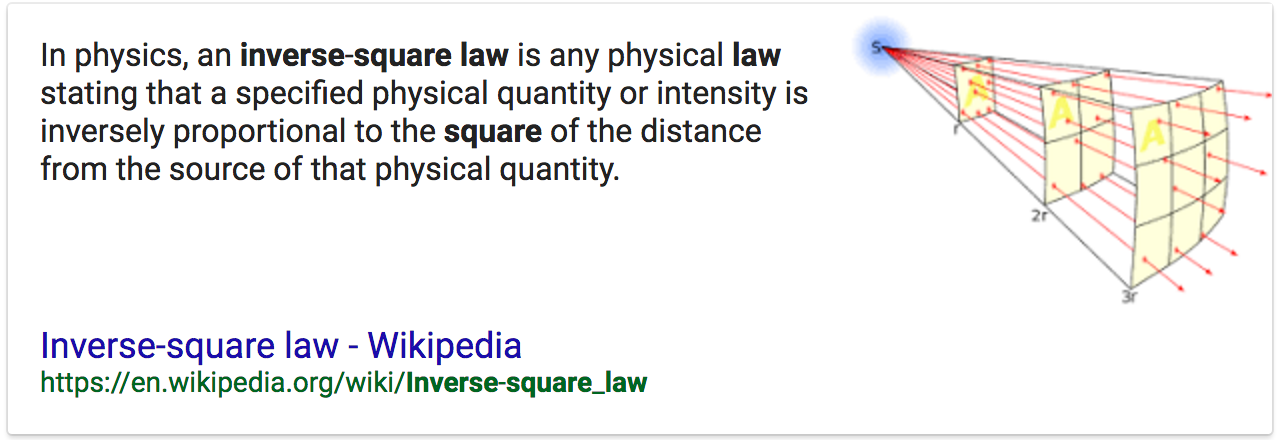
As you can see in the illustration above, at twice the distance the light has to cover four times as much space making it four times less powerful.
Four times less = 2 stops less in f-stops.
So if the light was f-8 on your subject at 4 feet, and you moved the light back to 8 feet, the amount of light on the subject would now equal f-4. If you started at f-4 at 8 ft and moved the light in to 4 ft it would be f-8.
What if instead of moving the light from 8 ft to 4 ft you decided to move it in 6 ft? Well, that would be half way between f-8 and f-4… f-5.6.
Now look at what happens when we apply the rule to a set of distances.
THE IMPORTANCE OF KNOWING RECIPROCALS
A reciprocal is simply understanding the relationships between all the numbers we throw around in photography.
F-stops, shutter speeds, ISO – all work hand in hand with each other to make the image with correct (for you) exposure. Changing any one of these three will necessitate a change in one of the others to compensate.
Let’s look at ISO:
f-4 / 1/125 @ ISO 100
If we change that to ISO 200 one of those above will have to change. Either the f-stop or the shutter speed. Since the ISO is now one stop more powerful, we either have to change to f-5.6 or change the shutter speed to 1/250. Both of these changes have the affect of decreasing the exposure setting one stop due to increasing the ISO by one stop.
Simply knowing the basics of one set will make it easy for you to re-configure for a new set.
I use ISO as my constant. In this case, I will use the settings of Sunny 16 (f-16 at 1/ISO).
ISO is 100 for these reciprocals.
f-16 @ 1/100
f-11 @ 1/200
f-8 @ 1/400
f-5.6 @ 1/800
f-4 @ 1/1600
f-2.8 @ 1/3200
These are committed to rote memory.
Changing the ISO compels me to make associated changes in these figures. If the ISO goes faster, I simply change the f-stop OR shutter speed to correlate to the amount of change in ISO. If the changes go out of the range of my camera, I will change one first, then catch up the other.
Example:
The light is getting a bit low, and I want to shoot with a shutter speed that allows me to hold the camera still. I take a meter reading and find that at ISO 100, my exposure for that shot is f-4 @ 1/15. Well, that aint’a gonna work for me handheld.
So first I decide that f-4 should be f-5.6 because of some Depth of Field issues (which moves the shutter speed down to 1/8), so that means I will have to move the ISO one stop for that aperture change to:
f-4 / ISO 100 @ 1/15 to f5.6 / ISO 100 @ 1/8 (reciprocal, one less stop in shutter speed to correlate with additional stop in aperture.
f-5.6 / ISO 200 @ 1/15
f-5.6 / ISO 400 @ 1/30
f-5.6 / ISO 800 @ 1/60
Learn your reciprocals for faster and more accurate decisions in the field.
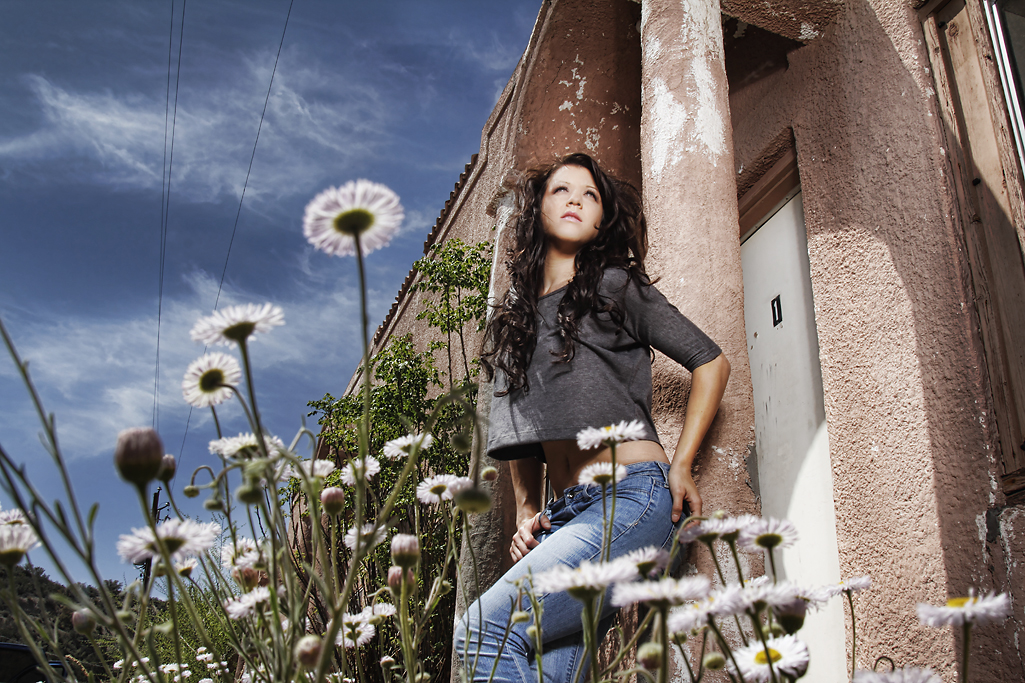
Bri in Miami.
I didn’t want the old building to go too dark behind her so I moved her next to the column. This gave me the ability to move the light in close to her, and let the background fall off fast – but retain the light and the texture right around her so she didn’t ‘pop’ out and look too overly lit.
This is a 4ft softbox with a Profoto 300 WS head and a single diffusion panel in the softbox. It is just above camera viewpoint in this shot – very close to her. You can see the light falling off as it reaches her knees.
I wanted the shot to appear somewhat realistic and not “strobed” so a careful blend of one stop over the ambient was chosen.
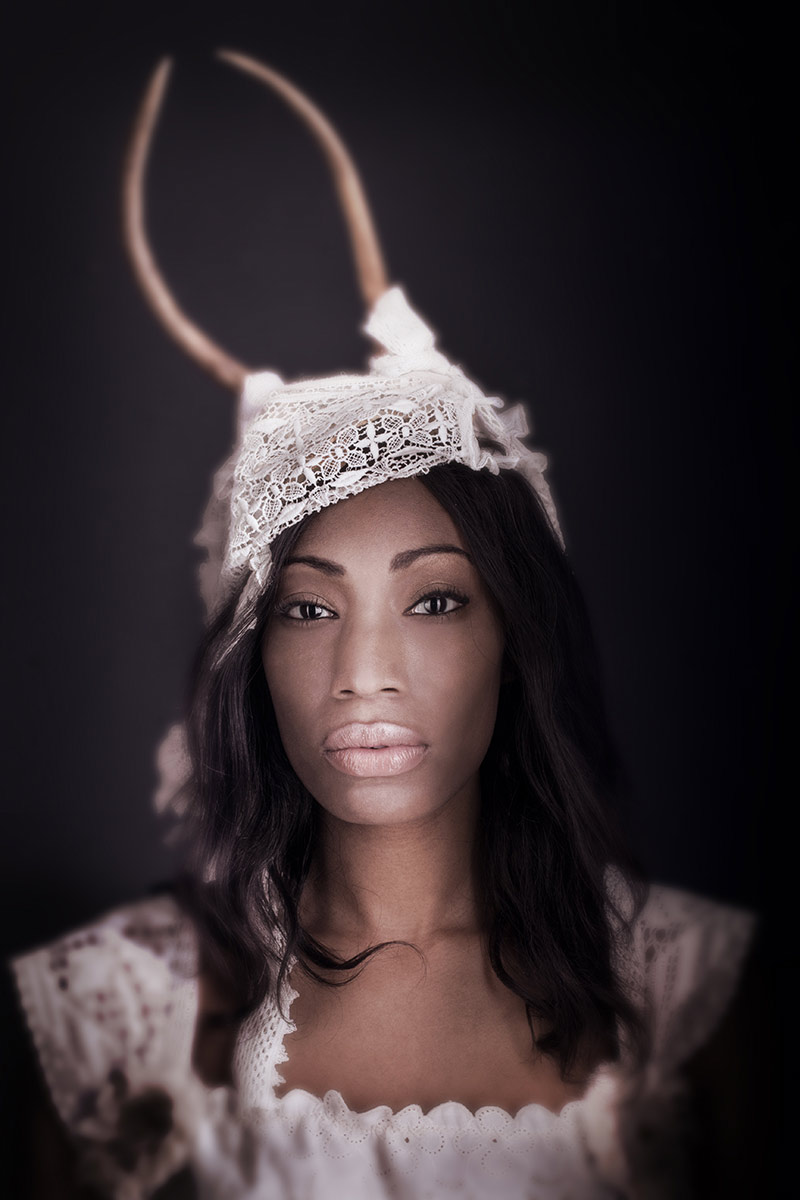
Ivy in the Studio.
My studio had bright white walls in a cove. I didn’t want this image to be on a white background so I moved Ivy far enough away that the light on her had no effect at all on the white wall behind her. It was simply way too underexposed to render at all.
Controlling the exposure through the Inverse Square Law is one of the more important tools you will have at your disposal.
And get this – it doesn’t cost a penny.
ASSIGNMENTS FOR THIS CLASS:
- Using a light source of your own: (studio strobe, speedlight, continuous light) place the light close to the subject and then move the subject AND light source closer to and farther back from a single background. Notice how the image presents itself as you go closer to the background with your subject and light, and what happens when you take subject and light farther away.
- Place camera and background at a fixed point. Then move your subject into the f-16 and make an exposure. Move back to f-11, then f-8, f-5.6, f-4 and if you can f2.8. What happens to the background as you move the subject closer to it and adjust exposure.
- Build your string meter. See below.
Find a piece of good, smallish rope. Clothesline will do nicely.
Put your light on a stand, and run the string straight out from the flash. The flash should be set at 1/8 power if possible. Not full. It should be on “normal” zoom setting neither on telephoto or wide angle.
- Using a meter and a remote flash trigger, find the exposure point for f-4 by going down the rope and aiming the ambient light meter dome directly at the strobe. Keep going until you find the point where f-4 is noted on your meter.
- Using a knot or marker, note that point as f-4.
- Now find the middle of the rope and note it with knot or marker.
- Between the end of the rope and the middle (left side) put a knot or mark in the middle of that area.
- Between the middle of the rope and the end to the right put a knot or marker
- On the right side, now find the middle between the end and the first mark, and knot it or marker
You now have simple rope meter that will be incredibly accurate in all situations.
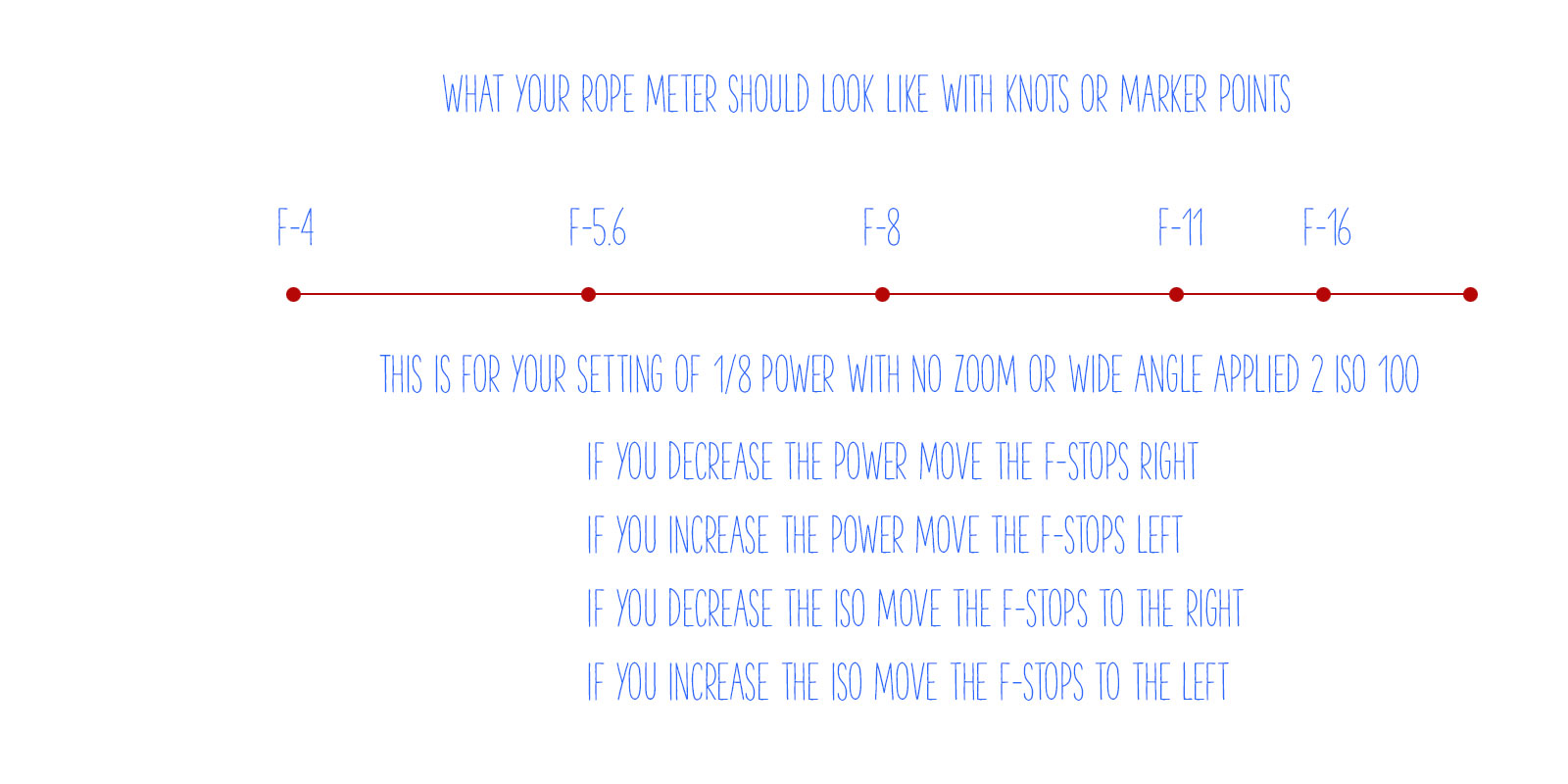
Finding f-4 is the most important part. Use a lightmeter for best results.
If you want to use a gray card, make sure it is at a very slight angle to the light source so it will not have a specular for the camera to see (the reflection of the light source). Shoot at f-4 until you find the distance that will render a single line of pixels in your histogram dead center. That is perfect exposure of a gray card.
Of course, you must fill the lens with the gray card, no extraneous stuff in the viewfinder – just the gray card.
Hey Amazon… REALLY? Are You Kidding Me?
WHAT THE FUCK?. "On March 18, 2014 Amazon Technologies, Inc. (an operating subsidiary of Amazon.com, Inc.) obtained a United States Patent (8,676,045) for a “Studio Arrangement” and a “method of capturing images and/or video.” ibook-store-widgetMany photographers will...
My Favorite Film Cameras and Film Choices
We do so many cool things in P52 and this idea is one a lot of the photographers are picking up on. We are going to have a fun little 'assignment' to shoot 24 frames of film in May. Just 24... but we want all of them to be 'good shots'. What started as a one shot per...
“Air” by Meggan Joy Trobaugh
At the Project 52 2014 group, the assignment was "Air". There were many wonderful submissions. This one by Meggan Joy Trobaugh was exceptional I thought. She carefully planned out the work and made the elements for the final work with a previsualized image already in...
A Fall Workshop in the Canyons Announced
The workshop is a blast. We all pile into a large, comfortable van and head off to Northern Arizona. Our first night is in Flagstaff, then off to the reservation lands of the Navajo, Vermillion Cliffs, Marble Canyon, Kaibab Plateau and more. We spend an afternoon and...
“Black Angels” – An Assignment for a CD Cover
This week the Project 52 PROS for 2014 are working on an CD album cover for a faux assignment. The music is George Crumb's "Black Angels" for Electric String Quartet. It is very challenging music. The students for this morning's Friday class really knocked it out of...
A Life, A Lifetime, and a Tie
John Thomas Banta had over 200 ties. Most were bold, loud, occasionally whimsical and always hard-to-miss. In short, they were very much like him. He dressed for occasions, often wearing his wildly interesting ties. And he lit up the room with his presence. He was a...
Is Giving One’s Images Away for Free a Brilliant Marketing Move?
... or a very very bad idea? Trey Ratcliff (Lost in Customs) has always given his images away on the Non-Commercial Creative Commons License. What is new today is his link to grab ALL of his favorite 500 images for free and download them in full high res form. See...
“What Should Photographers Charge in 2014?” – A Discussion with Rosh Sillars
My bud Rosh Sillars' recent article on "What Should Photographers Charge in 2014?" really hit home with me and a lot of my Project 52 PRO's. Pricing and figuring out what to charge is always a very difficult part of starting a photo business, and Rosh takes a very...
Shooting a Beer with Rui Bandeira
We have so many talented people in the Project 52 PRO group. Meet Rui Bandeira. He shared this shot with my last night and I knew I had to share it with you all. Here is Rui: "Hi, I had 3 goals for this shot: 1) it had to be fresh and make the viewer desire to drink...
Photoshop Repair: Bri in the High Desert
I like to play around in Photoshop a lot, and when I do I am going to start sharing what I do with my Project 52 Pros. And anyone else who wants to know what I do. I am not putting myself out there as a Photoshop Guru by any stretch of the imagination. I am simply...
WHY I AM CHUCKING ALL MY GEAR AND RETURNING TO SAND PAINTING AS MY VISUAL MEDIUM.
I have always loved sand. When I was a kid I would play in it, except when mum let the cat play in it first, and then it smelled sort of like my little brother, but... I digress. Cameras are obsolete. We hear every day about this new gizmo and that new gizmo, and how...
Project 52 Summer Group Opens For Registration
More Information on this page.
Book Ideas: “What If…”
What if. What if you created a magazine instead of a book? Told a story or two in the magazine, showed a subject in depth, then printed 10 copies for influential art directors in your town and offered all who came to the site a PDF? (Blurb does magazines for as little...
ISLA: A New Book by Ernesto Bazan, Photographer
"No, I don’t [do assignments]. I stopped doing that, more or less, when I decided to become a teacher in 2002. Because of my workshops, I had to leave Cuba in 2006, which is ironic. I fund all my work thanks to the generosity of my students. This will be the third...
What Is The Biggest Problem with Your Photography?
The biggest problem may also be the one that most people focus on. No pun intended. "So let’s get the elephant out of the bag most of you keep it in and into the room where we can discuss it: most people are complaining about their cameras because otherwise they’d...
Photographs = Communication = New Creative
Photographs as communication. The new uses of photography continues to grow. "It’s not that my memory improved but, instead, that I started archiving these events and ideas with my phone, as photographs. Now, if I want to research the painter whose portraits I admired...
Omaha
I have been asked by Christopher Tierney to come out to Omaha for a workshop. I have not done workshops for a while, but I really like the midwest and look forward to spending some time there. REGISTRATION PAGE IS NOW READY. For more information, please click on the...
Documentary Photography with a Fresh Twist
PHOTOGRAPH BY MICHAEL DAVID FRIBERG Michael Friberg and Benjamin Rasmussen find a fresh way to explore the conflict in the Middle East. Part reportage, part editorial, they create a powerful new way of communication on a contemporary problem. “The way that we shoot...
The Last Project 52 Assignment for the 2013 Group
"Cooking With Chili" is the name of the faux cookbook. The assignment was to shoot to the layout. The students did a magnificent job with this, and I want to share the work with you all. You can see the layout, and it was provided as a layered PSD file to the...
Irene Liebler’s “Cooking With Chili” BTS Work
Irene Liebler is a photographer/designer in Connecticut. She is also a Project 52 member and has developed quite a unique style. This is a recent image for an assignment on P52, a "Cooking With Chilis" Cookbook Cover, shot to layout. In this post, she walks you...
Art And Its Detractors
"How has your art been received in your community? Do you have any detractors?" "Oh, yeah. That comes up all the time. If you really, really commit to something, someone will hate you for it. And that’s ok. But the further you pursue your art, and the more you come to...
“NO” versus “YES” – Which Got The Most Response?
On the previous post I mentioned, almost in passing, how negative articles and stories are more highly engaged than are positive ones. A few minutes later, this catches my attention: Just Say NO "So, one answer to my student’s rhetorical question is “Just say NO.” As...
On Change Changing What was Changed…
... or something. My friend Jan Klier (NYC) and I were discussing the recent Getty move to grant access to millions of images for only a byline. He feels it is a good move for photographers, and while I am still somewhat ambivalent we both agree that the worst thing...
Chocolate: Two Shots
Photographer David Price shows us two ways to light chocolate. In the first shot, he is using a very large light source. The source is above and behind the chocolate, and that masks the individual color of the items. This is because the specular - the reflected light...