
DISTANCE OF THE LIGHT SOURCE FROM THE SUBJECT
The second principle of light is the distance of the light source from the subject.
One thing for sure, if it is artificial light, the distance of the light source from the subject can change the size relationship, but there are other things that happen as well.
With artificial lights, one of the most important rules is The Inverse Square Law.
And it can be kinda scary that one. First, it’s a law. That seems pretty definite. And of course it has something to do with math – ‘squared[. But the word INVERSE? What the heck is that?
Let’s not sweat that right at the moment.
Let’s just acknowledge it for what it means to us.
Essentially, the Inverse Square Law (ISL) means that the farther the light is from the subject, the less bright it will appear. We know that, right. The closer we get to a light source, the brighter the reflectance of that source from whatever we are bringing close to the light.
Say you are in a very dark room, and there is only one small light in the corner. You are desperately trying to read the calory count on your small bag of Cheetos but it is way too dark where you are. Well – simple, we take the Cheetos bag over to the light and as we get close to the light, we can instantly read that we are never allowed to eat Cheetos again.
Now that is way too simple for any rule, or LAW, especially one that concerns math and something called Inverse.
The ISL is a way of measuring that light fall off and it shows us that there is actually a formula to how much that light falls off. Formulas are great. They are like systems. We can use them over and over to achieve the results we need.
This formula is way simpler than the name implies:
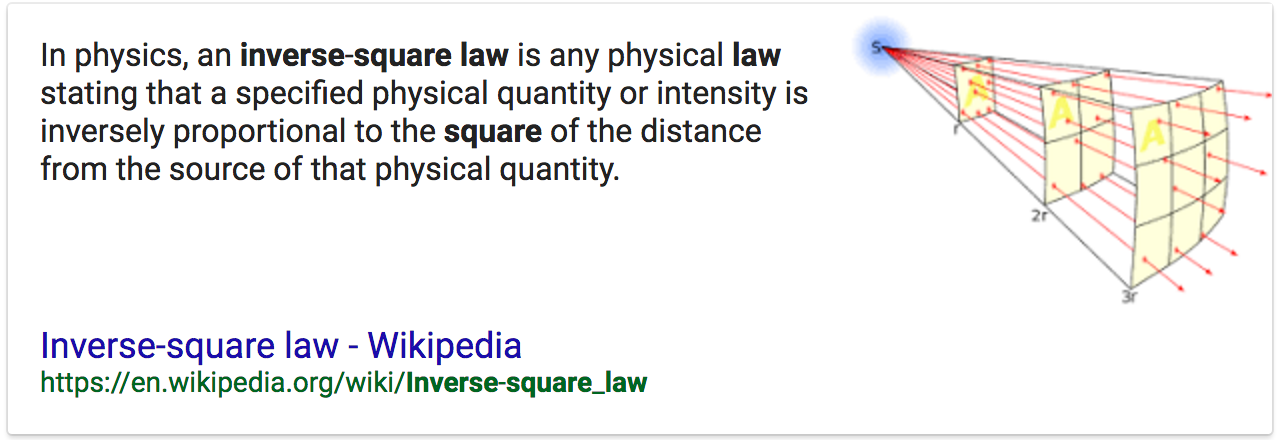
As you can see in the illustration above, at twice the distance the light has to cover four times as much space making it four times less powerful.
Four times less = 2 stops less in f-stops.
So if the light was f-8 on your subject at 4 feet, and you moved the light back to 8 feet, the amount of light on the subject would now equal f-4. If you started at f-4 at 8 ft and moved the light in to 4 ft it would be f-8.
What if instead of moving the light from 8 ft to 4 ft you decided to move it in 6 ft? Well, that would be half way between f-8 and f-4… f-5.6.
Now look at what happens when we apply the rule to a set of distances.
THE IMPORTANCE OF KNOWING RECIPROCALS
A reciprocal is simply understanding the relationships between all the numbers we throw around in photography.
F-stops, shutter speeds, ISO – all work hand in hand with each other to make the image with correct (for you) exposure. Changing any one of these three will necessitate a change in one of the others to compensate.
Let’s look at ISO:
f-4 / 1/125 @ ISO 100
If we change that to ISO 200 one of those above will have to change. Either the f-stop or the shutter speed. Since the ISO is now one stop more powerful, we either have to change to f-5.6 or change the shutter speed to 1/250. Both of these changes have the affect of decreasing the exposure setting one stop due to increasing the ISO by one stop.
Simply knowing the basics of one set will make it easy for you to re-configure for a new set.
I use ISO as my constant. In this case, I will use the settings of Sunny 16 (f-16 at 1/ISO).
ISO is 100 for these reciprocals.
f-16 @ 1/100
f-11 @ 1/200
f-8 @ 1/400
f-5.6 @ 1/800
f-4 @ 1/1600
f-2.8 @ 1/3200
These are committed to rote memory.
Changing the ISO compels me to make associated changes in these figures. If the ISO goes faster, I simply change the f-stop OR shutter speed to correlate to the amount of change in ISO. If the changes go out of the range of my camera, I will change one first, then catch up the other.
Example:
The light is getting a bit low, and I want to shoot with a shutter speed that allows me to hold the camera still. I take a meter reading and find that at ISO 100, my exposure for that shot is f-4 @ 1/15. Well, that aint’a gonna work for me handheld.
So first I decide that f-4 should be f-5.6 because of some Depth of Field issues (which moves the shutter speed down to 1/8), so that means I will have to move the ISO one stop for that aperture change to:
f-4 / ISO 100 @ 1/15 to f5.6 / ISO 100 @ 1/8 (reciprocal, one less stop in shutter speed to correlate with additional stop in aperture.
f-5.6 / ISO 200 @ 1/15
f-5.6 / ISO 400 @ 1/30
f-5.6 / ISO 800 @ 1/60
Learn your reciprocals for faster and more accurate decisions in the field.
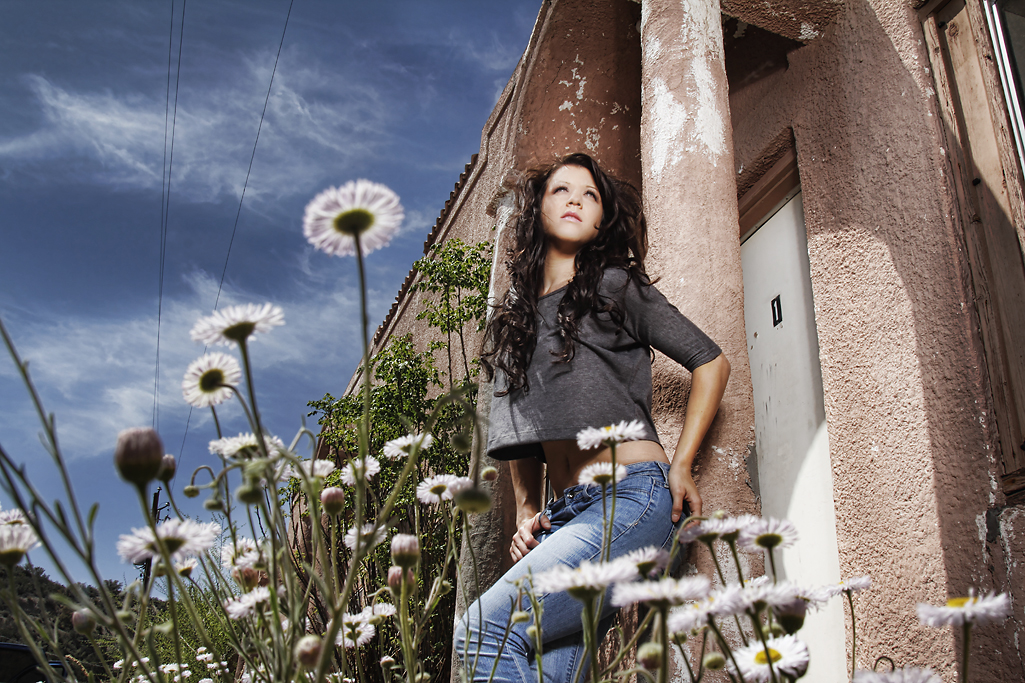
Bri in Miami.
I didn’t want the old building to go too dark behind her so I moved her next to the column. This gave me the ability to move the light in close to her, and let the background fall off fast – but retain the light and the texture right around her so she didn’t ‘pop’ out and look too overly lit.
This is a 4ft softbox with a Profoto 300 WS head and a single diffusion panel in the softbox. It is just above camera viewpoint in this shot – very close to her. You can see the light falling off as it reaches her knees.
I wanted the shot to appear somewhat realistic and not “strobed” so a careful blend of one stop over the ambient was chosen.
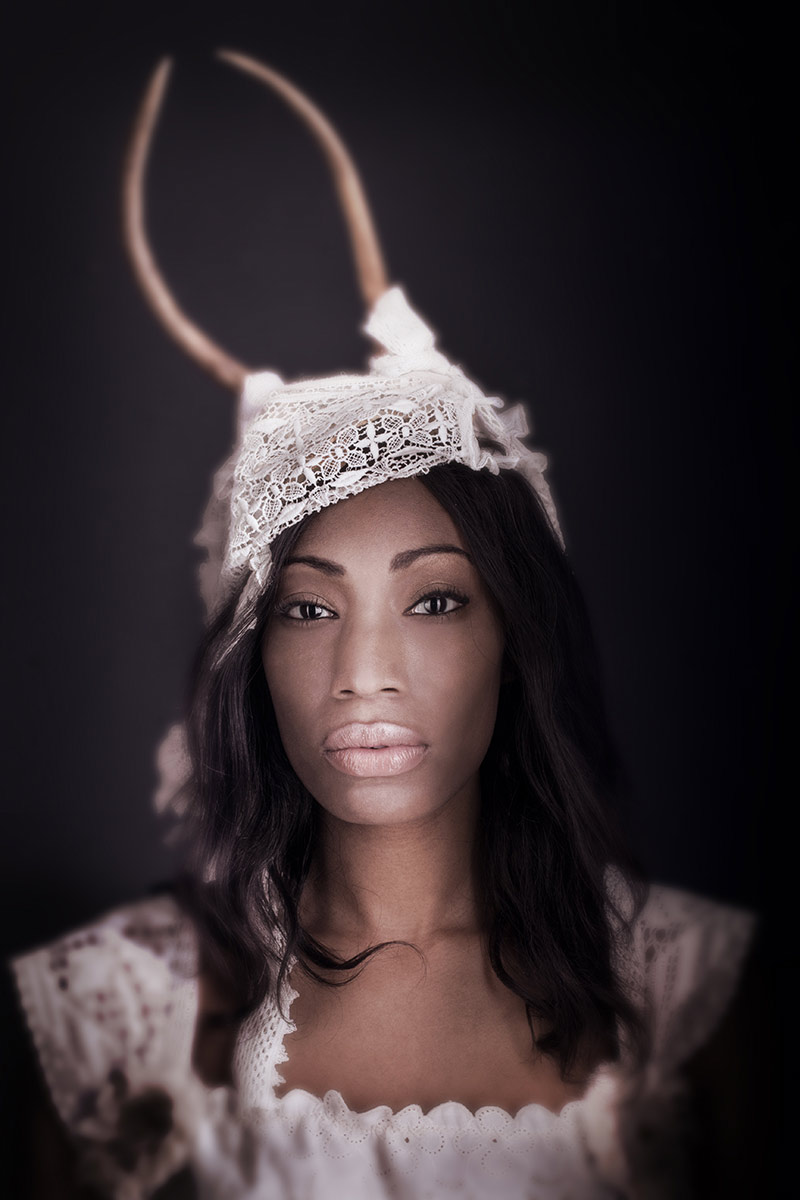
Ivy in the Studio.
My studio had bright white walls in a cove. I didn’t want this image to be on a white background so I moved Ivy far enough away that the light on her had no effect at all on the white wall behind her. It was simply way too underexposed to render at all.
Controlling the exposure through the Inverse Square Law is one of the more important tools you will have at your disposal.
And get this – it doesn’t cost a penny.
ASSIGNMENTS FOR THIS CLASS:
- Using a light source of your own: (studio strobe, speedlight, continuous light) place the light close to the subject and then move the subject AND light source closer to and farther back from a single background. Notice how the image presents itself as you go closer to the background with your subject and light, and what happens when you take subject and light farther away.
- Place camera and background at a fixed point. Then move your subject into the f-16 and make an exposure. Move back to f-11, then f-8, f-5.6, f-4 and if you can f2.8. What happens to the background as you move the subject closer to it and adjust exposure.
- Build your string meter. See below.
Find a piece of good, smallish rope. Clothesline will do nicely.
Put your light on a stand, and run the string straight out from the flash. The flash should be set at 1/8 power if possible. Not full. It should be on “normal” zoom setting neither on telephoto or wide angle.
- Using a meter and a remote flash trigger, find the exposure point for f-4 by going down the rope and aiming the ambient light meter dome directly at the strobe. Keep going until you find the point where f-4 is noted on your meter.
- Using a knot or marker, note that point as f-4.
- Now find the middle of the rope and note it with knot or marker.
- Between the end of the rope and the middle (left side) put a knot or mark in the middle of that area.
- Between the middle of the rope and the end to the right put a knot or marker
- On the right side, now find the middle between the end and the first mark, and knot it or marker
You now have simple rope meter that will be incredibly accurate in all situations.
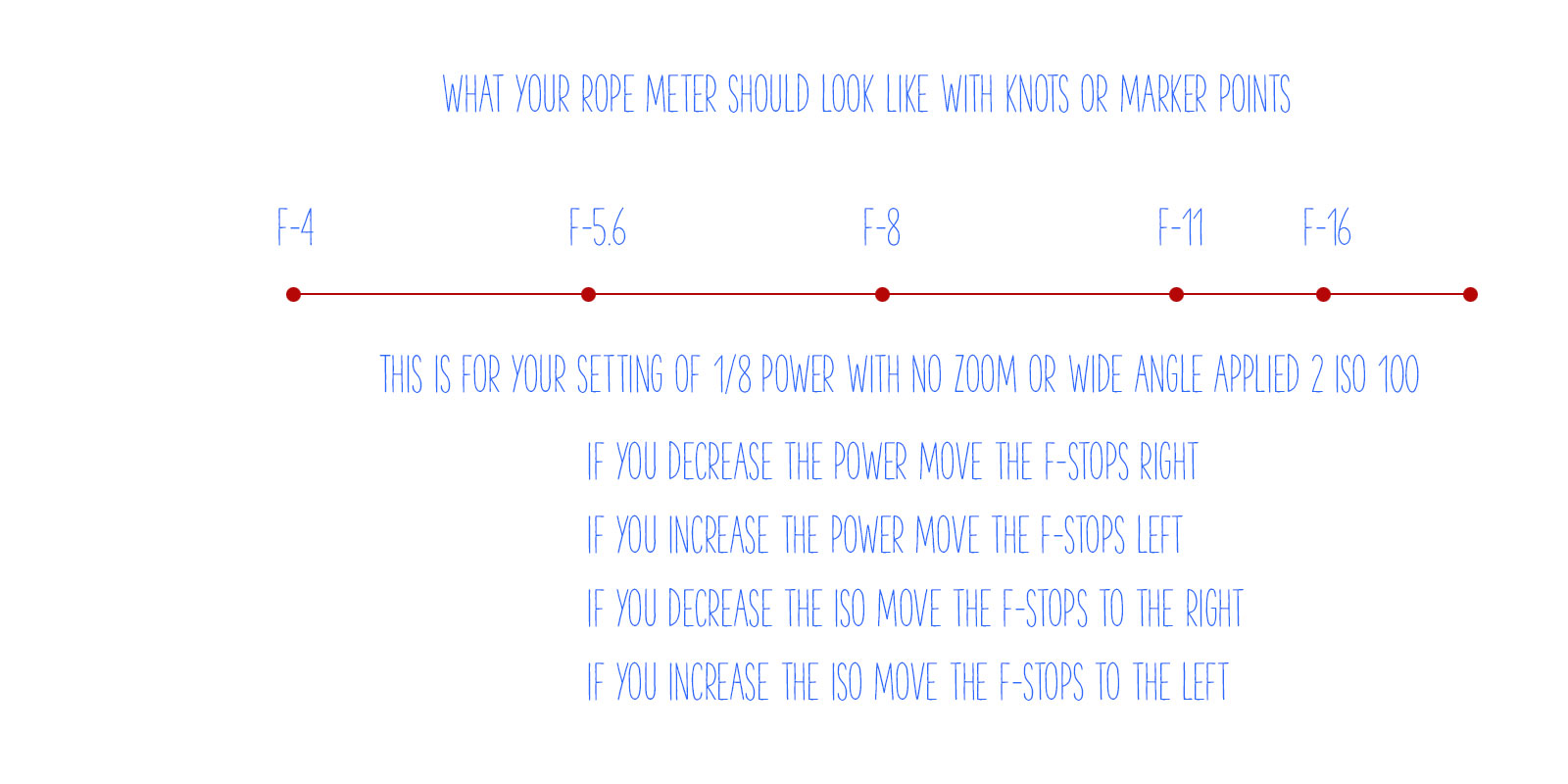
Finding f-4 is the most important part. Use a lightmeter for best results.
If you want to use a gray card, make sure it is at a very slight angle to the light source so it will not have a specular for the camera to see (the reflection of the light source). Shoot at f-4 until you find the distance that will render a single line of pixels in your histogram dead center. That is perfect exposure of a gray card.
Of course, you must fill the lens with the gray card, no extraneous stuff in the viewfinder – just the gray card.
Inspired by Sarah Moon: 8 Week Portrait Class Student Work
This week we studied the work of Sarah Moon for inspiration. The students looked at Ms Moon's work, analyzed it, found what they liked and used it for inspiration. The goal is not to copy the masters, it is to understand them and let that understanding inspire the...
“Protectionism” is NOT The Way of Professional Photographers
The "Protectionist" Attitude Among Photographers Well, not all photographers, but a considerable few. Enough that they can make a lot of noise and bluster. I don't suffer that attitude well, never have. The whining about how there are too many photographers and how we...
Lighting Essentials Place Among Photography Blogs
Very excited to see that Lighting Essentials is the number 16 highest rated photography blog, overall. There is a whole lot of information on the page about designations for certain criteria that LE can certainly improve on. But heck... I am very happy to be up there...
Portraits Inspired by Yousef Karsh
This past week we looked at the work of Yousef Karsh. The students in the 8 Week Portrait Workshop are learning a ton and putting it to practical use. Here are their images from last weeks assignment. [gallery link="file" columns="6"...
Creating a Photo Portfolio That Represents Your Work
“What makes a photograph “Portfolio Worthy” I want to talk about what makes an image worthy of your portfolio today, and have you think about your work in possibly a different sort of way. What is your portfolio, anyway? It is the repository of the work you have made,...
6 New Books I Have Ordered
From Amazon: "W magazine is renowned for its avant-garde fashion stories, those elaborate confections of magic and mystery that have inspired and captivated readers for more than two decades. This volume gathers 10 of the most remarkable stories, each in its entirety,...
A Simple Tool for Shooting To Layout
Shooting for the web has created some interesting configured imagery. From very wide and narrow images for banners to tall and skinny images for side bars, shooting to layout is as important as ever. Here is a simple video for making a viewing tool that can help you...
Portraits Inspired by Victor Skrebneski
In the 8 week portrait class we looked at the work of famed Chicago photographer Victor Skrebneski. The students were asked to make a photograph inspired by what they saw in Skrebneski's work. Not to copy it, but to be inspired by it. Here are the remarkable expamples...
Distraction, Discontent and Distruption (Part One)
Distractions, Discontent, and Disruption The three “D’s” of the new daily discomforts. Wait, is that a fourth? We are constantly being distracted from our work, made to feel discontent at every turn and facing disruption in our business like never before....
Trends to Watch in 2015
Trends I am noticing: Social Media Thinning. Photographers are becoming more selective in where and how they spend their time in social media. This is a good thing. Not every SM platform is right for you and what you do.Facebook may be find for consumer shooters, but...
Providing Cover – Keeping Clients
Finding someone to “cover” for you on a photography assignment can be tricky business. Not just for your client, but for you AND the person who you hire to do the shoot in your place. Look, stuff happens. We all get sick or a relative passes away or there is emergency...
What I’ve Learned So Far: Thirty One; “I Love Photography… I Always Have”
{This is the final post of the "What I've Learned So Far" series and it will become a book very soon. All of you may download it for free if you are interested. I hope you enjoyed the series. I've learned more than just this, but I figured wrapping it in a month long...
What I’ve Learned So Far: Thirty; “The Overwhelming Mystique of Negativity”
"You can't do that anymore. The market is full of photographers." "Nobody is making any money in this business." "Why the hell would anyone want to go into the professional photography now, all the clients have dried up." I know. We hear that all the time. Nothing new...
What I’ve Learned So Far: Twenty Nine; “Overnight Success? I’ve Got Your Overnight Success Right Here!”
I read all about "overnight success" and usually I just smile to myself. Of course I do not believe them, but that's OK - they are always great entertainment. I remember an interview with the band "Foreigner" where the gushing interviewer mentioned their meteoric rise...
What I’ve Learned So Far: Twenty Seven; “Baggage Sucks”
What do I mean by "baggage"? I mean the crap we think about when we are making our work, the stuff that goes on between our ears that may have NOTHING at all to do with reality, but begins to weigh on us with false intentions and ruinous decisions. When I was younger...
What I’ve Learned So Far: Twenty Six; “Be Deliberate”
Be certain. Be sure. Be deliberate. Now this may sound strange coming from someone who advocates challenging everything, finding new solutions, and experimenting, but they actually go very well together. When I say be deliberate, I am talking about a process from 0 -...
What I’ve Learned So Far: Twenty Five; “Now and Then, Turn It Off”
I am writing this on Christmas Day, 2014. Not gonna do too much today. Spend time with the family, have a quiet read, and listen to some of my favorite music. There are times we must do this after long periods of stress and hyperactivity. It is our way of...
What I’ve Learned So Far: Twenty Four; “Photography is a Privilege”
Is making a photograph easy? Good question... although the question should really be; Should making a photograph be easy? We seem to expect it to be. I see the ads about how easy it is to "click" and get a picture. Kodak said it decades earlier: "Push the button and...
What I’ve Learned So Far: Twenty Three; “On Creativity”
Occasionally we run into the argument of whether or not 'creativity' can be taught, or does it have to be born within us? We read all about creativity and how important it is. We award little statuettes to really "creative" people. Creativity is blessed, cursed,...
What I’ve Learned So Far: Twenty Two; “Photography Is an Incredible Art”
Photography at its best can be a reflection of the world in ways that we have never been seen before. It is the photographer's vision that makes the image become more than it could have been. But at the heart of the photographer's vision, there is a deep foundation of...
What I’ve Learned So Far: Twenty One; “Don’t Be A Clone”
Nobody likes a clone. A clone is a copy, a non-authentic 'ringer' that has no soul, no guts, no passion, no quirks or guilts or pleasures. And it is way, way too easy to be a clone. Just copy something or someone and do that as you. But it is you. Case in point. A...
What I’ve Learned So Far: Twenty; “Gravity; A Force of Nature, Not a Way of Life”
One of the more difficult things to wrap our arms around is that not everyone out there wants us to succeed. In fact, the numbers are highly stacked against us. More people will seem to want to douse your flame of passions before it gets lit than will block the wind...
What I’ve Learned So Far: Nineteen; “It Isn’t What You Shoot, It’s HOW You Shoot What You Shoot”
In the 'business' of photography some things have changed drastically since I started out a long time ago. From "day rates" to "snip tests" some of what we did as a normal part of our creative lives have either vanished or have been recreated into some new language -...
What I’ve Learned So Far: Eighteen; “It Costs What It Costs”
Have you ever purchased a car? From a dealership? All the run around they do, the "let me take this to my manager" BS, and the "hey, what do you want to spend per month for this little honey..." makes me cringe. I am a marketer, and that stuff makes me laugh. But it...