
Subject Centric Lighting
LIGHTING ESSENTIALS WORKSHOP: SUBJECT CENTRIC LIGHTING
I hope you enjoy this workshop.
It is the culmination of decades of being a working, professional photographer and having to meet the challenges of making images for other people. Other people with high expectations and demands for the work. Other people who didn’t necessarily care how hard it was to make the shot they wanted, they wanted that shot. Now.
Being a photographer in a small market meant I didn’t necessarily have a strict specialty, although people and still life did make up the bulk of my work. I would occasionally shoot architecture and food, as well as the now and then corporate shoot.
I wasn’t really a ‘generalist’, but some weeks it seemed as though my assignments were as unrelated as they possibly could be.
One week I had a food shot going on in one corner of the studio, with a catalog shoot going on in the other part. All of this while I was shooting a lingerie shoot for an ad agency in the rest of the studio. Heady times, long hours, really damned fun.
This workshop will take us through many of the ways to light photographic subjects. And lighting is, as they say, lighting. Yeah, I am so old I remember when “off camera flash” was simply called lighting.
We are going back to that time. Lighting is lighting and the goal is always the same: to make an image that represents what we see in our mind’s eye. Knowing what we want is step one, making it happen with the tools at hand is step two.
The assignments will be given one per week. They will remain in place for future photographers. You do not have to start at the beginning, but the first five lessons are absolutely important to review before moving to the assignments you want to do.
SUBJECT CENTRIC LIGHTING
I call my system “Subject Centric Lighting” because the subject plays a bigger part in the lighting than the lighting gear does. How a subject renders the lighting we apply to it, and how the camera receives that light is what makes our images interesting.
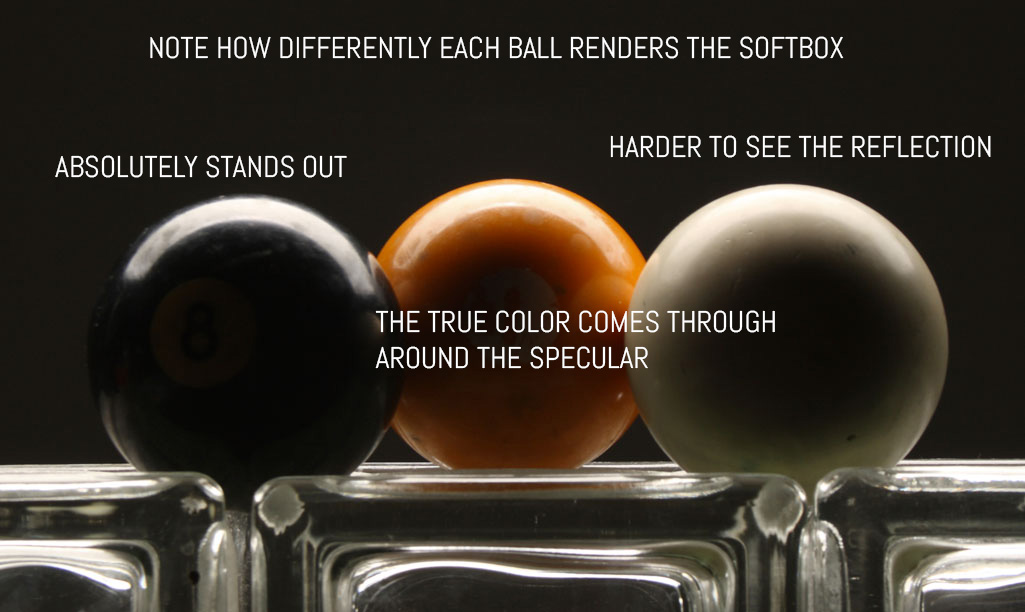
Subject Centric Lighting recognizes that light does the same thing every time. It is the subject that changes the way the light reflects back to our camera, not the light tool we choose to light the subject with. Lighting a dark bowling ball with a soft box presents a far different rendition of the light than using the same light for a white bowling ball. Everything is changed – from specular presentation to shadow fall.
But more of that as we go along.
First, let’s get into the basic principals of light and lighting.
LIGHT DOES THE SAME THING EVERY TIME
It must. Otherwise, we could never control it.
Imagine a saxophone with its many variations of keys. A sax player has to know that if a certain set of keys are pushed, a specific sound will come out. If it was random, then no music could be produced. There would be no point in learning the saxophone since there was no knowledge to be applied that would render it usable.
The same with lighting. We have to know that if we have a flash at 1/4 power, 15′ from the subject, that a specific exposure will be generated. We can control how much exposure that is by changing the ISO of course, but always at any specific setting that flash will produce the same measurable amount of light. Every time.
It is the same thing with modifiers. A softbox will look like a softbox when it is being reflected from a shiny surface. An umbrella will wrap the light if used to do so based on science and physics, not some magical desire to use an umbrella.
So if light does the same thing, how can we use that knowledge to make light do what we want it to do? And if it does the same thing every time, why do images look different from each other when using the same or similar lighting?
Subjects.
Subjects are dimensional, with textures and surfaces, and shadows and speculars and more. A shiny subject renders the light back to the camera differently than a diffuse subject does. A dark subject renders the perceptible highlights differently than a light subject. Subject change, but the physics of light do not.
WHAT YOU WILL NEED:
This workshop is designed to teach you the basic principles of lighting for photography. We will have weekly assignments and you can start anywhere, anytime. There is no charge for this workshop, although we will be asking for your email so we can keep you up-to-date with all that is going on in the workshop.
We have a Facebook Group for this workshop, and you will be able to meet others in the workshop, ask questions and find out when the open webinars will be.
You will need a camera, of course. And while much of the natural light information can be used with even a cell phone camera, much of the photographic education will require a camera with aperture / shutter speed controls.
Lighting gear:
A 5-in-one reflector kit would be a great purchase since it will be something you will be available to use over and over for all sorts of image lighting effects. I call them the best bang for the buck in lighting gear.
White cards. From the Dollar Store or Target, white foam style boards will be a vital part of your gear.
Photographic light stands. A couple of cheap ones would be fine if you do not have any at the moment.
A couple of ‘A’ Clamps from the local hardware store will hold the boards and reflectors to the stands. Get the cheap ones.
A tripod will make your work a lot easier, and there are some good ones that are not expensive.
If you are going to use artificial light, there are too many options for me to tell you much other than we will be doing a lot with them. So whether you are a speedlight shooter, have a couple of studio lights, or even continuous light set ups, all the information is the same. Light is light, and the gear is there to provide that light.
We will learn to control light and make it do provide the look we want.
On the black cue ball, the light is distinctly shaped and no other light is seen. On the orange ball, we see the softbox specular, and a bit of the true tone of the orange around it. That bright orange makes the highlight specular a bit harder to see distinctly – at least as distinctly as the black ball. On the white ball, the specular all but disappears into the white true tone of the ball.
Same light is seen differently by the camera because of the makeup of the subject. We will be discussing this in length in future posts.
Light.
It is a substance that we cannot smell, touch or hear.
Can we see light? No… we can only see what it reflects from. The subject.
I will refer to that as the “presentation of the light” in this workshop. That refers to the way the subject is taking the light onto its surface, then reflecting it back to the camera lens.
No… we can only see what it reflects from. The subject defines the light… we cannot see the light in transit from source to subject, only what the subject reveals after the light has come into contact with it.
To me, that is one of the magical qualities of light, almost mysterious and yet compliant with our wishes. I think of light as a liquid when planning my lighting… it helps
I think of light as a liquid when planning my lighting… it helps me ‘see’ something that isn’t there but yet has similar properties. Direct light is like water from a hose, while diffused light is mist. Ambient is similar to fog in my mind, while umbrellas are more like garden sprinklers.
You can think of light in many different ways to help you plan your shots, but whatever you do to help, keep in mind that light does the same thing every time. Everytime. If you have a light that gives you an exposure at f-ll
If you have a light tool that gives you an exposure at f-ll on 1/2 power at ISO 100 at 6 feet… it will repeat that for you (barring some sort of malfunction) every single time you set it at that distance, power, and ISO.
The predictability of light tools makes controlling it a matter of understanding what it does and how to use the tools at our disposal to modify, control, and adjust it to suit our plan.
Even the sun is predictable. F-16 at 1/100 with ISO 100 film. (Sunny 16 Rule: F-16 at 1/ISO). This makes understanding light far easier than if it was unpredictable.
Getting the idea of what to shoot is harder than shooting it in most case… once you know how to light correctly.
Important Note:
Everything reflects. Everything.
Dark, rough fabric does not reflect as much as a shiny, painted surface. But it does indeed reflect.
It is important to know that as we begin.
We will first turn our study to the four principles of light. While I am not a fan of rules, I will say that understanding these four principles will definitely enhance your ability to handle any lighting situation you may have.
SIZE OF THE LIGHTSOURCE RELATIVE TO THE SUBJECT
DISTANCE OF THE LIGHTSOURCE
COLOR OF THE LIGHTSOURCE
ANGLE OF THE LIGHTSOURCE
Now here is the hard part: there is no hierarchy to these principles. What that means is there is no ‘first, second’, etc. Each one of these four principles are as important as the others. We do not approach it from size first, then color – or any of that. All of it is very important and all are important at the same time.
This single idea – that all four of these principles are equal in importance is perhaps the hardest one to think about – but it starts to flow when you get it down. You can do this.
Now to be sure there are times when we start with one or another of these principles because that is the biggest challenge at the moment. And those priorities will change from shot to shot. It is to be expected since we never know what is going to be in front of us at any specific moment.
LIGHT DOES THE SAME THING EVERY TIME.
And we can control that light by the way we understand the principles of light, and understand how those principles affect a given subject depending on their properties.
Let’s look at the four principles of light.
THE FOUR MAIN PRINCIPLES OF LIGHT
Two Different Approaches to Discussing Art and its Future
Well, it seems we have had some interesting discussions on the future (or lack of it) of photography as a career. I personally find the whining very unattractive, and somewhat arrogant. I found two different approaches to discussing the difficult changes facing those...
Kirk Tuck and I are doing a Workshop in San Diego: Focus on Portraiture and Light
OK... this has been in the works for a while, but it is time to take off the wraps and announce a truly special workshop with yours truly and Kirk Tuck of Visual Science Lab. We discussed it a bit last month when I was in Austin, and yesterday we decided to pull the...
Creating an Asset List for Your Photography Business
We are all familiar with lists. Lists of gear for our insurance agencies and reporting. Lists of our clients. Lists of our images. Lists of all kinds of things. When I talk about an asset list, I mean to also consider the assets that are not 'tangible'. Sure that...
Two Book Reviews on Styling for Food
Today we look at two books on food styling directed toward the photographer and the commercial approach to food images. With the lowered budgets these days, the commercial photographer is being called on to style food on many assignments. And while the pure food...
Featured Photographs from Project 52: Part Two
We are really having a blast with Project 52 - "52 weeks to go pro" and I need to share a few of the images from a few weeks projects. If you aren't participating, you should be. Whether or not you go pro, or want to, it is a mind-sharpening, skill enhancing...
Dave Siegel: Photographer. Arizona and the West
Meet my friend Dave Siegel. Dave is a photographer in Phoenix, but works all over the country for major advertising agencies and destination resorts. He has several specialties over the course of his career, and is now focused on the spa/resort industry. I met Dave a...
Gary Crabbe, Enlightened Images: Interview and Images
I am so glad to welcome Gary Crabbe to Lighting Essentials. I met Gary last summer when he contacted me to discuss designing a new website for him. We hit it off pretty quick and I was really happy when he selected me to do the redesign of www.enlightphoto.com. Gary...
Clarion Call II, and getting ready for the new LE Contest
Selina Maitreya, a great friend to Lighting Essentials, is having a second Clarion Call. If you were on the last one, you will remember how cool it was. And if you missed it, you missed one of the most important two days of photography information in a long time....
A Strategy for Going Pro as a Commercial Photographer: Part Three – Engage
A Strategy for Going Pro as a Commercial Photographer: Part Three – Engage We have gone through a basic discovery process in part one, finding out who is doing what in your area. Are there clients and agencies buying photographs and are you able to make photographs...
“Can’t We All Just Get Along?” – Well, no… apparently. SPAM rage in Adland.
(Photograph by Ryan Hyde.) (As was noted in the first comment, the CD who was the focus of this flap has replaced the website with something less onerous. That may take the heat off of the current situation, but it does NOT change the underlying situation, does it. I...
A Strategy for Going Pro as a Commercial Photographer: Part Two – Preparation
This part two of a series on Going Pro from my perspective, experience and research. (Part One here) This one we call "preparation" because before we can launch into strategical and implementation, we must be prepared. Just as a surgeon prepares for his craft with...
Potpourri Friday: Some new and some old – but all about Photography
From the series: Girls looking off camera at stuff." Well, it is Good Friday, and this weekend will be a blur. But I wanted to get some thoughts down before I hit the schedule for the upcoming Project 52 and workshops. First from the web: Some really good reads: From...
Need Inspiration: Try “Immersion”
Have you ever needed some inspiration? Maybe the batteries were a little low and the doldrums of creative deadlock begin to swirl around your camera. Maybe you had to do something really creative and simply needed to see some stuff to “get the juices going.” And then...
What Do You See When You Look at a Photograph?
What do you see when you look at a photograph? Simple question. How you answer it may reveal what you find important in imagery. I was once in a gallery at a large Arizona University. We were looking at a show of a photographer who had just completed his Master’s...
Some thoughts on Photography as I wait for a plane in Omaha
I am in a hotel in Omaha as I write this. Kind of a jumble of ideas and notes I wrote while thinking about my place in the world. I know what you are thinking… right now my place in the world is Omaha. Right, but I was really thinking a bit more metaphysically, so...
A Strategy for Going Pro as a Commercial Photographer: Part One: Discovery
It is one of the paradoxes of our business that one cannot get assignments until one has done assignments. “How do I get assignments if I don’t have any work to show the clients” is an often-heard complaint. And it is a complaint not without merit. It is tough to get...

Shooting to Layout: A Point of Purchase Display
One of the most difficult parts of commercial photography is shooting to layout. A designer or art director has an approved layout, and your shot must work within the elements on the page. We see it a lot in catalog, advertising, collateral, and web oriented...
A WordPress Plugin for Photographers
Because… Natalia (and it’s Friday)
Jake Stangel on Starting Out as a Professional Photographer
Jake Stangel is one of my favorite photographers. I love the fresh way he shoots, and his no-nonsense approach to making images that reveal more than what may meet the eye in the real world. First: here is an hour talk he gave at CCA, and it is really good. (Below is...
Shooting to Layout: P52 Members are “Cooking” with heat!
The assignment was given with a "napkin" layout. A very simple sketch similar to what we get from AD's from time to time. Then the photographers got to download the layout - and shoot to that layout exactly. It is one of my favorite assignments because we get to see...
A Few More Portraits
The 8 Week Portrait Classes are now finished. I added a bonus photographer on for each of them (9 photographers per class) and this is the gallery of inspired images from the bonus photographer for the 8 Week II class, Mark Tucker. We look at the work of the...