
Module One-B: Finding Clients
Finding Clients and Getting Your List Started
This is the time to start looking around for businesses that are in your two lanes of work. Use your phone camera, notepads, or whatever you want to use to get the names and addresses of potential clients. Use the Google method as well as the AI methods and start getting your list together.

Course Details
Module
One-B / Create Your List Now
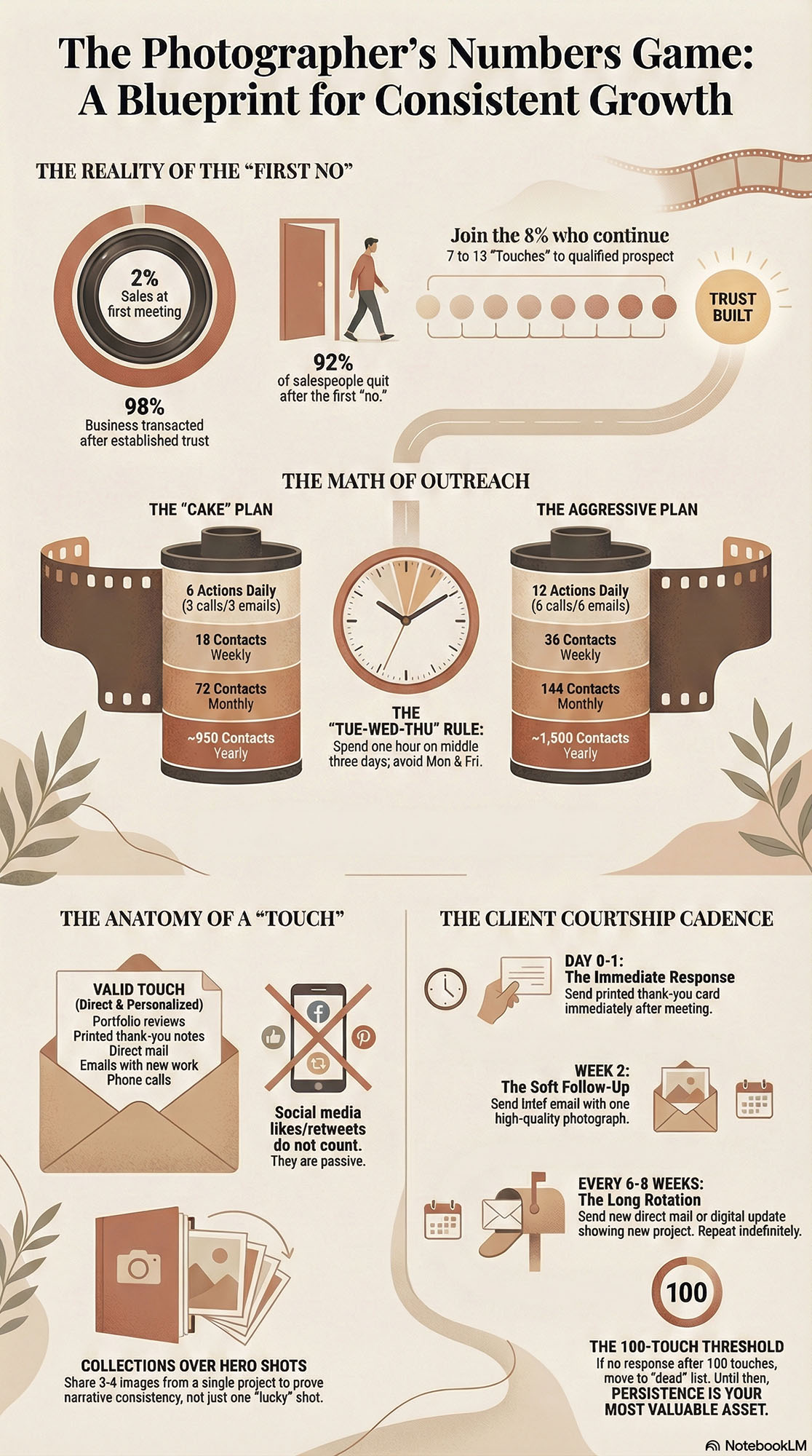
Operational Marketing Implementation Plan: A Numbers Game Strategy
Operational Marketing Implementation Plan: A Numbers Game Strategy
1. Executive Philosophy: Overcoming Professional Resistance
In the creative economy, talent is a baseline requirement, but volume is the actual engine of success. Strategic growth is not a lottery; it is a mathematical function of consistent outreach. The “Numbers Game” mindset demands an unsympathetic rejection of the “Stagnant Talent” archetype—the professional who waits for the phone to ring while perfecting a portfolio that no one sees. Active promotion is the only reliable path to business sustainability. If you are good, it is your professional obligation to ensure that every potential buyer in your niche is aware of your existence.
The primary obstacle to this execution is “Resistance.” This is not a lack of time; it is a psychological barrier designed to keep you small. Resistance typically manifests through:
- The “Not Ready” Trap: Endlessly tweaking a website or “the book” as a way to avoid the vulnerability of outreach.
- Procrastination disguised as Polish: Waiting for the “perfect” project to justify a contact.
- Fear of Rejection: Treating a lack of response as a personal failure rather than a data point in a long-term cycle.
- The Busy-ness Fallacy: As a consultant, I see this constantly. You are so busy not being busy that it is simply not possible to spend an hour a day making your business successful.
The “Mediocre Marketer” will always outperform the “Stagnant Talent” because the probability of being hired is zero if the client is unaware of you. To shift from amateurism to professional dominance, you must move from an emotional relationship with your marketing to a mathematical one.
2. The Mathematical Blueprint: Contact Volume Tracks
A data-driven approach to outreach eliminates the uncertainty of “hope-based” marketing. When you commit to the math, you remove the daily decision-making process that allows Resistance to take hold. The following tracks represent the industry-standard commitments required to move from the stagnant 80% to the high-earning 20%.
Outreach Volume Comparison
| Plan | Daily Goal (Actions) | Weekly Volume | Monthly Volume | Yearly Impact |
| Minimum Commitment (Cake Plan) | 3 Contacts + 3 Emails | 18 Actions | 72 Actions | ~950 Actions |
| Aggressive Growth Plan | 6 Contacts + 6 Emails | 36 Actions | 144 Actions | ~1,500 Actions |
The industry’s 80/20 Rule is not an accident of fate; it is a reflection of time investment. Statistics show that 80% of photographers spend less than one hour per week on marketing, while the elite 20% who capture the bulk of the revenue dedicate 15 hours or more. By hitting these yearly volume targets, you are mathematically separating yourself from the “Stagnant Talent” and entering the tier of professional winners. This volume is the foundation upon which your weekly schedule is built.
3. Operational Cadence: The Weekly Execution Schedule
To maintain a high-volume strategy without burnout, you must adopt a rhythmic, three-day workweek for active marketing. This cadence respects the client’s planning cycles while ensuring you remain a consistent presence rather than a sporadic “hustler.”
The Tuesday, Wednesday, Thursday Schedule
Active outreach is restricted to the middle of the week to maximize receptivity:
- Monday Exclusion: Clients are focused on planning their week or recovering from the previous one; unsolicited outreach is perceived as an intrusive distraction.
- Friday Exclusion: Decision-makers are often mentally “checking out” or handling end-of-week crises. Engagement levels are at their lowest.
The Follow-Up Rhythm
Professional outreach is a slow courtship, requiring a specific cadence of “touches”:
- Day 0 (The Immediate Touch): Immediately following a meeting or portfolio review, send a physical, printed thank-you card. The physicality of a card carries significantly more weight than a digital message and reinforces your brand’s attention to detail.
- 2-Week Mark: Send a brief follow-up email. Attach exactly one specific, high-quality photograph to keep your work fresh in their mind without requiring a link-click.
- 6–8 Week Rotation: Transition into the long-term cycle. Reach out every two months with new work or a direct mail piece.
- The “New Work” Reset: The only valid reason to break this rhythm and ask for a new meeting is the completion of a significant new body of work. This “Reset” protects your reputation from the “spam” label while demonstrating your evolution as an artist.
4. The Methodology of the “Touch”: Building Professional Trust
Securing a high-end commission is a process of building trust, not selling a commodity. Research confirms that 98% of sales occur only after the “7-to-13 Touches” threshold has been met. Most professionals quit at the third touch; the winners understand that the first six touches are simply the cost of entry.
Valid vs. Invalid Touches
A “touch” is only valid if it is a deliberate, direct action that puts your work in front of a decision-maker.
Valid Touches (Counted toward goals):
- In-person portfolio reviews (the highest value touch).
- Physical, printed thank-you notes.
- Direct mail pieces and promotional items.
- Personalized emails containing new, specific work.
- Direct phone calls for appointments.
Invalid Touches (FORBIDDEN):
- Social media “likes,” “retweets,” or “pins.” These are passive digital noise and do not constitute a marketing move.
Warning: The “Commodity” Trap. You are not selling “toner cartridges” or accounting services where there is a constant, logistical need. You are selling a creative vision. Therefore, do not launch immediately into BANT questions (Budget, Authority, Need, Timing). Asking about the budget or if they are the “purchaser” in the first interaction is a major turn-off. Your goal is “top-of-mind” status, ensuring you are the first professional considered when a visual problem eventually arises.
5. Visual Strategy: From Hero Shots to Narrative Collections
The industry has moved away from the solitary “hero shot” toward a demand for storytelling and visual problem-solving. Art directors need proof that you can sustain a narrative across a campaign, providing diverse assets for web, print, and social formats from a single shoot.
The Collection Strategy
Instead of a single highlight, your promos must feature 3–4 related images from one project. This demonstrates:
- Consistency: Proving the quality wasn’t a “lucky shot.”
- Versatility: Showing multiple perspectives (wide, detail, portrait) of a single subject.
- The “Dance Company” Analogy: Just as a dance company requires unison among its performers, your portfolio must reflect a cohesive style. Even across different subjects, you must maintain a Signature Look through a consistent color palette and lighting style.
The Personal Project Protocol
To fuel the high-volume requirements of the Numbers Game, you cannot wait for commissions. You must be “heavily shooting” personal work. These projects are not “fillers”; they are the primary source of the “wow” factor and emotional connection that commercial commissions often lack. High-end clients want to be emotionally moved, and your personal passion is what facilitates that “inside track” to premium contracts.
6. Persistence Management and Lead Disposition
The “Numbers Game” is won by the 8% of professionals who persist where 92% of their competition quits after the first “no.” Persistence alone puts you in the elite tier of the industry.
Persistence Math and Lead Disposition
- The “Dead Lead” Threshold: A prospect is only removed from your active rotation after 100 touches with zero response. Until that threshold is met, they remain in the 6–8 week cycle.
- The 1,247 Rule: For those who are truly committed, remember the hyperbolic “magic number” of 1,247 touches. While humorous, it underscores the philosophy: you keep going until they hire you or tell you to stop.
CRM Methodology: Conscious Connection
Avoid complex, automated sales software that produces impersonal, generic blasts. These tools turn your outreach into “spam,” which is worse for your reputation than no outreach at all.
- Manual Tracking: Use a simple spreadsheet or a notebook. Manually logging each contact forces you to remain “conscious” of the individual relationship. You must personally know what you sent them last and when you spoke.
The “Numbers Game” is not a search for luck; it is a commitment to the hard, droll, and often messy work of consistent outreach. By adhering to this mathematical cadence, you ensure that when the right job arrives, you are the professional who is already top-of-mind. Stop procrastinating. Kick Resistance’s ass. Do the math.
1. Walk the Commercial Neighborhoods (Not the Cool Ones)
This sounds obvious. It’s not.
Walk or drive the “working” parts of town:
-
Strip malls
-
Light industrial zones
-
Old downtown corridors
-
Warehouse districts turning semi-hip
Look for:
-
Bad signage
-
Outdated menus
-
Inconsistent branding
-
Websites printed on windows (always a tell)
If a business looks like it’s trying but failing visually, that’s not a red flag—that’s a lead.
2. Google Maps Is a Gold Mine (If Used Ruthlessly)
Search by category:
-
“restaurant”
-
“coffee roaster”
-
“brewery”
-
“boutique”
-
“maker”
-
“manufacturer”
Then:
-
Click through 10–20 listings
-
Open their websites
-
Screenshot the worst imagery
Patterns emerge fast:
-
Stock photos everywhere
-
No product shots
-
One hero image used for ten years
-
Instagram feed doing all the heavy lifting
This isn’t about judging.
It’s about spotting visual gaps.
3. Chamber of Commerce + Business Associations
Nobody wants to join these. That’s why they work.
Have them:
-
Download the member directory
-
Look at sponsors for events
-
Note businesses that pay to be visible
Sponsors = businesses that already understand marketing spend.
Those are not cold leads. They’re warm and badly served.
4. Local Printers Know Everything
This is a sleeper move.
Local print shops:
-
Menus
-
Packaging
-
Brochures
-
Event signage
Printers know:
-
Who just rebranded
-
Who is opening soon
-
Who is constantly changing materials
-
Who complains about “needing better photos”
Photographers don’t need an intro.
They need a conversation.
5. Job Boards (Yes, Really)
Indeed, Craigslist, LinkedIn—search for:
-
“Social media”
-
“Content creator”
-
“Marketing assistant”
-
“Brand coordinator”
Why?
Because businesses hire these roles when they can’t solve the visual problem internally.
If a bakery is hiring a “part-time social media person,” what they really need is:
-
Better images
-
A cleaner visual system
-
Fewer panic posts
That’s an opening.
6. Study Who’s Not Shooting Locally
This one sharpens positioning.
Have them identify:
-
The 3–5 photographers who dominate locally
-
What they shoot repeatedly
-
Who they don’t shoot for
Every strong photographer leaves gaps:
-
Small manufacturers
-
Boring B2B
-
Unsexy products
-
“Too small” clients
That’s not oversight. It’s opportunity.
7. Events Without Glamour
Skip the galas. Go where money quietly moves:
-
Food distributor tastings
-
Farm co-op meetings
-
Craft beverage supplier demos
-
Trade breakfasts
-
Local maker fairs
These are people selling something, not building personal brands.
They need images. They just don’t say it out loud.
8. The “Visual Autopsy” Exercise (Highly Recommended)
Have them pick five local businesses and answer:
-
Where do these images appear?
-
What job are they trying to do?
-
What’s missing?
-
What would one strong image fix?
This flips the brain from:
“How do I get clients?”
to:
“Where is photography failing to do its job?”
That’s a professional shift.
9. Rates Come After Reality
One thing to be very clear about:
Rates are not discovered by Googling other photographers.
Rates are revealed by:
-
How businesses use images
-
How often they need them
-
What breaks when images fail
Once you understand the role of photography in your city, pricing becomes calmer, not emotional.
It is my sincere hope that you take this information and create a wonderful side-hustle business that will bring you joy and some income. But I do warn that it is not an easy profession, even as a part-time worker. You will require yourself to work hard, and consistently to succeed.