
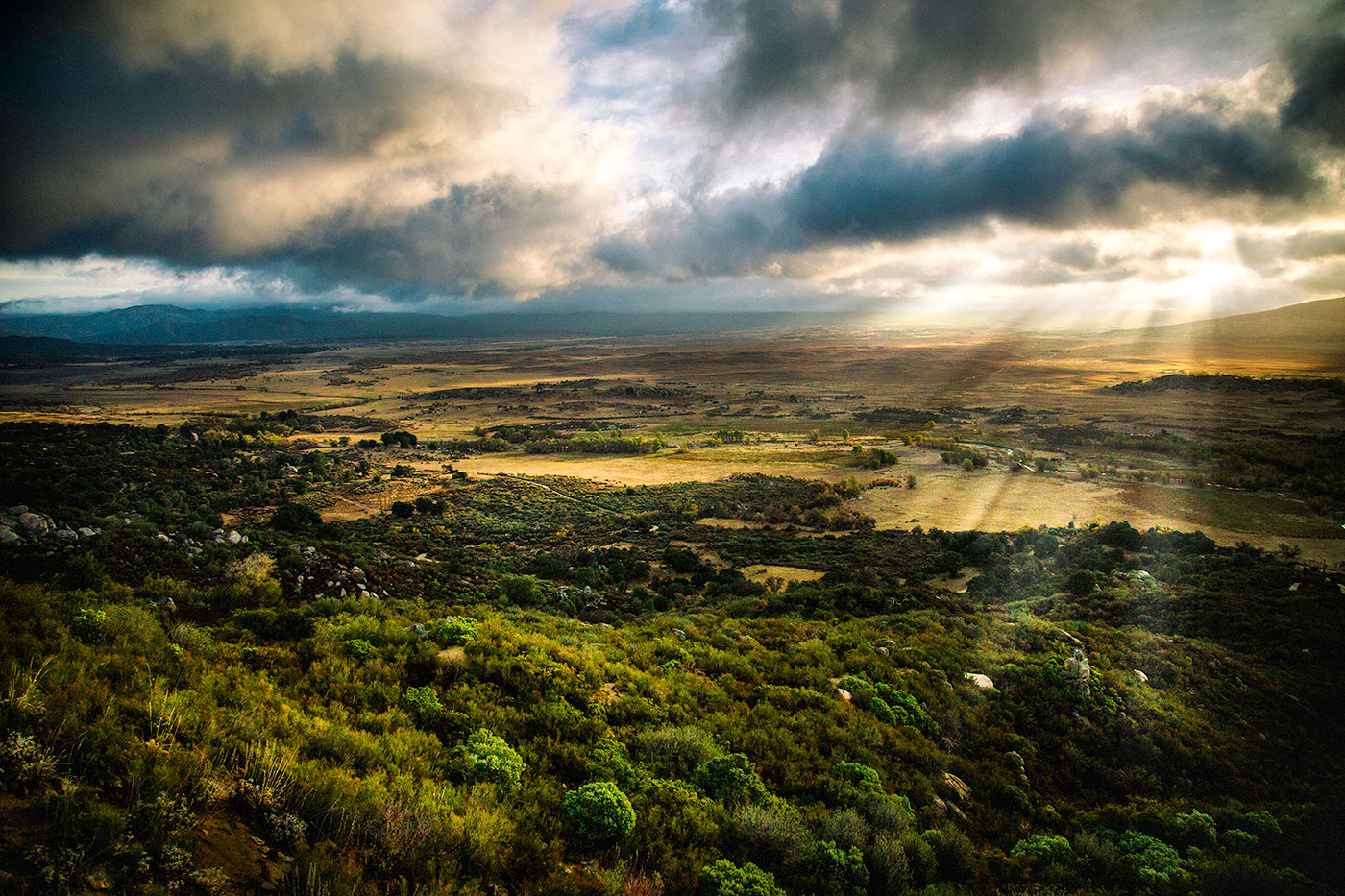
DISTANCE OF THE LIGHT SOURCE FROM THE SUBJECT
The second principle of light is the distance of the light source from the subject.
One thing for sure, if it is artificial light, the distance of the light source from the subject can change the size relationship, but there are other things that happen as well.
With artificial lights, one of the most important rules is The Inverse Square Law.
And it can be kinda scary that one. First, it’s a law. That seems pretty definite. And of course it has something to do with math – ‘squared[. But the word INVERSE? What the heck is that?
Let’s not sweat that right at the moment.
Let’s just acknowledge it for what it means to us.
Essentially, the Inverse Square Law (ISL) means that the farther the light is from the subject, the less bright it will appear. We know that, right. The closer we get to a light source, the brighter the reflectance of that source from whatever we are bringing close to the light.
Say you are in a very dark room, and there is only one small light in the corner. You are desperately trying to read the calory count on your small bag of Cheetos but it is way too dark where you are. Well – simple, we take the Cheetos bag over to the light and as we get close to the light, we can instantly read that we are never allowed to eat Cheetos again.
Now that is way too simple for any rule, or LAW, especially one that concerns math and something called Inverse.
The ISL is a way of measuring that light fall off and it shows us that there is actually a formula to how much that light falls off. Formulas are great. They are like systems. We can use them over and over to achieve the results we need.
This formula is way simpler than the name implies:
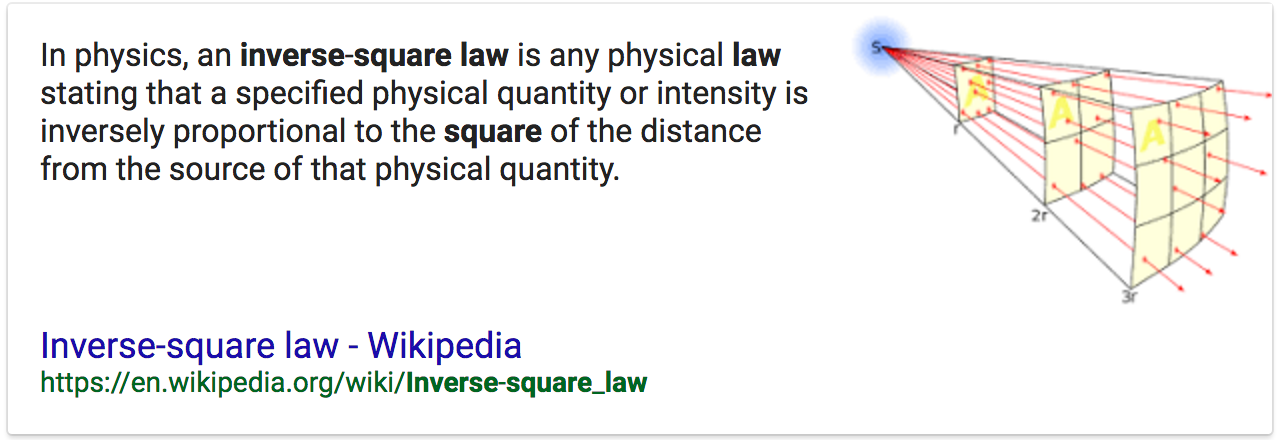
As you can see in the illustration above, at twice the distance the light has to cover four times as much space making it four times less powerful.
Four times less = 2 stops less in f-stops.
So if the light was f-8 on your subject at 4 feet, and you moved the light back to 8 feet, the amount of light on the subject would now equal f-4. If you started at f-4 at 8 ft and moved the light in to 4 ft it would be f-8.
What if instead of moving the light from 8 ft to 4 ft you decided to move it in 6 ft? Well, that would be half way between f-8 and f-4… f-5.6.
Now look at what happens when we apply the rule to a set of distances.
THE IMPORTANCE OF KNOWING RECIPROCALS
A reciprocal is simply understanding the relationships between all the numbers we throw around in photography.
F-stops, shutter speeds, ISO – all work hand in hand with each other to make the image with correct (for you) exposure. Changing any one of these three will necessitate a change in one of the others to compensate.
Let’s look at ISO:
f-4 / 1/125 @ ISO 100
If we change that to ISO 200 one of those above will have to change. Either the f-stop or the shutter speed. Since the ISO is now one stop more powerful, we either have to change to f-5.6 or change the shutter speed to 1/250. Both of these changes have the affect of decreasing the exposure setting one stop due to increasing the ISO by one stop.
Simply knowing the basics of one set will make it easy for you to re-configure for a new set.
I use ISO as my constant. In this case, I will use the settings of Sunny 16 (f-16 at 1/ISO).
ISO is 100 for these reciprocals.
f-16 @ 1/100
f-11 @ 1/200
f-8 @ 1/400
f-5.6 @ 1/800
f-4 @ 1/1600
f-2.8 @ 1/3200
These are committed to rote memory.
Changing the ISO compels me to make associated changes in these figures. If the ISO goes faster, I simply change the f-stop OR shutter speed to correlate to the amount of change in ISO. If the changes go out of the range of my camera, I will change one first, then catch up the other.
Example:
The light is getting a bit low, and I want to shoot with a shutter speed that allows me to hold the camera still. I take a meter reading and find that at ISO 100, my exposure for that shot is f-4 @ 1/15. Well, that aint’a gonna work for me handheld.
So first I decide that f-4 should be f-5.6 because of some Depth of Field issues (which moves the shutter speed down to 1/8), so that means I will have to move the ISO one stop for that aperture change to:
f-4 / ISO 100 @ 1/15 to f5.6 / ISO 100 @ 1/8 (reciprocal, one less stop in shutter speed to correlate with additional stop in aperture.
f-5.6 / ISO 200 @ 1/15
f-5.6 / ISO 400 @ 1/30
f-5.6 / ISO 800 @ 1/60
Learn your reciprocals for faster and more accurate decisions in the field.
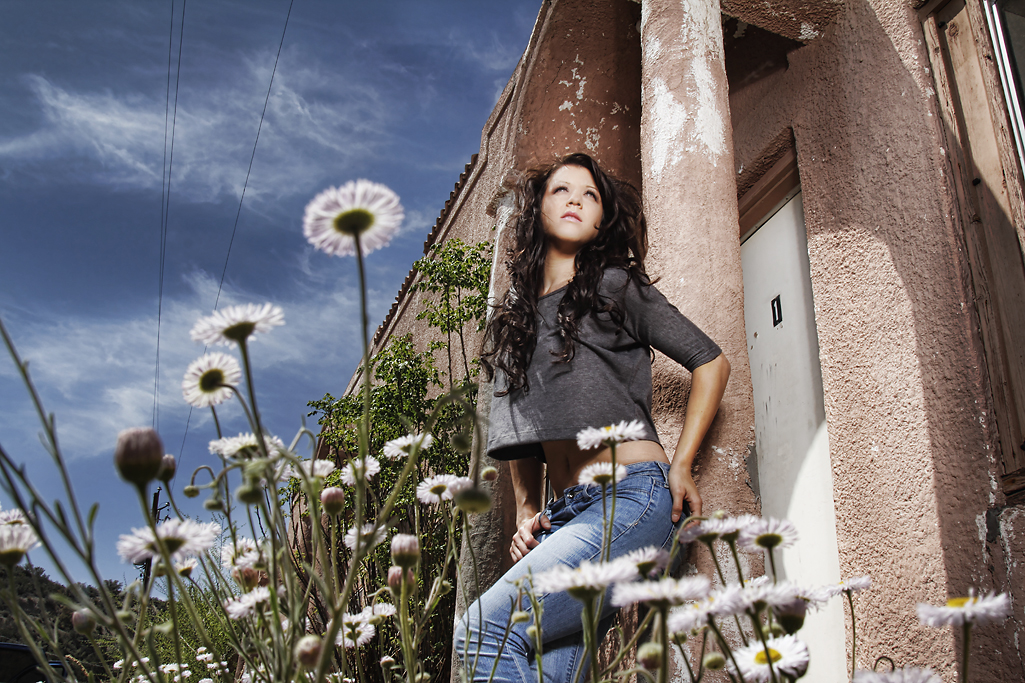
Bri in Miami.
I didn’t want the old building to go too dark behind her so I moved her next to the column. This gave me the ability to move the light in close to her, and let the background fall off fast – but retain the light and the texture right around her so she didn’t ‘pop’ out and look too overly lit.
This is a 4ft softbox with a Profoto 300 WS head and a single diffusion panel in the softbox. It is just above camera viewpoint in this shot – very close to her. You can see the light falling off as it reaches her knees.
I wanted the shot to appear somewhat realistic and not “strobed” so a careful blend of one stop over the ambient was chosen.
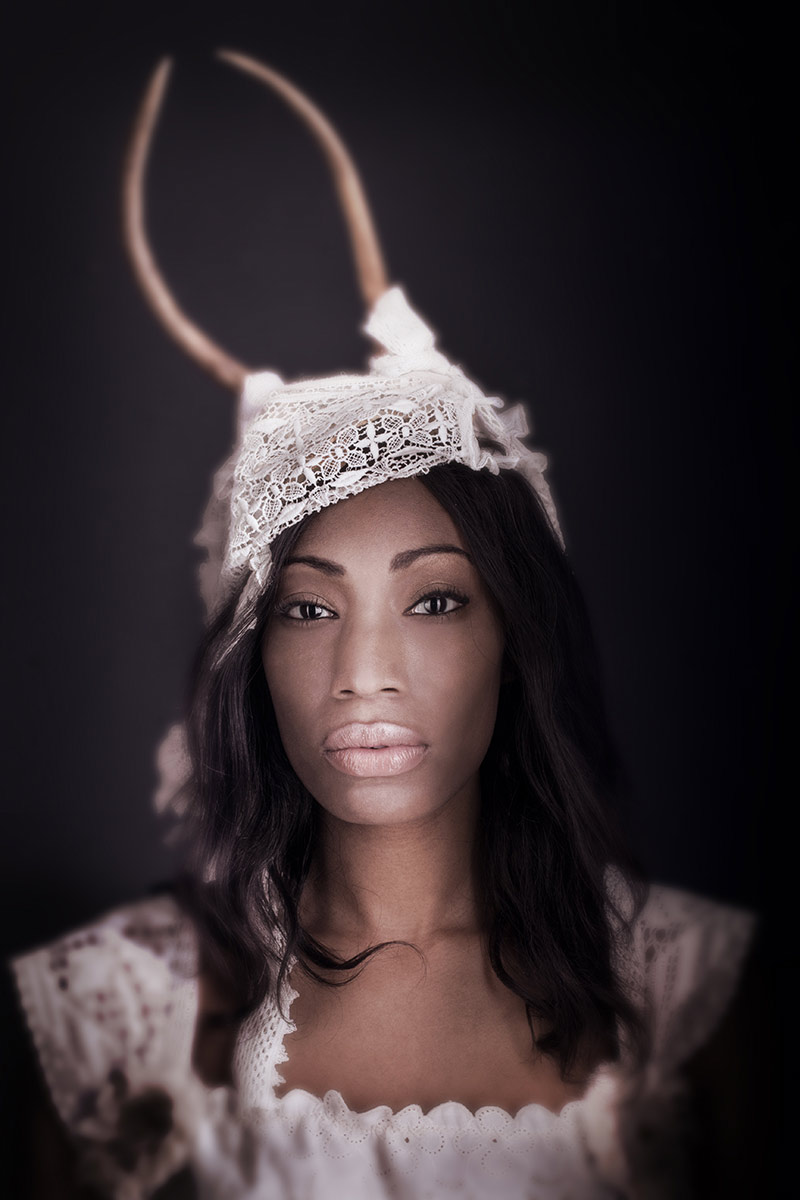
Ivy in the Studio.
My studio had bright white walls in a cove. I didn’t want this image to be on a white background so I moved Ivy far enough away that the light on her had no effect at all on the white wall behind her. It was simply way too underexposed to render at all.
Controlling the exposure through the Inverse Square Law is one of the more important tools you will have at your disposal.
And get this – it doesn’t cost a penny.
ASSIGNMENTS FOR THIS CLASS:
- Using a light source of your own: (studio strobe, speedlight, continuous light) place the light close to the subject and then move the subject AND light source closer to and farther back from a single background. Notice how the image presents itself as you go closer to the background with your subject and light, and what happens when you take subject and light farther away.
- Place camera and background at a fixed point. Then move your subject into the f-16 and make an exposure. Move back to f-11, then f-8, f-5.6, f-4 and if you can f2.8. What happens to the background as you move the subject closer to it and adjust exposure.
- Build your string meter. See below.
Find a piece of good, smallish rope. Clothesline will do nicely.
Put your light on a stand, and run the string straight out from the flash. The flash should be set at 1/8 power if possible. Not full. It should be on “normal” zoom setting neither on telephoto or wide angle.
- Using a meter and a remote flash trigger, find the exposure point for f-4 by going down the rope and aiming the ambient light meter dome directly at the strobe. Keep going until you find the point where f-4 is noted on your meter.
- Using a knot or marker, note that point as f-4.
- Now find the middle of the rope and note it with knot or marker.
- Between the end of the rope and the middle (left side) put a knot or mark in the middle of that area.
- Between the middle of the rope and the end to the right put a knot or marker
- On the right side, now find the middle between the end and the first mark, and knot it or marker
You now have simple rope meter that will be incredibly accurate in all situations.
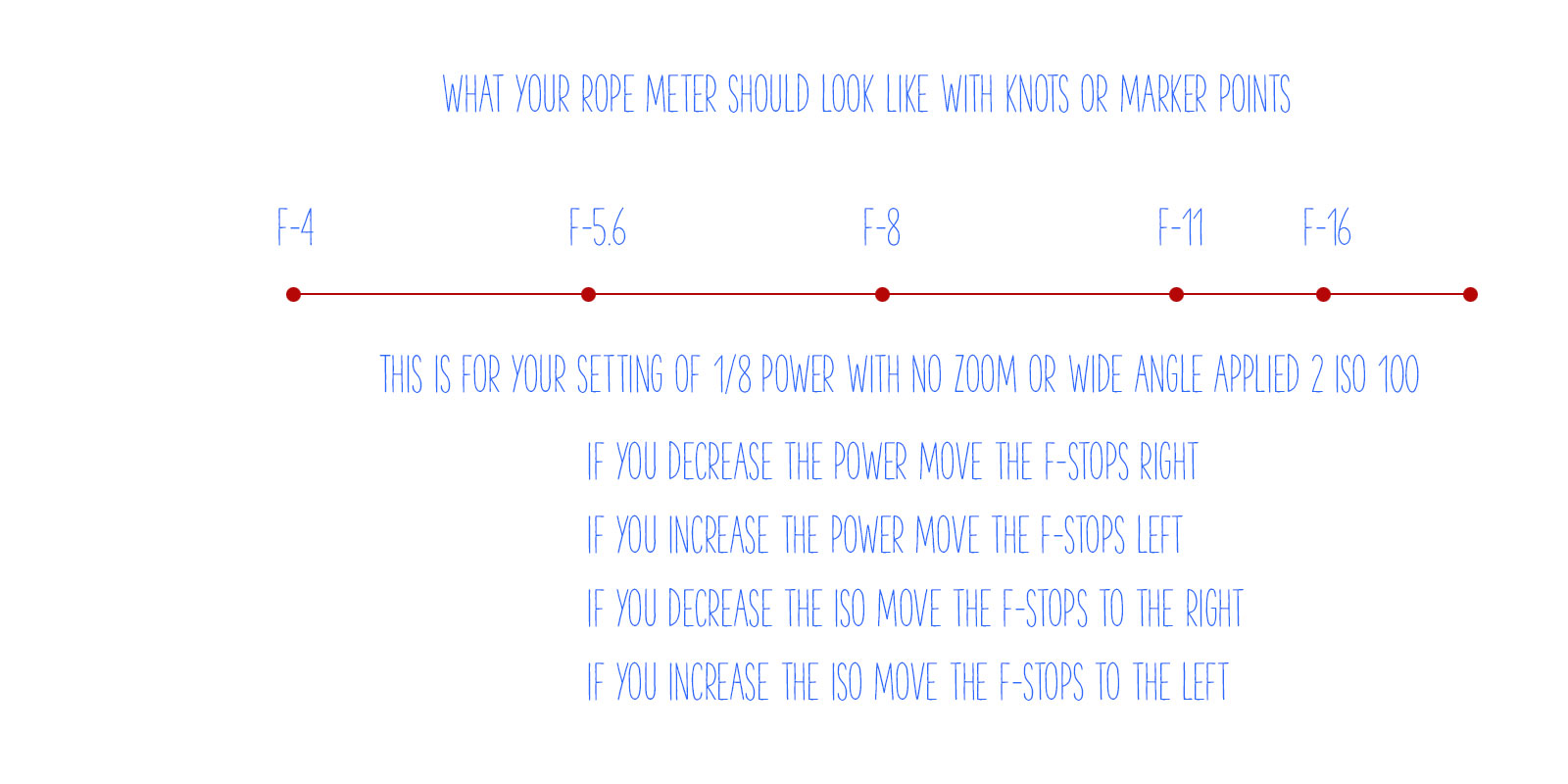
Finding f-4 is the most important part. Use a lightmeter for best results.
If you want to use a gray card, make sure it is at a very slight angle to the light source so it will not have a specular for the camera to see (the reflection of the light source). Shoot at f-4 until you find the distance that will render a single line of pixels in your histogram dead center. That is perfect exposure of a gray card.
Of course, you must fill the lens with the gray card, no extraneous stuff in the viewfinder – just the gray card.
Portrait Class Members Discuss the Workshop
"Imitate. Assimilate. Innovate." - Clark Terry, Jazz trumpet genius. This portrait class (and the companion 102 class) have been huge successes. The students are fired up and some are saying they are making the best images of their lives. We look closely at the work...
24 Frames In May
Begins today. It's a non-contest, and just for fun. Not many rules, but a few guidelines: This is for film cameras only. Black and White or Color is fine, and there are no restrictions on the type of film you shoot. Polaroid is OK. 4×5 or sheet film cameras are OK....
New Photography Books
From Amazon. I love Photography Books, and have a wall of them waiting for me when I have some quiet time and simply want to stimulate my brain. From early works of Steichen and Cunningham to books by Demarchelier and Watson, the photography book is one of my great...
Light Conversation, Volume 2
A new bi-weekly, Lighting Essentials program. I call it "Light Conversation" and we discuss all things photography. Our next discussion will be Monday, May 11. Open to all LE readers. https://youtu.be/_O4uR0bU04Y Some links from this discussion: Canon white balance...
Two New Online Workshops
Project 52 Project: Incredible Egg (Shot to Layout)
The layout was furnished and the photographers had to shoot to a fixed set of parameters. Size and position of the type could not change. [gallery link="file"...
Nicole Fernley: Cookbook Project
Project 52 members sharing recent work. Nicole Fernley: "These four images come from a larger selection of images that I recently shot for The Cheese Lover’s Cookbook, so the common thread is, of course, cheese. The cookbook author made most of the food, and we worked...
David Price: Illustrated Proverbs
David Price: "This project grew out of some recent discussions about drawing inspiration from anyone, anything, and everything around you. I admit, I drew a lot of inspiration for this idea from Irene Liebler’s series she did across last year of Common and Idiomatic...
Learning from the work of Ritts, Lindbergh and Moon; Hiram Chee
Hiram Chee, one of the longest running members of Project 52, shares a post of portraits he did during the 8 Week Portrait Class. Learning from the work of Herb Ritts, Peter Lindbergh and Sarah Moon Check it out for some wonderful portrait work.
Anders Eriksson: “Cars and Drivers”
Anders Eriksson: Anders Eriksson
From the Early Days of Color Photography
The year was 1913. I absolutely love these images. From composition through framing and of course the patina, they are simply lovely. "Mervyn O'Gorman was 42 when he took these pictures of his daughter, Christina O'Gorman at Lulworth Cove, in the English county of...
Carol Rioux “Revealing a Portrait”
Carol Rioux: "I chose to make a series of portraits of a single person. I chose this project because I am very interested in everything that constitutes a person as it is important to me to capture who a person is not just a pretty picture. I photographed parts of...
Jay Chatzkel: “The Neighborhood”
Project 52 members share recent projects. Jay Chatzkel: A Day in the Life of the Neighborhood (PDF) Jay Chatzkel
Anna Gunn “Dreams in a Suitcase”
Project 52 Member shares recent work. Anna Gunn: "Concept: a girl who carries her dreams in a suitcase. These dreams aren’t plans, or in any way constructive – they are merely a distraction from the beautiful, fleeting moments that life places in front of her. Yet...
Read more“I have always been more interested in the power of what a good photograph or film can do – not who created it and what box that creator fits into. I’m interested in the story one has to tell. We are visual communicators and we are all unique but only if we listen to our own voice and create from that voice. Whenever I have trusted and listened to my internal voice and created from my own unique perspective and my life’s experiences, I have been “on purpose” and my work has resonated across genders, race and age. I suppose I could copy or mimic the “style du jour” whether it is HDR or photographing hipsters with tattoos and attempt to be someone I’m not. I don’t have the desire to do that because that is not why I became a photographer or filmmaker. That’s not to say that I don’t like and appreciate photographers who are following these styles but it’s not me and creativity doesn’t come from mimicking others. I’ve seen a lot of styles and techniques over the decades I’ve been in the photo business. They come and they go – just like the photographers who chase after the latest trend.”
“Labels, Finger Pointing, Fear, and the Real Value of Photography”
"I have always been more interested in the power of what a good photograph or film can do – not who created it and what box that creator fits into. I’m interested in the story one has to tell. We are visual communicators and we are all unique but only if we listen to...
Catherine Vibert: Environmental Portraits
Project 52 Members share some of their recent project work over the next five posts. Catherine Vibert: "Environmental Portraits & Personal Branding. Through the course of the year of the Project 52, I found that my favorite subject to shoot is people. I especially...
Portraits Inspired by Gregory Heisler
We spent a couple of weeks studying the work of Gregory Heisler. He is a remarkably talented photographer with a very disciplined approach to image making. The goal was to learn from his approach and find the inspiration to make images from what you garnered from the...
24 Frames In May (2015 Edition)
TWENTY FOUR FRAMES IN MAY Last year the Project 52 folks were invited to a special project: shoot 24 frames of film in the month of May. The idea was to treat a single frame of film with the same deliberate attention we would give it if it were a sheet of 8x10....
Portraits Inspired by David Bailey
Monday I shared the images from the 8 Week Workshop, and today I share some from the Portrait 102 Workshop. These photographers studied the work of David Bailey and were inspired to make some lovely portraits. [gallery columns="4" link="file"...
Ten Things About ‘Creativity’
Occasionally we find ourselves in an argument of whether or not 'creativity' can be taught, or does it have to be born within us? We read all about creativity and how important it is. We award little statuettes to really "creative" people. Creativity is blessed,...
Protected: “Light Conversation” Volume One
Password Protected
To view this protected post, enter the password below:
Portraits Inspired by Jeanloup Sieff
One of the photographers we are studying in the 8 Week Portrait class is Jeanloup Sieff. This master photographer created images in almost every genre from portraits and nudes to landscape and commercial. The idea is not to copy the work of each of the photographers...
These photos are sweeet!
The project 52 group looked at photographing sweets and chocolate this week. Some very tasty images were shot by the gang. I figured since it is Friday, I should let you in on some of them.
An Open Letter to People Who Write Open Letters
Last week an open letter dispute erupted on social media. That could be said of just about any week on social media, but this time it was about a photographer and a band who wanted to use a photograph. I found myself intrigued but after reading both letters I felt...