
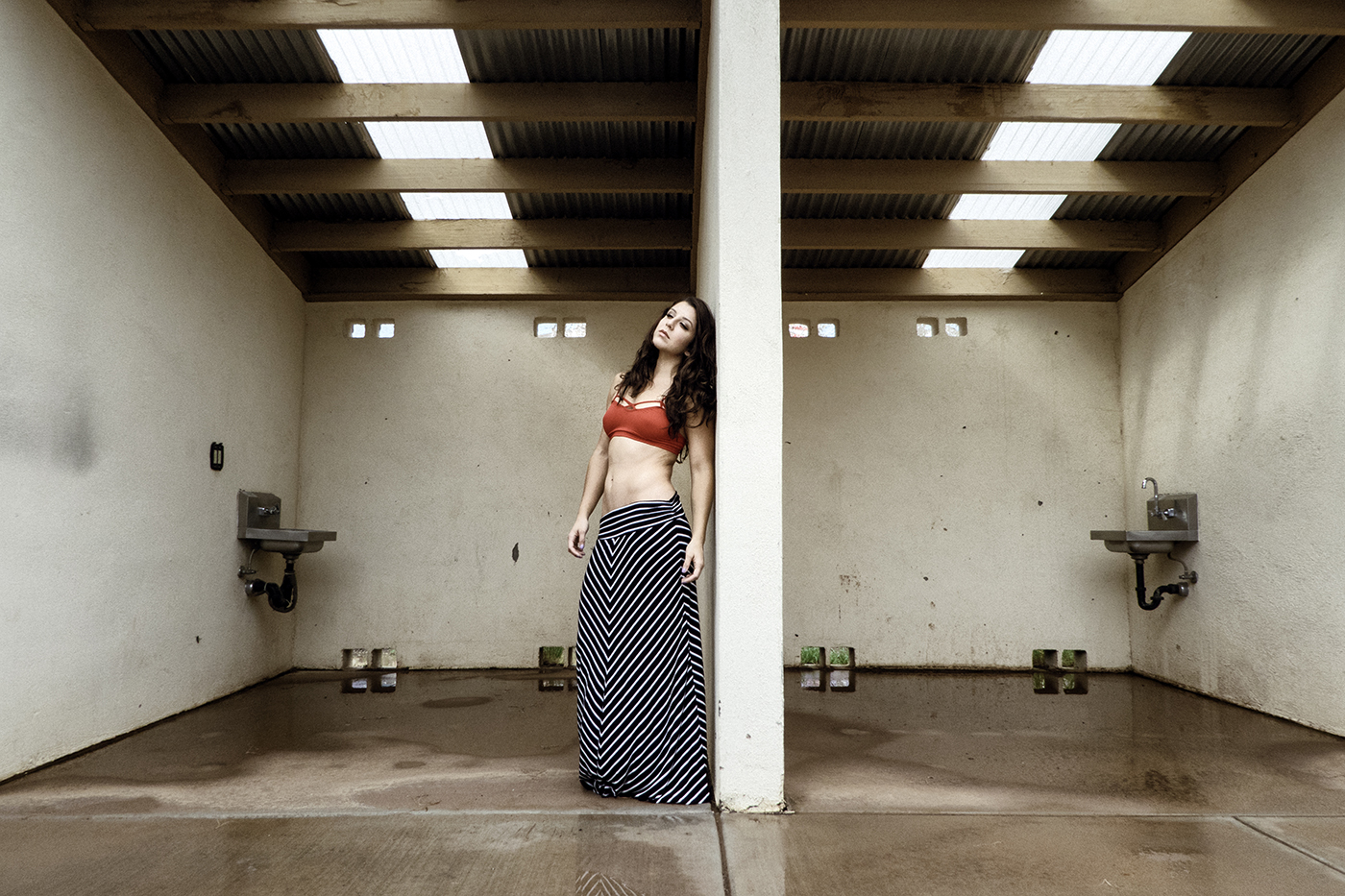
First up, the size of the light source in relation to the size of the subject.
Imagine looking out the window at the front yard and without seeing the sky knowing whether it is sunny or cloudy. We do know, right?
We don’t have to see the sky to know if it is sunny or cloudy, we can tell from the way the light is behaving on the subjects in our yard. The car has a deep shadow below it if it is sunny and very little shadow at all if it is cloudy.
The plants are either casting long shadows or seemingly no shadows. The sun makes everything have a shadow, while the cloud cover acts as a shadow reliever.
We know this because we have observed the world for our whole lives and we understand how light works when it is sunny and when it is cloudy.
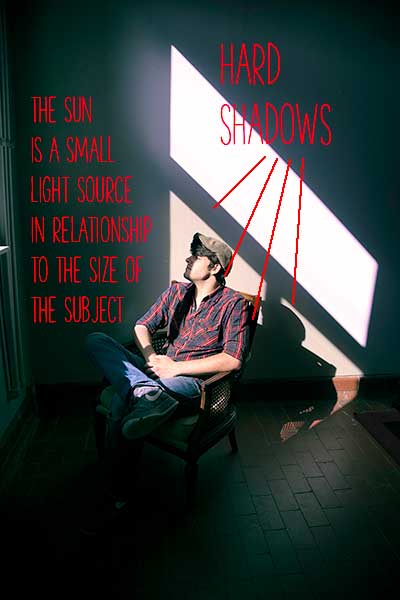
The sun is a tiny light source. (Yes, science nerds it is way huge, but I am talking about from where we look at it.) No more than a coin in the sky.
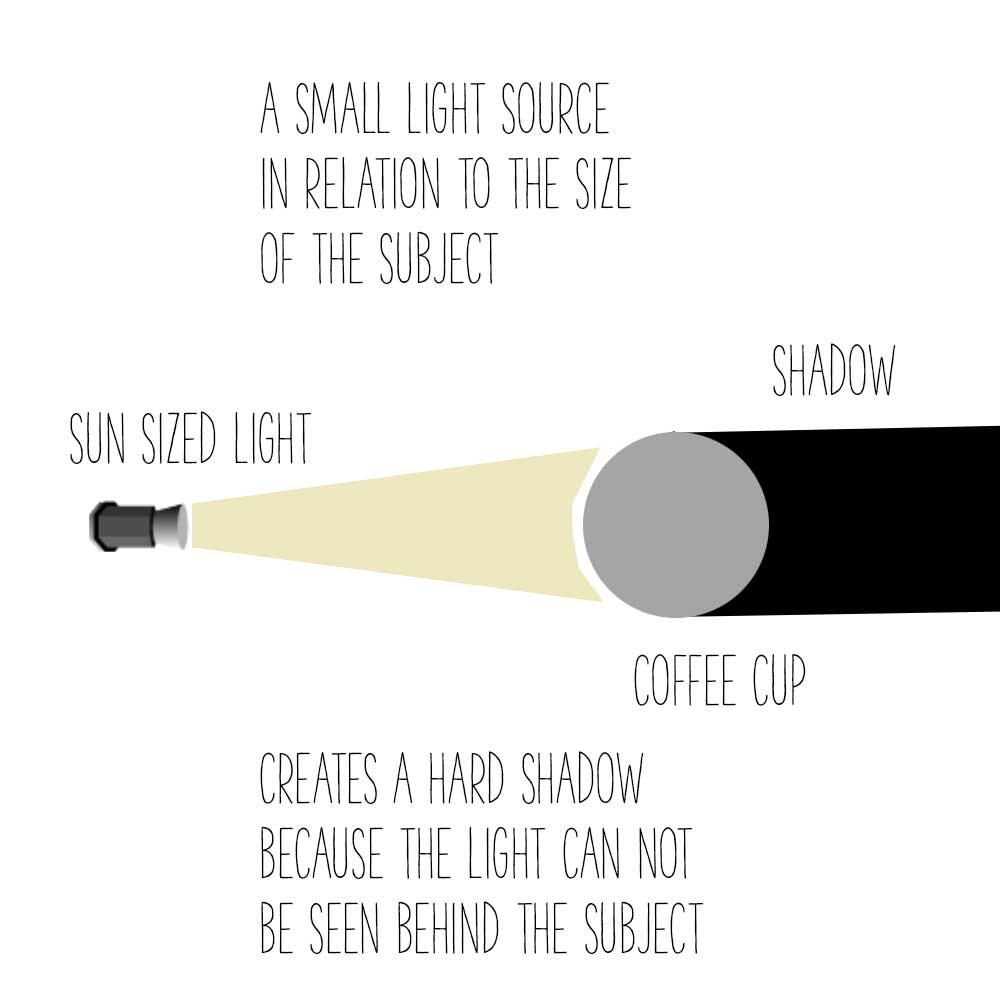
That is a very small light source. And it can be totally blocked out by the smallest of items: a branch, or a rose, or even a butterfly. That means that the light cannot go around the subject and is instead blocked by the subject.
Here is the equivalent of the sun in the studio. A small, unmodified light at a distance from a coffee cup.
And here is how the shadow falls on a small coffee cup when a very large light is applied. The light wraps around the coffee cup because the light is so much larger than the subject.
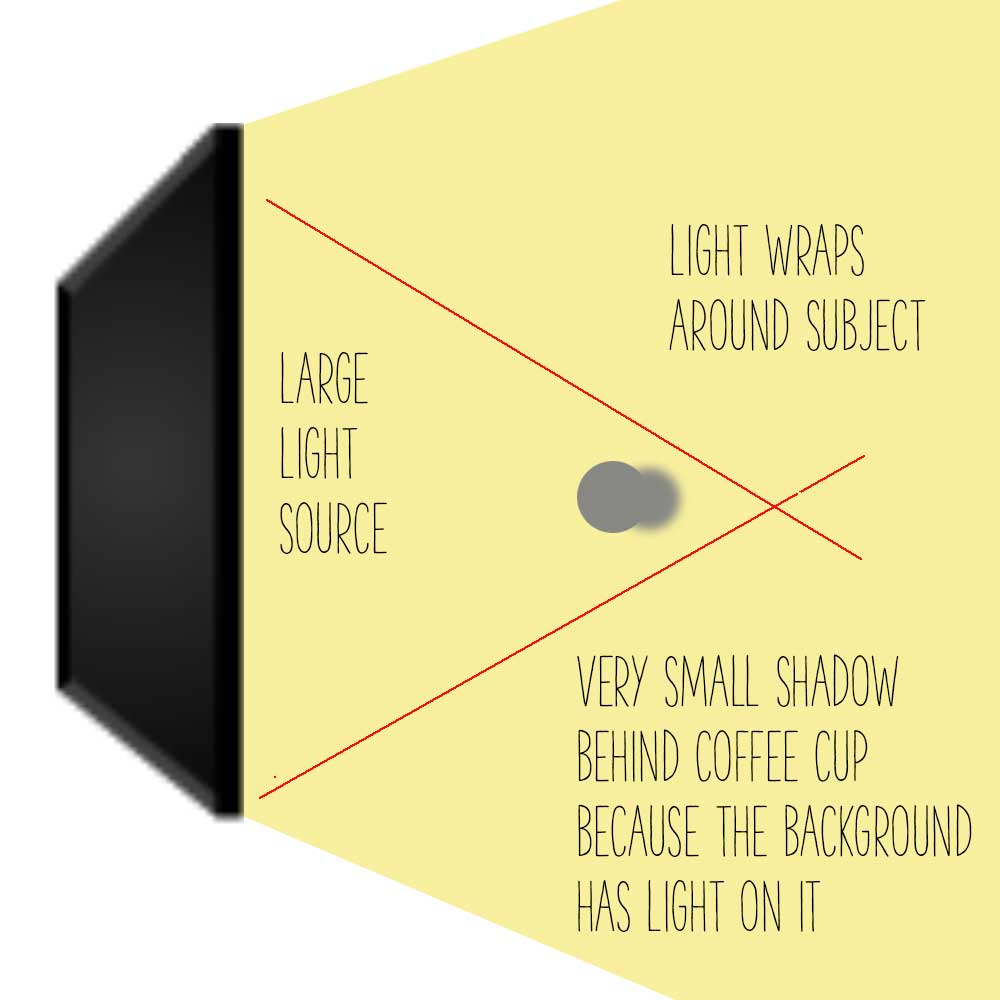
That is how the sun works as well.
The sun is the very small light source, and when the clouds come over the land, the sun lights the back of the clouds and they light the earth with no shadows because they go from horizon to horizon. Light is wrapping all around all the subjects it is seen by.
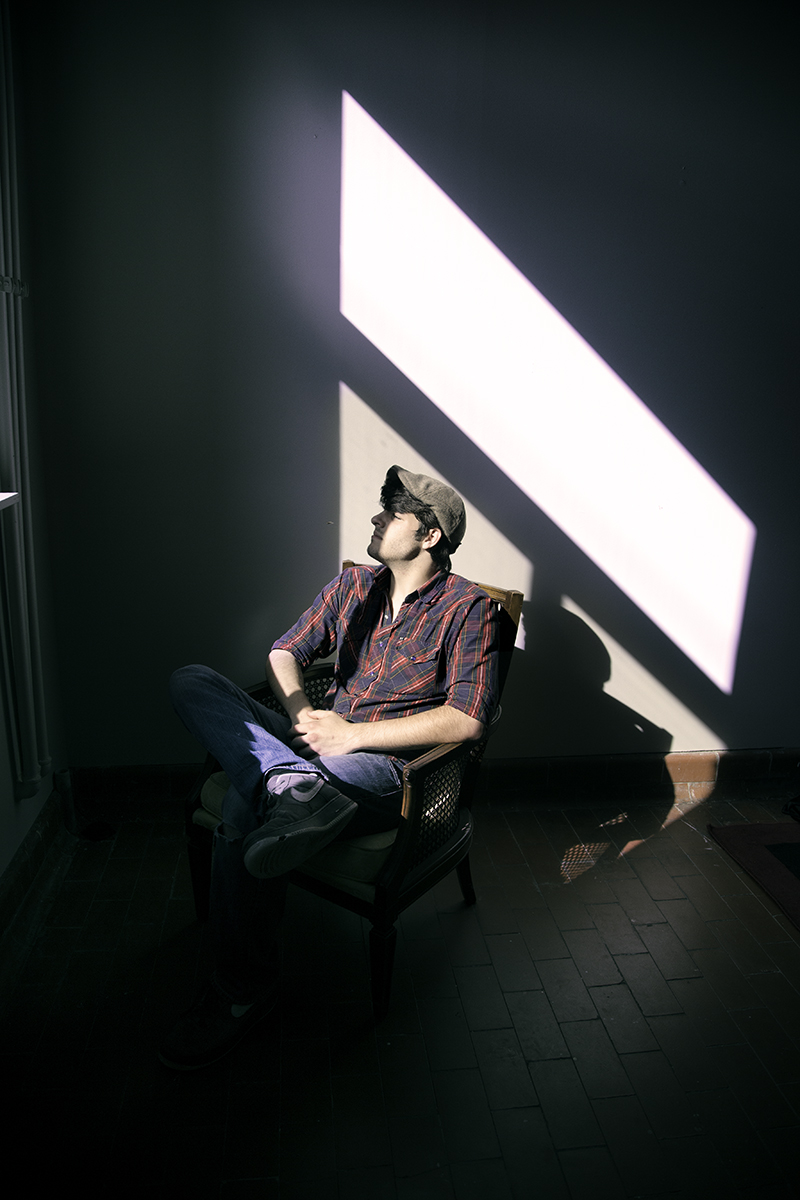
Think of your softbox as a “cloud cover” for your light (the sun) and it makes more sense to you.
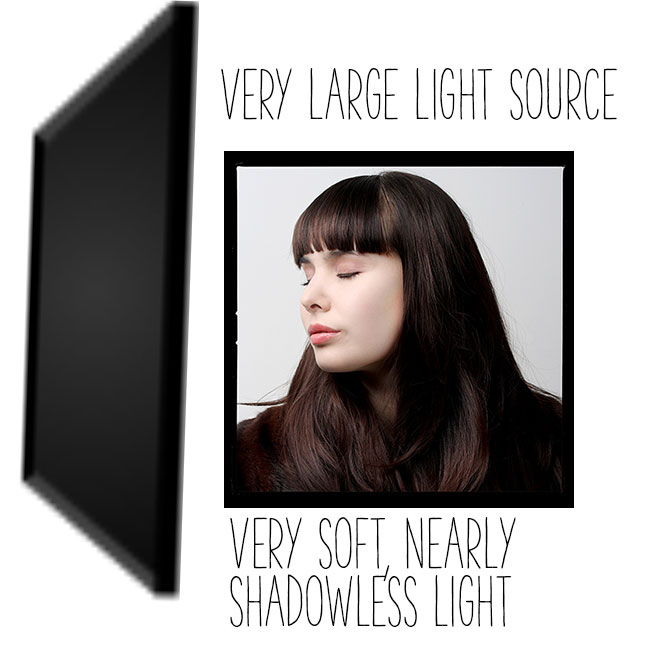

Question: is a 4’x5′ softbox a large softbox or a small softbox?
The answer is compared to what? Other softboxes? Yes.
The subject? Well – that depends. What is the subject?
If the subject is a Hot Air Popcorn Maker, then it is indeed a very large light source.
If our subject is a jetliner, then no – it is not a very big light source at all.
And then… how far will it be from our subject?
Distance makes the perceptual size of the light source diminish as it gets farther away. And it is that perceptual view is the one that matters.
A 20″ light source very close to a 1″ watch is a large light source. A 72″ x 72″ source far away from a 14′ square box is a small light source.
And the light will render that way as well.
LIGHT DOES THE SAME THING EVERY TIME – IT IS THE SUBJECTS THAT CHANGE THE GAME
ASSIGNMENT FOR THIS CLASS:
- Choose a subject less than about 8″ – like a shoe or a water bottle. Light it with a small light source (speedlight) to see how the shadows fall. Then light it with a softbox (24″ or so) in close. Very close.
- Move the softbox 6″ away and take another shot. Then do it again at 6″ intervals until the softbox is 6 feet away. Notice the changes in how the subject responds to the light, and how the shadows get sharper and deeper.
The size of the light source in relationship to the subject is one of the four principles of light.

PROJECT 52 PRO IS NOW A SUBSCRIPTION COMMUNITY
After 6 years of single start dates, it is time to move the workshop to a monthly subscription service that allows you to join, do assignments, communicate with and learn from peers, and most of all have a highly creative experience. We call it Project 52 Pro System...

10 Questions That May Predict Your Success as a Photographer
Commercial photography is a lot of fun, and it is a lot of work. Hard work. Some of it mind-numbing boring work, but more important than most anything else you do. Understanding what we do, who we do it for, and what its value is can be a crucial part of getting work...
A New Workshop for Learning Video
CREATE A 2-3 MINUTE VIDEO FOR SELF PROMOTION LINK to Enroll. We do it together. Creative Approach > Storyboard > Simple Special Effects (Slow Motion, B Roll, etc…) > Shoot Video to Storyboard > Assembling Assets: A Roll / B Roll / Audio > Building Video...
You Must Believe BEFORE You Will Ever See Success
https://www.youtube.com/watch?v=VrtT-WIka8s

Are Free Images Destroying the Professional Photographer?
IS UNSPLASH DESTROYING THE BUSINESS OF PHOTOGRAPHY?NOTE:MY BELIEFS HAVE EVOLVED QUITE A BIT.I LOVE UNSPLASH AND AM A VERY ACTIVE CONTRIBUTOR.Edited July 2, 2019https://www.youtube.com/watch?v=1VDR7mI5dJM&t=3sA recent article in PDN noted that Unsplash...
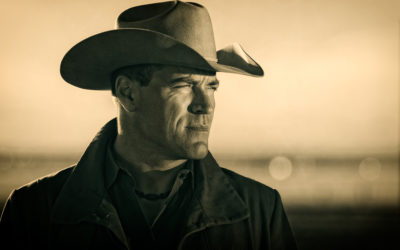
Meet Neville Palmer, Project 52 Photographer in Calgary
Calgary Photographer Neville Palmer https://www.youtube.com/watch?v=r510ZZ_FtTg What brought out your interest in photography? How'd you get started? When I was a very young kid I got a Kodak 126(?) cassette type camera for Christmas. I used it to make images of...
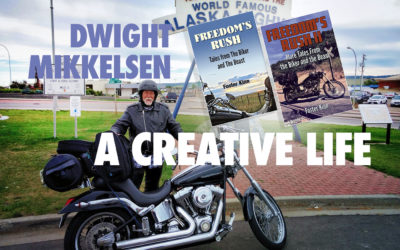
Meet Dwight Mikkelsen: A Creative Life
NOTE: THIS IS AN AUDIO INTERVIEW. Enjoy. Dwight Mikkelsen is a composer, writer, and motorcycle adventurer. His music has been performed all over the world, and he has written and arranged for major motion pictures including "Dichotomy of Man", "She Devil", "Reservoir...

Meet Craig Ferguson: Project 52 Photographer, Taipei, Taiwan
https://www.youtube.com/watch?v=JI-AcRLMl8A What brought out your interest in photography? How'd you get started? To some extent it’s always been there. I remember having a Kodak 110 camera when I was quite young, maybe 7 or 8. For Christmas, birthday’s etc, I’d...

Meet Brian Miller: Project 52 Photographer, St Augustine
Website URL: http://totallyswellstudio.com Instagram URL: @totallyswellstudio Linkedin: https://www.linkedin.com/in/brian-miller-0b04ab10/ Facebook Page: https://www.facebook.com/totallyswellstudio/ Email: brian@totallyswellstudio.com Phone:...
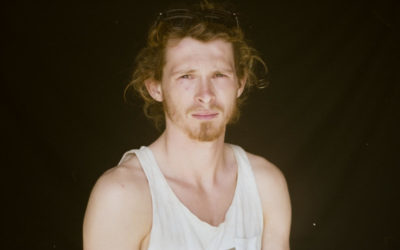
24 Frames in May: Film Is Still Alive and Well
These submissions were from the 24 Frames in May project we did in May. The goal was to shoot one roll of 24 exposure 35mm film or two rolls of 120 on a medium format camera. As you can see, we got some great work. Film is not dead - it is...
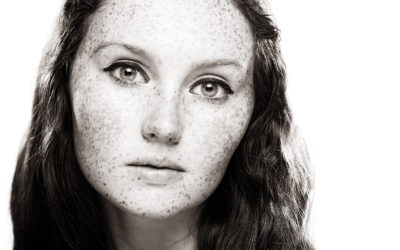
Meet Sid Ceaser: Nashua New Hampshire
(All photographs copyright Sid Ceaser) Sid Ceaser Photography www.ceaserphotography.com www.sidceaserfineart.com http://dedpxl.com/author/sid-ceaser/ Video Interview https://www.youtube.com/watch?v=umKQ8VWZIRI 1. What brought out your interest in photography? How'd...
Personal Projects and Recharging the Inner Batteries
This is kind of a personal post for me. There are challenges that I face as an artist and writer. And photographer. And sometimes those challenges can take its toll on me, and us. Creativity, for me, takes nurturing and constant practice. I have always felt that...
Using the RNI Presets for Color Palette Consistency
https://www.youtube.com/watch?v=HTwtS3c45BI I like to 'metaphorically' be shooting film in my head while holding a digital camera. One of the great things that I loved about film was the fact that different emulsions gave different color palettes. Kodachrome didn't...

Three Ideas Thursday: June 8
3 IDEA THURSDAY 1. Partner with an up and coming graphic designer or PR firm. Connect at meetups for creatives and see if there is any synergy there. Find someone who has a similar vision and create a double hit agency to allow you to sell the graphics and them to...
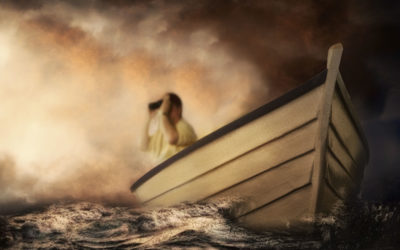
Best of Project 52, May 27, 2017
The Best of Project 52 is a completion of images from our 2016, 2017 P52 Pro groups and any of the 8 Week Courses that may be live at the time. These photographers work hard to create images that will work for a portfolio and to show clients that they can indeed shoot...
Three Idea Thursday June 1
These will become more prevalent as I continue to exercise the brain muscle. Working the 10 ideas a day from James Altucher's great book "Choose Yourself". So here goes. Three Idea Thursday, June 1 1. Photograph all of the Thai Food (Italian, Mexican, French -...
Behind The Image: 5-21-2017
https://www.youtube.com/watch?v=kTQ7x1H1pOA
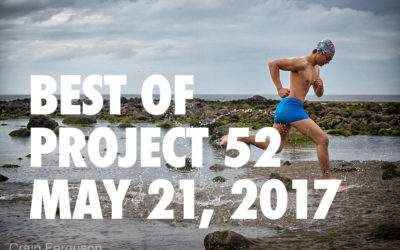
Best of Project 52: May 21, 2017
https://www.youtube.com/watch?v=9QYPBOhfWis
Do You Want a Stronger Portfolio? Try Writing About Your Images
https://www.youtube.com/watch?v=Ex8zMLrn1ug

Charge What It’s Worth… Or Shoot it For Free
A gift is a gift. If you want to gift your photography, I have nothing to say about it. Your right and good for you for gifting your gift. When you pull the plug on pricing, you bring everyone else down as well, and mostly you hurt yourself worse than anyone. If you...

Best of Project 52: May 14th, 2017 Edition
A new ongoing feature on Lighting Essentials; Best of Project 52. Project 52 has so many wonderful images posted each week and I want to feature the best of the best here for you to enjoy. Whether it is portraiture, product, still life, food or conceptual imagery, the...
“You go where you look…”
ON a motorcycle or in life, what we see in front of us will draw us in. Don't focus on the negativity or the problems, focus on the solutions and the positivity all around you. It works... it really does. WATCH THE VIDEO FOR MORE:...
Second Guessing the Art Director… Don’t Do It
https://www.youtube.com/watch?v=b2jAWaekI4c There are two parts. 1. Don't shoot images you think art directors or clients WANT to see because you will be wrong more often than right. There is no aesthetic that everyone wants to see. So be authentically you and shoot...
I Nearly Destroyed Two Vintage Cameras in One Stupid Move
https://www.youtube.com/watch?v=CsZG_DZmimQ