
Our Tech Sheet on using a meter will be next time, we decided for a variety of reasons to bring you this Tech Sheet on beating the sun for effect instead. Explanation could come soon on why, but I wouldn’t wait for it… heh. It just happens when you are a one man publishing mogul. LOL
OK, there are times when you want to be able to beat the sun, that is, provide light that is equal to or brighter than the sun. When using small strobes it becomes even more tricky because there is a limit to the speedlight’s power. And to beat the sun we do need some power.
We are going to take this in two parts, the first being this tech sheet with small speedlights, and later this year with some large strobes. We will be using one and two lights for this exercise, so it should be something most will be able to do easily.
Before we get going, I want to say how cool it is that people are calling from all over the country asking me to bring the Lighting Workshop to their town. We have added Montana, Omaha, Chicago, Detroit and Cleveland, and they are filling up pretty fast. I have decided to lower the attendee count a bit because of how well they have done with a few less photogs. We would like to keep it at 12 with an assistant.
Now, let’s get on with the Tech Sheet for the end of February, how to beat the sun with small strobes.
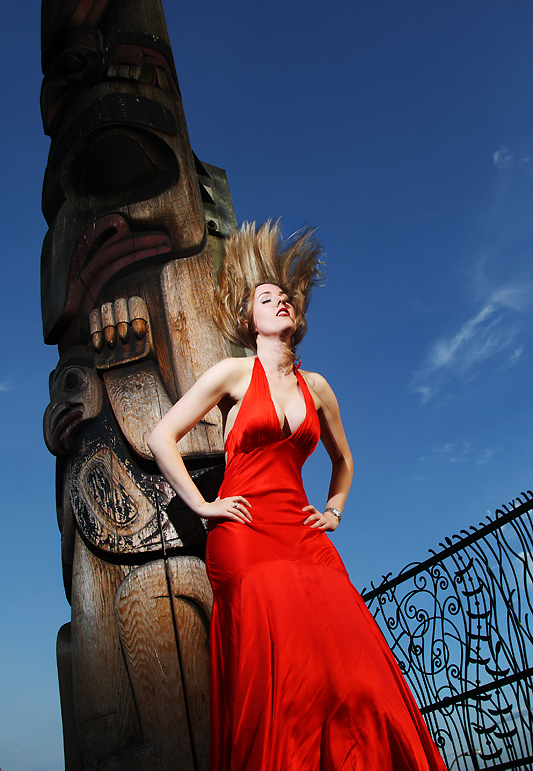
Red Dress, Blond hair and a strange totem pole thing. The sun had slipped a little below the fog bank and it was getting a nice, ambient warmth everywhere. I decided to create our own light with the speedlights. One to camera right and one to camera left. I took an ambient reading and found that at 1/125 the ambient was just a little brighter than f-5.6. So I set the camera at f-11@1/125 and moved the strobes to a distance that would give me f-11 at 1/4 power. Shooting at f-11, we end up with an exposure that is a stop and a half under in the ambient.

Download our Tech Sheet on Beating the Sun here as a PDF file.
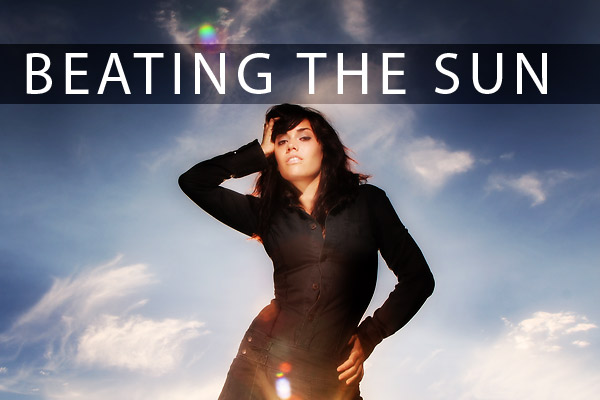
Sometimes you end up shooting straight into the sun, and there are all kinds of challenges with that… flare being one of the most challenging.
I couldn’t see the model as she was posing, so I had to trust her to do a great job. She did. I caught the flare by accident, but it made a nice touch to the composition. I underexposed the ambient by shutter speed, keeping the flash to expose the subject. See the tech sheet for more information on this particular shot.
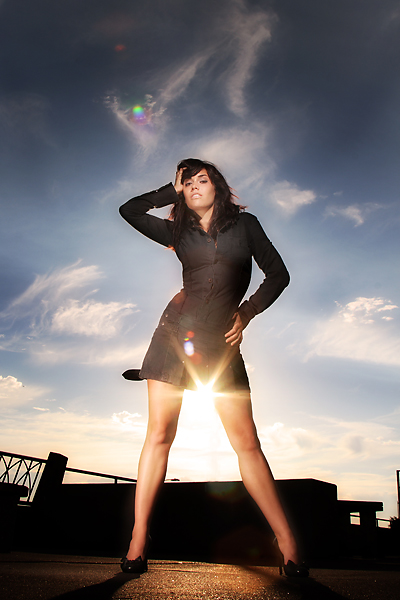
Briana on the roof in Mexico. The sun is coming in over her shoulder and behind her. I took a meter reading of the light hitting Briana from the back and it was f-16@1/125 at ISO 100. I wanted the ambient to be darker so I lowered the ambient two ways: First, I changed the shutter speed from 1/125 to 1/160. This darkened the ambient by 1/3 stop. I then changed the f-stop from f-16 to f-20, effectively darkening the ambient 2/3. Combined, the ambient is 1 full stop under the metered light. So I left the camera setting at f-20 and 1/160 then moved the speed light into a spot where it would provide an exposure of f-20. That put it at 1/2 power, so there was a bit of a wait for the recycle. I hate that, but it is certainly a doable situation.
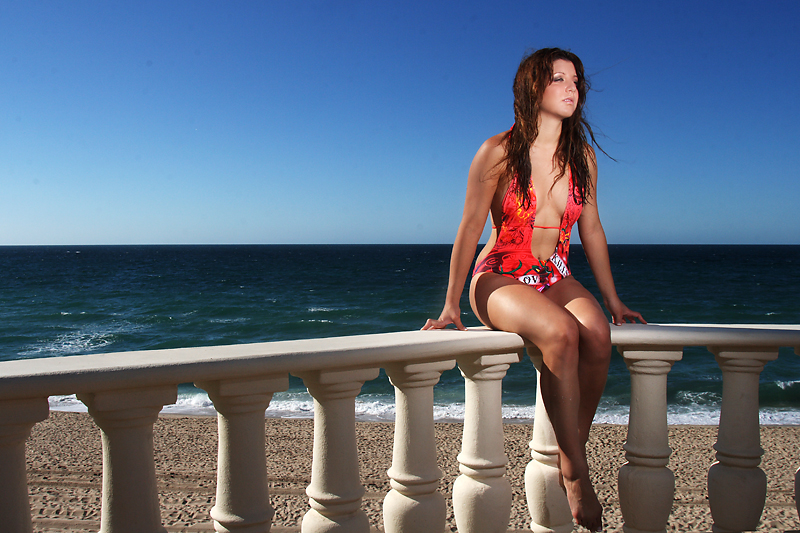
Trikita in Bermuda. What a wonderful place and exceptional young lady. We had her in the shade, and the ambient was a full f-16 @1/100 – perfect Sunny 16 – and I wanted it to be more muted. I decided to lower the ambient light by a full stop, creating more bang for the flash on Trikita.
Shutter speed was upped to my highest possible sync with those triggers, 1/200 would sync, and that lowered the ambient 2/3 stops, then I set the f-stop at 1/20 which is 1/3 stop less than the ambient exposure reading. Combined they are a full stop less than the ambient light. Keeping the strobe at 1/2 power at 6.5 feet gave me a full f-16 at a medium zoom. The ‘zoom’ setting created a sort of spot light on her and I like that look a lot.

Assignment:
Place a subject with the sun slightly to fully behind them. Take a reading to find your ambient light. If it is a sunny day, you should be around f-16 at 1/100 of a second. Put a speed light on a stand at about 6 feet, then put it on 1/2 power. Adjust to a point where it is giving you an exposure of f-16.
Put the camera on 1/60th and take a picture. At f-16 and 1/60, the background should appear light and bland. Continue at 1/80, 1/100, 1/125, 1/160, 1/200, 1/250. Check the images. The subject should remain fairly consistent, but your ambient background will get darker and darker.
Now change the power of your strobe to full power. That should render f-22 on your subject. Set the camera f-stop to f-22. Do the series over again… 1/60 through 1/250 and examine the images. The darkest images will be those of the 1/250 @ f-22.
This exercise will show you how the ambient is controlled by the shutter speed and the flash exposure by the f-stop.
I hope that you will try some of these tips and download the Tech Sheet for your collection… you do have a collection started, right?
Exciting news to be announced Monday. I think you will like it. See you next week.

Get tutorial! I’ll definitely be making use of this when it’s not so cold and windy here 😉
Don, at it again! always great instruction. Take my word for it, his workshops are great. Boatloads of info on those mighty little speedlights. It will open up a whole new world to your photography.
This was a great tutorial! I was looking all over the web for this kind of info. But you have given it in the form of a great tutorial.
Thanks very much,
Ranjan
another one of my favorites, love the assignments and tech sheets.
Don,
Curious why, especially when trying to overpower the sun, you don’t work at maximum sync speed with small flashes. Understand for studio lights, but why not shoot at 1/2?? when shooting with speedlights? I recognize you managed to get the look you wanted at 1/160th, just curious if there’s a reason not to be shooting at max sync here?
Thanks
Love the blog and learn a lot.
Brian
Brian,
When I do the workshops I always try to be as lo-tech as possible. I don’t want the attendees to think that they must have a 5DMKII, ProFoto and tons of expensive gear. On this day in New York I was using the inexpensive Cactus triggers available on E-Bay for around $40. While they work pretty well, getting a sync speed over 1/160 has not proved to be reliable… missing sync about 30% of the time. At 1/160 it was fine. The tools dictated the limits, simple as that.
Glad you like what we do here. And thanks for the question.
This is really great stuff. I just bought a light meter the other day and my GF is gonna let me shoot her. Your info here has saved me HOURS of frustration and trial and error! Thanks so much for your knowledge!!!
I’m looking for the tech sheet for this one too but the link is broken, could you fix that please? Thanks!
http://www.lighting-essentials.com/tech-sheet-beat-the-sun.pdf