
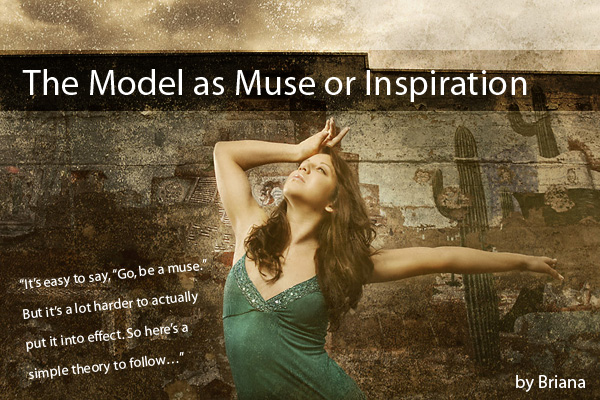
A Two Part Article
By Briana Shaker
Part I
What is a muse? The romantic poets knew. The ancient Greeks did as well. Now it’s time for models and photographers alike to learn. Quite simply, the muse is she (or he) for whom the artist creates or in whom the artist finds his (or her) inspiration. But that sounds more like the dictionary than me, so let’s put it this way… inspiration can be found anywhere, in a face, in nature, or even in a puddle. But like anything worth doing, it is the muse that creates enjoyment for the artist. For the true artist, this enjoyment is found in both the process of creation and in the finished result. Thus the muse has a certain responsibility (well, a live muse has a responsibility, it’s hard to get a puddle to accept responsibility) and that is to inspire her artist positively.
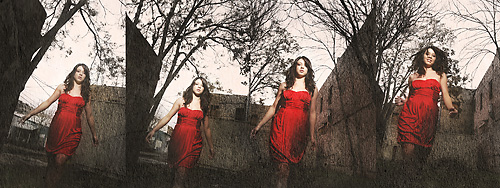
Romance of the Muse:
Ahhh, romantics are my favorite. All are artists. But who sets the mood for these romantic artists? The weather? The environment? The model? Yup, yup, yup. All three do. What about photogs? Are they artists? Yup. Models? They’re artists too. (Don’t laugh, they are so. No muse can “muse” without understanding art. Trust me and read on.)
Now, a photog can find inspiration in his subject, but it’s up to the subject to become – ummm – Desirable? Attractive? Inspiring? All three. See? The model here is artist too. She creates an illusion and the photog captures that moment and shows the illusion that he saw. Are they the same? Maybe. Does it matter? Nope. What matters is that a model can directly influence both creation and result. So she (or he) better do just that. That’s why the muse is both inspiration and artist. Otherwise, all art would be the same (but that’s a philosophical debate for another time.)
Model as Muse:
It’s easy to say, “Go, be a muse.” But it’s a lot harder to actually put it into effect. So here’s a simple theory to follow – both for models and for photogs to help get the most out of their muses. “Don’t think, feel.” Okay, it’s not my theory, I stole it from Bruce Lee, but at essence, it’s how I do what I do. I’m not trying to say, don’t think at all. One should always think. It’s half the process. But the feeling, the empathy with one’s surroundings, that’s the part I want to discuss.
Art and Subject:
Apples and oranges, photogs and models, and art and subject… all binary oppositions, right? Wrong. That’s not what society is about and that’s not what art is about. They’re all one and the same. Creation comes out of the gray area in between the opposition. It’s the area a good muse can help a good artist find; the better the muse the more for an artist with which to work.
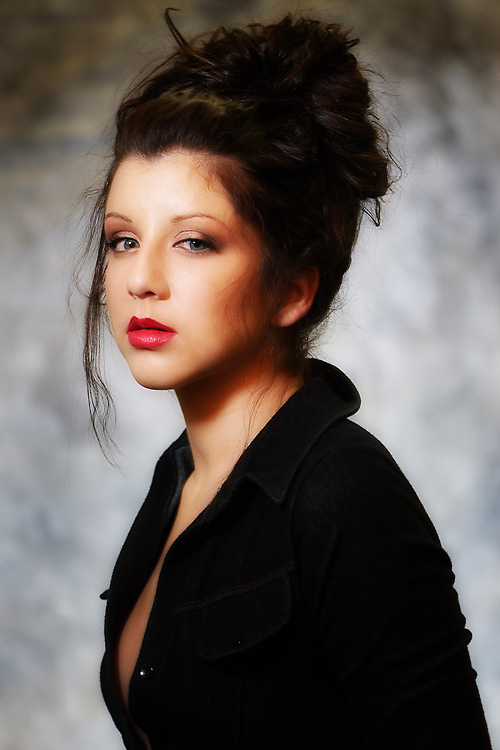
Further, one (subject and artist) can’t really exist without the other. Art includes the contrast and how one inter-relates with the other. For instance, give a model an object and watch how she interacts with it. The photographer then is responsible for capturing that moment. Yet, it is the moment he saw. There may have been many wonderful moments, but the photog picks the moment to click. What was it he or she saw? And what does it tell the viewer about the model and about the one who took the picture? What does the interaction add to the viewer’s life?
That’s art… it allows the viewer to answer, to question, and to answer again, and thus to continuously delve deeper. You don’t feel that way when you leave the newest Adam Sandler movie do ya? Hey, it was funny, but no one is going to look for hidden subtext there. But they will when a good model works with a good photographer. It’s inevitable. It’s like a puzzle, we like to figure out how things fit together. (Order out of chaos? Obsessive compulsion? Does that sound like you? You know it does… you wouldn’t be in this business if it didn’t.)
Anyway, some photogs have little things they like to include in their work, like their specialties or their trademarks (a nod to Don and his “noir poetry,” as I like to call it.) These aspects tell us about the artist and add/change the way a viewer sees the model and her overall work. So? Well, it is that interaction that generates an overall experience. Now it’s not just one picture, but an entire body of work… for both Muse/Artist and Photographer/Artist.
Now, what does all that have to do with ‘feeling’ one’s surroundings? Everything. To feel is innate to our experience. And a single picture or body of work can create a feeling for the viewer. But without “feeling” at the moment of creation, it’s often difficult to create it after. It’s not impossible I’m sure, photo-shop seems capable of almost anything these days, but it’s not the same. The intent of an artist is to translate his or her “feeling” of a moment to others and to the future. And a muse creates that initial feeling by revealing something within the natural contrast or comparison to her surroundings. (Got it? If not, you will. Nothing beats experience. Remember photogs when you didn’t know what the little knob did on the top of your camera? Practice and trial and error build on natural ability. Just like feeling and thinking, one needs the other.)
Thanks for reading!

Briana Shaker
MM Page
Briana Model
To be Continued… Next: A How to Guide.


Thanks for your work! Again an interesting article.
xxx to Bri and Don
How apropos. I am truly fascinated by the images that you, The Muse, and Don, The Artist, create. I return to this site to glean what I can from Don and to be enthralled by the images that the two of you produce; beauty, depth, emotive. Thanks to both of you.
Ah, you must be a closet Taoist. Forget all the jumping around; I’m thinking I need to get you into some Tai Chi poses the next time I attend a workshop! 😉
Nicely done.
Thanks for yoru insite 🙂
I don’t often enjoy, seek out, form or agree with philosophical musings about art and photography BUT, alas, it would seem that you know what you’re talking about. Thanks for the helpful words that keep it real and bring it all big-picture for me. Thanks for helping to adjust my focus.